. 2016 May 31;82(12):3537-3545.
doi: 10.1128/AEM.00559-16. Print 2016 Jun 15.

Population- and Individual-Level Dynamics of the Intestinal Microbiota of a Small Primate

Affiliations

Population- and Individual-Level Dynamics of the Intestinal Microbiota of a Small Primate

Tuomas Aivelo et al. Appl Environ Microbiol. .

Abstract

Longitudinal sampling for intestinal microbiota in wild animals is difficult, leading to a lack of information on bacterial dynamics occurring in nature. We studied how the composition of microbiota communities changed temporally in free-ranging small primates, rufous mouse lemurs (Microcebus rufus). We marked and recaptured mouse lemurs during their mating season in Ranomafana National Park in southeastern mountainous rainforests of Madagascar for 2 years and determined the fecal microbiota compositions of these mouse lemurs with MiSeq sequencing. We collected 160 fecal samples from 71 animals and had two or more samples from 39 individuals. We found small, but statistically significant, effects of site and age on microbiota richness and diversity and effects of sex, year, and site on microbiota composition, while the within-year temporal trends were less clear. Within-host microbiota showed pervasive variation in intestinal bacterial community composition, especially during the second study year. We hypothesize that the biological properties of mouse lemurs, including their small body size and fast metabolism, may contribute to the temporal intraindividual-level variation, something that should be testable with more-extensive sampling regimes.

Importance: While microbiome research has blossomed in recent years, there is a lack of longitudinal studies on microbiome dynamics on free-ranging hosts. To fill this gap, we followed mouse lemurs, which are small heterothermic primates, for 2 years. Most studied animals have shown microbiota to be stable over the life span of host individuals, but some previous research also found ample within-host variation in microbiota composition. Our study used a larger sample size than previous studies and a study setting well suited to track within-host variation in free-ranging mammals. Despite the overall microbiota stability at the population level, the microbiota of individual mouse lemurs can show large-scale changes in composition in time periods as short as 2 days, suggesting caution in inferring individual-level patterns from population-level data.


Figures

FIG 1
FIG 1
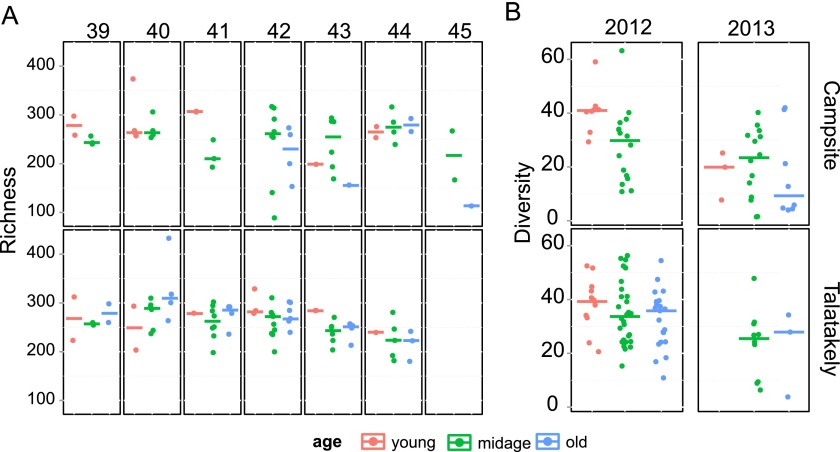
Richness and diversity in different age groups on two sites. (A) Richness is shown along the trapping weeks. Whereas the secondary-forest transect in Talatakely had rather stable richness, with a slight trend toward decreasing, the degraded transect in campsite had higher variation, which partly can be explained by the smaller sample size. The richness was statistically significantly lower in campsite than that in Talatakely. Different age groups have differing temporal trends: for example, old individuals have their peak richness earlier in the season than young individuals. (B) Inverse Simpson indices for different age groups in two sites in 2012 and 2013. The higher inverse Simpson index values indicate higher diversity. The graphs show a similar trend as in panel A, in that the diversity is more stable between age groups and years in a better-quality habitat (Talatakely) than in a degraded habitat (campsite).
FIG 2
FIG 2
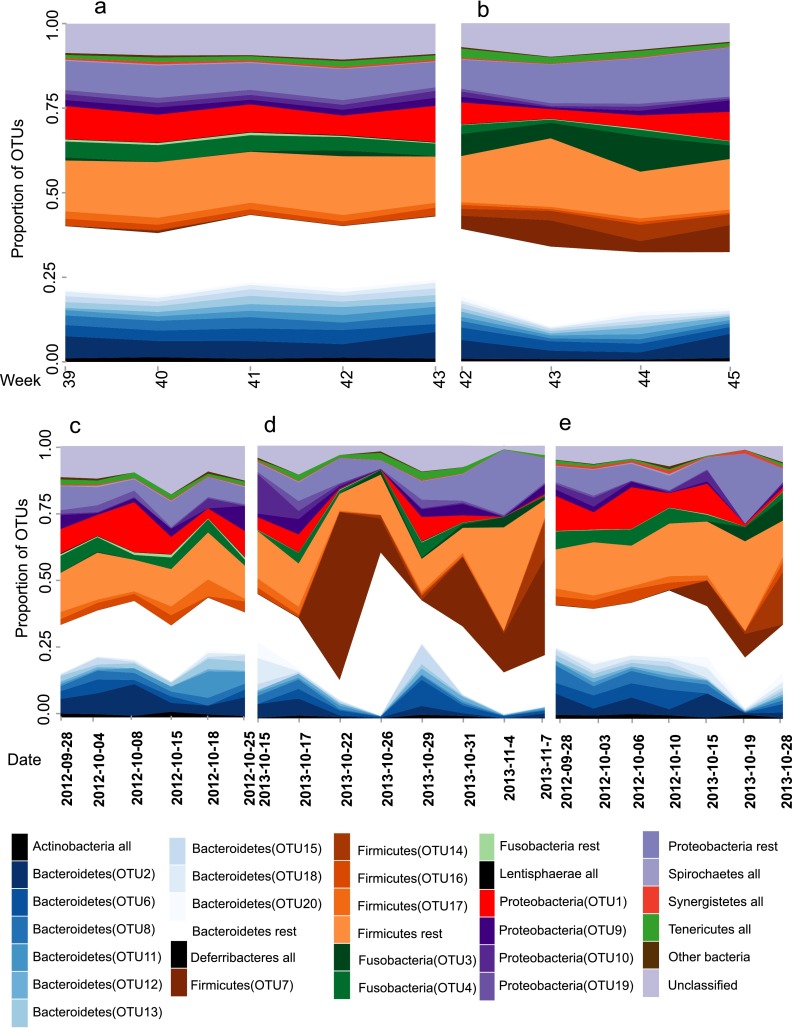
The bacterial composition in the whole mouse lemur population along the trapping season in years 2012 (a) and 2013 (b). The microbiota composition is shown weekly as average values across individuals. The microbiota is slightly different between years (e.g., OTU3, 7, and 14), but the overall patterns are remarkably stable over time. In comparison, microbiota in individual mouse lemurs varied substantially in 2013 but much less in 2012. All samples from the mouse lemur named Napolean (c) are from 2012, and the proportion of OTUs varies much less than that in Alan (d), from which all samples came in 2013. For Rachootin (e), we have samples for both years, and the microbiota composition follows the yearly trends. The graphs for the rest of the lemurs caught at least three times can be found in the Fig. S4 in the supplemental material. Dates in panels c to e are displayed in the format year-month-day.
FIG 3
FIG 3
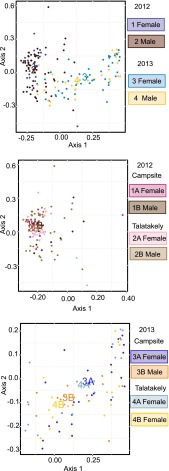
Visualization of the analysis of multivariate homogeneity of group dispersions based on Yue-Clayton dissimilarity metrics. There is a clear difference between years, whereas within-year groups overlap extensively. The between-group variation is smaller in 2012, as the group centroids are more spread apart in 2013.
FIG 4
FIG 4
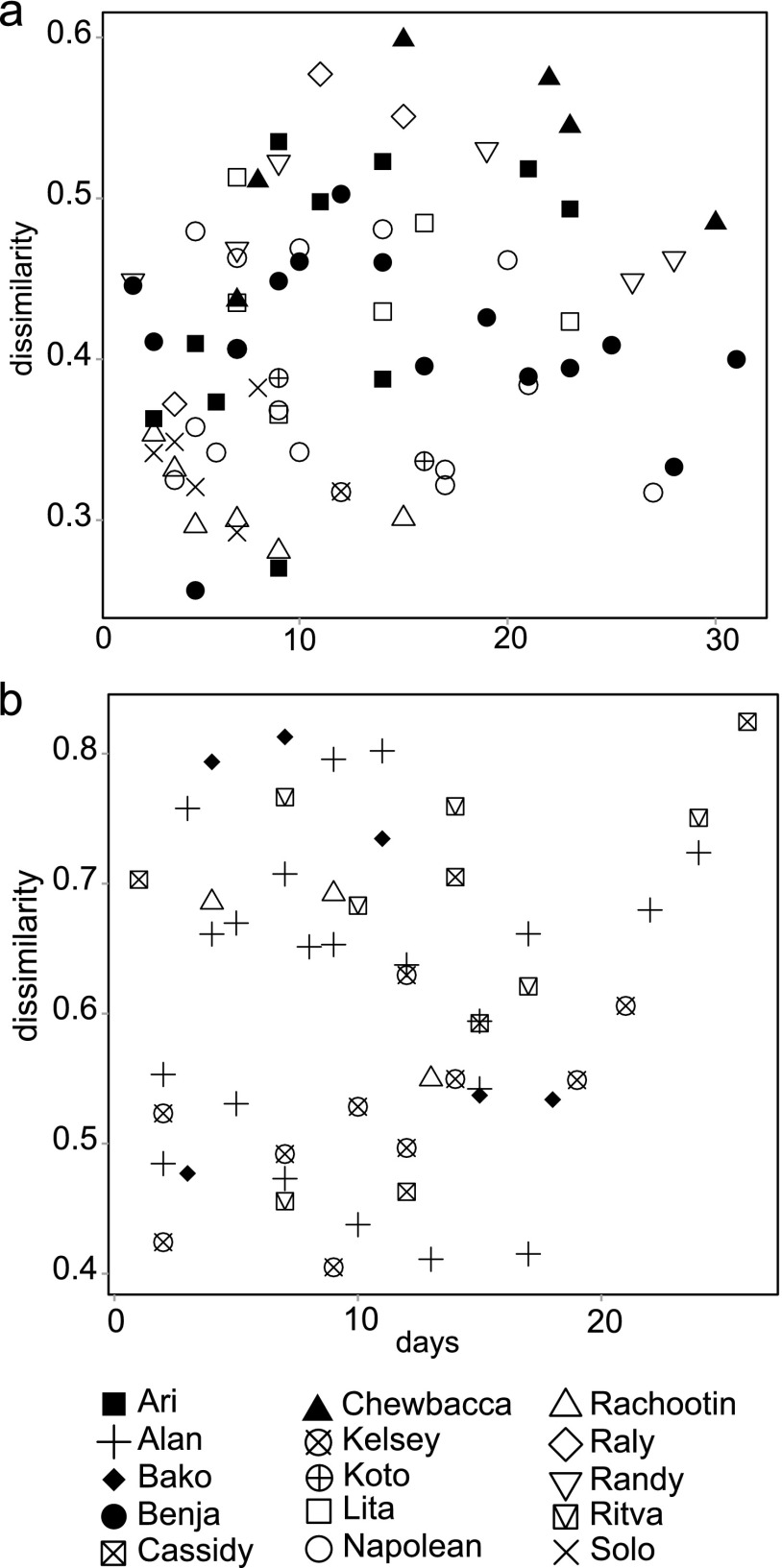
Dissimilarity indices of microbiota from mouse lemurs caught three or more times as a function of the intervals of the trappings in 2012 (a) and 2013 (b), with Yue-Clayton dissimilarity index. There is no clear trend, but the dissimilarities between samples from the same individual are bigger in 2013 than those in 2012.

References

    1. Degnan PH, Pusey AE, Lonsdorf EV, Goodall J, Wroblewski EE, Wilson ML, Rudicell RS, Hahn BH, Ochman H. 2012. Factors associated with the diversification of the gut microbial communities within chimpanzees from Gombe National Park. Proc Natl Acad Sci U S A 109:13034–13039. doi: 10.1073/pnas.1110994109. - DOI - PMC - PubMed
    1. Stevenson TJ, Buck CL, Duddleston KN. 2014. Temporal dynamics of the cecal gut microbiota of juvenile arctic ground squirrels: a strong litter effect across the first active season. Appl Environ Microbiol 80:4260–4268. doi: 10.1128/AEM.00737-14. - DOI - PMC - PubMed
    1. Blekhman R, Goodrich JK, Huang K, Sun Q, Bukowski R, Bell JT, Spector TD, Keinan A, Ley RE, Gevers D, Clark AG. 2015. Host genetic variation impacts microbiome composition across human body sites. Genome Biol 16:191. doi: 10.1186/s13059-015-0759-1. - DOI - PMC - PubMed
    1. David LA, Maurice CF, Carmody RN, Gootenberg DB, Button JE, Wolfe BE, Ling AV, Devlin AS, Varma Y, Fischbach MA, Biddinger SB, Dutton RJ, Turnbaugh PJ. 2014. Diet rapidly and reproducibly alters the human gut microbiome. Nature 505:559–563. - PMC - PubMed
    1. Kau AL, Ahern PP, Griffin NW, Goodman AL, Gordon JI. 2011. Human nutrition, the gut microbiome, and the immune system: envisioning the future. Nature 474:327–336. doi: 10.1038/nature10213. - DOI - PMC - PubMed

Publication types

LinkOut - more resources