Review
. 2016 May;40(4):268-72.
doi: 10.1002/gepi.21966. Epub 2016 Apr 7.

Polygenic Epidemiology

Affiliations
Review

Polygenic Epidemiology

Frank Dudbridge. Genet Epidemiol. 2016 May.

Abstract

Much of the genetic basis of complex traits is present on current genotyping products, but the individual variants that affect the traits have largely not been identified. Several traditional problems in genetic epidemiology have recently been addressed by assuming a polygenic basis for disease and treating it as a single entity. Here I briefly review some of these applications, which collectively may be termed polygenic epidemiology. Methodologies in this area include polygenic scoring, linear mixed models, and linkage disequilibrium scoring. They have been used to establish a polygenic effect, estimate genetic correlation between traits, estimate how many variants affect a trait, stratify cases into subphenotypes, predict individual disease risks, and infer causal effects using Mendelian randomization. Polygenic epidemiology will continue to yield useful applications even while much of the specific variation underlying complex traits remains undiscovered.

Keywords: Mendelian randomization; genetic correlation; genetic risk prediction; missing heritability.


Figures

Figure 1
Figure 1
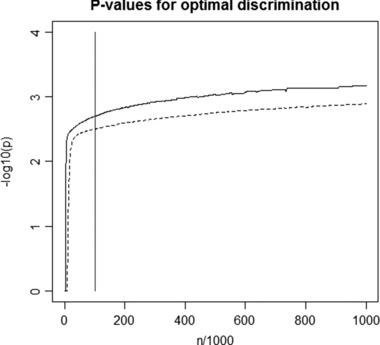
P‐values (−log10 scale) for selecting variants into a polygenic score such that the area under the receiver operator characteristic curve (AUC) is maximized. A binary trait with prevalence 10% is assumed, with variants selected from a case/control study with equal number of cases and controls. Chip heritability of 40% (solid line) and 20% (dashed line) is distributed among 100,000 independent variants, of which 5% have normally distributed effects and the rest have no effect. The vertical line is at 50,000 cases and 50,000 controls, at which point over 95% of the maximum AUC is achieved.

References

    1. Antoniou AC, Pharoah PD, McMullan G, Day NE, Stratton MR, Peto J, Ponder BJ, Easton DF. 2002. A comprehensive model for familial breast cancer incorporating BRCA1, BRCA2 and other genes. Br J Cancer 86(1):76–83. Epub 2002/02/22. - PMC - PubMed
    1. Aulchenko YS, Struchalin MV, Belonogova NM, Axenovich TI, Weedon MN, Hofman A, Uitterlinden AG, Kayser M, Oostra BA, van Duijn CM, and others. 2009. Predicting human height by Victorian and genomic methods. Eur J Hum Genet 17(8):1070–1075. Epub 2009/02/19. - PMC - PubMed
    1. Berg JJ, Coop G. 2014. A population genetic signal of polygenic adaptation. PLoS Genet 10(8):e1004412. Epub 2014/08/08. - PMC - PubMed
    1. Bowden J, Davey Smith G, Burgess S. 2015. Mendelian randomization with invalid instruments: effect estimation and bias detection through Egger regression. Int J Epidemiol 44(2):512–525. Epub 2015/06/08. - PMC - PubMed
    1. Bulik‐Sullivan BK, Loh PR, Finucane HK, Ripke S, Yang J, Patterson N, Daly MJ, Price AL, Neale BM. 2015a. LD Score regression distinguishes confounding from polygenicity in genome‐wide association studies. Nat Genet 47(3):291–295. Epub 2015/02/03. - PMC - PubMed

Publication types

LinkOut - more resources