


Incidence and patient survival of myeloproliferative neoplasms and myelodysplastic/myeloproliferative neoplasms in the United States, 2001-12
- PMID: 27061824
- PMCID: PMC4961550
- DOI: 10.1111/bjh.14061
Incidence and patient survival of myeloproliferative neoplasms and myelodysplastic/myeloproliferative neoplasms in the United States, 2001-12
Erratum in
-
Editor's note.Br J Haematol. 2017 Apr;177(2):331. doi: 10.1111/bjh.14674. Br J Haematol. 2017. PMID: 28387461 No abstract available.
Abstract
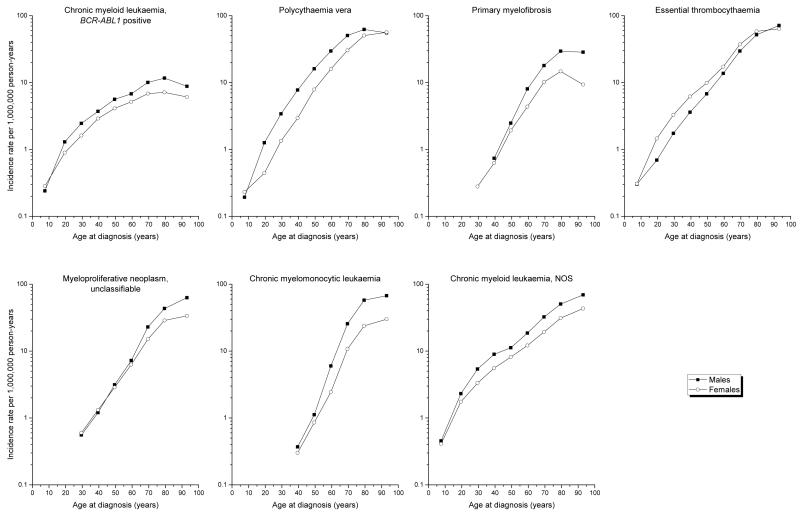
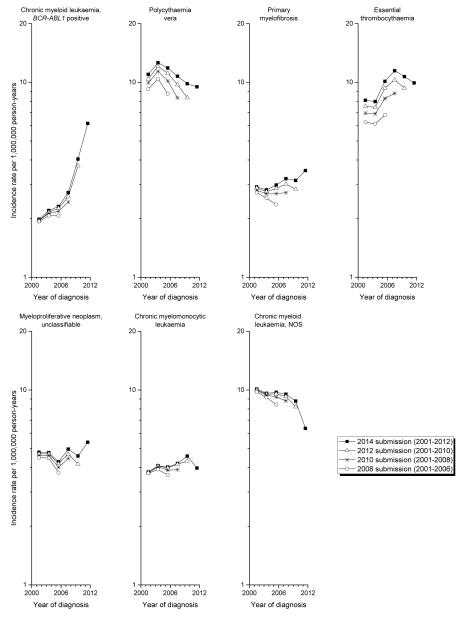
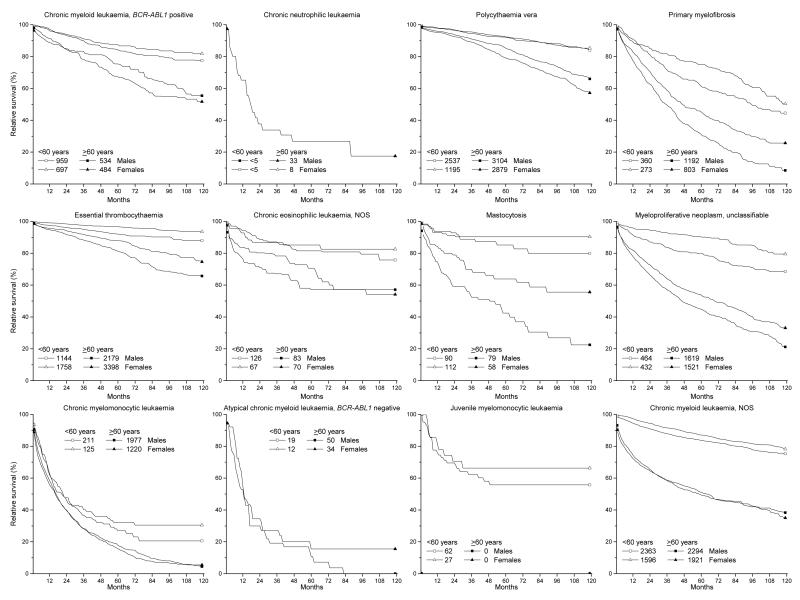
Descriptive epidemiological information on myeloproliferative neoplasms (MPNs) and myelodysplastic (MDS)/MPNs is largely derived from single institution and European population-based studies. Data obtained following adoption of the World Health Organization classification of haematopoietic neoplasms and JAK2 V617F mutation testing are sparse. Using population-based data, we comprehensively assessed subtype-specific MPN and MDS/MPN incidence rates (IRs), IR ratios (IRRs) and relative survival (RS) in the United States (2001-12). IRs were highest for polycythaemia vera (PV) (IR = 10·9) and essential thrombocythaemia (ET) (IR = 9·6). Except for ET and mastocytosis, overall IRs were significantly higher among males (IRRs = 1·4-2·3). All evaluable MPNs were associated with lower IRs among Hispanic whites than non-Hispanic whites (NHWs), with the exception of BCR-ABL1-positive chronic myeloid leukaemia (CML), chronic eosinophilic leukaemia (CEL) and juvenile myelomonocytic leukaemia. Except for CEL, Asians/Pacific Islanders had significantly lower MPN IRs than NHWs. ET, MPN-unclassifiable and CEL IRs were 18%, 19% and 60% higher, respectively, among blacks than NHWs. Five-year RS was more favourable for younger (<60 years) than older individuals and for women compared with men, except for PV at older ages. RS was highest (>90%) for younger PV and ET patients and lowest (<20%) for older chronic myelomonocytic leukaemia and atypical BCR-ABL1-negative CML patients. Varying MPN and MDS/MPN incidence patterns by subtype support distinct aetiologies and/or susceptible populations. Decreased survival rates as compared to that expected in the general population were associated with every MPN subtype, highlighting the need for new treatments, particularly among older individuals.
Keywords: epidemiology; incidence; myeloproliferative neoplasm; survival.
Published 2016. This article is a U.S. Government work and is in the public domain in the USA.
Figures
References
-
- Abdulkarim K, Ridell B, Johansson P, Kutti J, Safai-Kutti S, Andreasson B. The impact of peripheral blood values and bone marrow findings on prognosis for patients with essential thrombocythemia and polycythemia vera. Eur J Haematol. 2010;86:148–155. - PubMed
-
- Alvarez-Larran A, Ancochea A, Garcia M, Climent F, Garcia-Pallarols F, Angona A, Senin A, Barranco C, Martinez-Aviles L, Serrano S, Bellosillo B, Besses C. WHO-histological criteria for myeloproliferative neoplasms: reproducibility, diagnostic accuracy and correlation with gene mutations and clinical outcomes. Br J Haematol. 2014;166:911–919. - PubMed
-
- Anderson LA, Duncombe AS, Hughes M, Mills ME, Wilson JC, McMullin MF. Environmental, lifestyle, and familial/ethnic factors associated with myeloproliferative neoplasms. Am J Hematol. 2012;87:175–182. - PubMed
-
- Barbui T, Thiele J, Passamonti F, Rumi E, Boveri E, Ruggeri M, Rodeghiero F, d'Amore ES, Randi ML, Bertozzi I, Marino F, Vannucchi AM, Antonioli E, Carrai V, Gisslinger H, Buxhofer-Ausch V, Mullauer L, Carobbio A, Gianatti A, Gangat N, Hanson CA, Tefferi A. Survival and disease progression in essential thrombocythemia are significantly influenced by accurate morphologic diagnosis: an international study. J Clin Oncol. 2011;29:3179–3184. - PubMed
-
- Barbui T, Finazzi G, Carobbio A, Thiele J, Passamonti F, Rumi E, Ruggeri M, Rodeghiero F, Randi ML, Bertozzi I, Gisslinger H, Buxhofer-Ausch V, De Stefano V, Betti S, Rambaldi A, Vannucchi AM, Tefferi A. Development and validation of an International Prognostic Score of thrombosis in World Health Organization-essential thrombocythemia (IPSET-thrombosis) Blood. 2012;120:5128–5133. quiz 5252. - PubMed
MeSH terms
Grants and funding
LinkOut - more resources
Full Text Sources
Other Literature Sources
Medical
Research Materials
Miscellaneous
