Review
. 2016 Nov;231(11):2361-7.
doi: 10.1002/jcp.25401. Epub 2016 Apr 26.

Epigenetics in Intestinal Epithelial Cell Renewal

Affiliations
Review

Epigenetics in Intestinal Epithelial Cell Renewal

Alireza Roostaee et al. J Cell Physiol. 2016 Nov.

Abstract

A controlled balance between cell proliferation and differentiation is essential to maintain normal intestinal tissue renewal and physiology. Such regulation is powered by several intracellular pathways that are translated into the establishment of specific transcription programs, which influence intestinal cell fate along the crypt-villus axis. One important check-point in this process occurs in the transit amplifying zone of the intestinal crypts where different signaling pathways and transcription factors cooperate to manage cellular proliferation and differentiation, before secretory or absorptive cell lineage terminal differentiation. However, the importance of epigenetic modifications such as histone methylation and acetylation in the regulation of these processes is still incompletely understood. There have been recent advances in identifying the impact of histone modifications and chromatin remodelers on the proliferation and differentiation of normal intestinal crypt cells. In this review we discuss recent discoveries on the role of the cellular epigenome in intestinal cell fate, development, and tissue renewal. J. Cell. Physiol. 231: 2361-2367, 2016. © 2016 The Authors. Journal of Cellular Physiology Published by Wiley Periodicals, Inc.


Figures
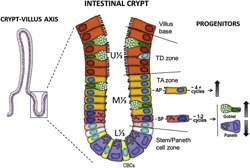
Figure 1
Figure 1
Human intestinal crypt architecture. The human intestinal crypt is subdivided into lower, middle, and upper thirds (L⅓, M⅓, U⅓) corresponding to the stem/Paneth cell compartment, the transit‐amplifying (TA) and terminal differentiation (TD) zones, respectively. TA undifferentiated progenitors arising from intestinal stem cell division undergo multiple rounds of mitosis prior to executing their differentiation program. Within the TA zone, absorptive progenitors (AP) divide approximately four times while secretory lineage progenitors (SP) will undergo one to two cycles before differentiating. APs, as well as goblet and enteroendocrine‐specific SPs are characterized by an upward migratory process in the crypt‐villus axis whereas Paneth‐determined SPs migrate downward.
Figure 2
Figure 2
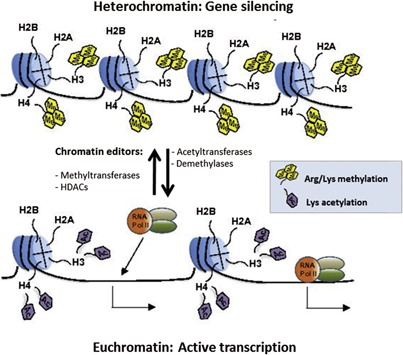
Histone tail modifications dictate chromatin organization and transcriptional activity. Methylation/acetylation of histone tails is one of the most important functional characteristics of euchromatin and heterochromatin patterning in the nucleus. Mono, di, and trimethylation of specific histone lysine and arginine residues are mostly associated with a tightly compacted and transcriptionally repressed form of chromatin called heterochromatin. Histone lysine acetylation however confers to DNA a relaxed and accessible (RNA Pol II, transcription factors) conformation called euchromatin. The concerted action of histone deacetylases (HDACs) and methyltransferases is generally responsible for heterochromatin domain organization, while the activity of histone acetyltransferases and demethylases is associated with transcriptionally active euchromatin regions.
Figure 3
Figure 3
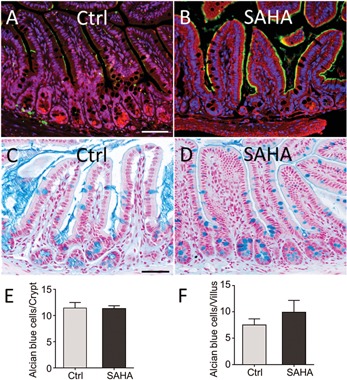
Selective effects of histone acetylation on the differentiation of intestinal cell progenitors. (A and B) Representative immunofluorescence illustrations showing that histone acetylation promotes expression of enterocyte specific differentiation protein SI (green) in the mouse ileum treated with SAHA (B) compared to the control (Ctrl) mouse (A). Blue (nuclei), Red (Evans blue). (C–F) SAHA treatment has no significant effect on the differentiation of goblet cells. (C and D) Alcian blue staining of mouse ileum for the detection of goblet cells in the Ctrl mice treated with DMSO (C) or SAHA (D). (E and F) Counting of goblet cells in the intestinal crypts (E) and villi (F) demonstrates that there is no significant difference in goblet cell number between mice treated with SAHA or control mice. Blue (goblet cells) and red (nuclei). Scale bar: 100 µm.
Figure 4
Figure 4
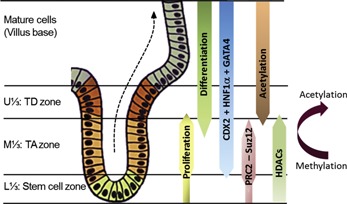
Integrative scheme of molecular mechanisms controlling intestinal tissue renewal. The intestinal crypt compartments are defined as the Stem cell, TA, and TD zones. The TA zone is composed of quickly dividing cells issued from the stem cell zone. For absorptive cells, experimental evidence suggests that the PRC2 complex and HDACs maintain cellular proliferation and restrain differentiation. Removal of methyl groups from H3K27me3 and acetylation of histones eliminates transcriptional repression, and the cell differentiation process starts (Benoit et al., 2012; Roostaee et al., 2015). Some studies have also reported a conversion of methylated‐to‐acetylated histones (Suzuki et al., 2008; Ong and Corces, 2011). Acetylation of histones is associated with robust expression of SI protein. The pro‐differentiation factors CDX2 and HNF1α are expressed by all epithelial cells including the cells residing in the TA zone and can up‐regulate expression of intestine‐specific genes such as SI.

References

    1. Barker N, van de Wetering M, Clevers H. 2008. The intestinal stem cell. Genes Dev 22:1856–1864. - PMC - PubMed
    1. Beaulieu JF. 1997. Extracellular matrix components and integrins in relationship to human intestinal epithelial cell differentiation. Prog Histochem Cytochem 31:1–78. - PubMed
    1. Beaulieu JF, Quaroni A. 1991. Clonal analysis of sucrase‐isomaltase expression in the human colon adenocarcinoma Caco‐2 cells. Biochem J 280:599–608. - PMC - PubMed
    1. Benoit YD, Laursen KB, Witherspoon MS, Lipkin SM, Gudas LJ. 2013a. Inhibition of PRC2 histone methyltransferase activity increases TRAIL‐mediated apoptosis sensitivity in human colon cancer cells. J Cell Physiol 228:764–772. - PMC - PubMed
    1. Benoit YD, Witherspoon MS, Laursen KB, Guezguez A, Beausejour M, Beaulieu JF, Lipkin SM, Gudas LJ. 2013b. Pharmacological inhibition of polycomb repressive complex‐2 activity induces apoptosis in human colon cancer stem cells. Exp Cell Res 319:1463–1470. - PMC - PubMed

Publication types

Grants and funding