. 2016 May;30(3):779-86.
doi: 10.1111/jvim.13932. Epub 2016 Apr 8.

A Prospective, Placebo-Controlled Pilot Evaluation of the Effect of Omeprazole on Serum Calcium, Magnesium, Cobalamin, Gastrin Concentrations, and Bone in Cats

Affiliations

A Prospective, Placebo-Controlled Pilot Evaluation of the Effect of Omeprazole on Serum Calcium, Magnesium, Cobalamin, Gastrin Concentrations, and Bone in Cats

E Gould et al. J Vet Intern Med. 2016 May.

Abstract

Background: Chronic proton pump inhibitor administration has been associated with electrolyte and cobalamin deficiency, disrupted bone homeostasis, hypergastrinemia, and rebound acid hypersecretion in humans. It is unknown if this occurs in cats.

Objectives: Prolonged oral omeprazole results in altered bone mineral density or content, serum calcium, magnesium, cobalamin, and gastrin concentrations in healthy cats.

Animals: Six healthy adult DSH cats.

Methods: In a within subjects, before and after design, cats received placebo followed by omeprazole (0.83-1.6 mg/kg PO q12h) for 60 days each. Analysis of serum calcium, magnesium, cobalamin, and gastrin concentrations was performed on days 0, 30, and 60. Bone density and content were evaluated on days 0 and 60 of each intervention. Continuous data were analyzed using a two-way ANOVA (α = 0.006). On day 60 of omeprazole administration, continuous intragastric pH monitoring was performed in 2 cats to evaluate the effects of abrupt withdrawal of omeprazole.

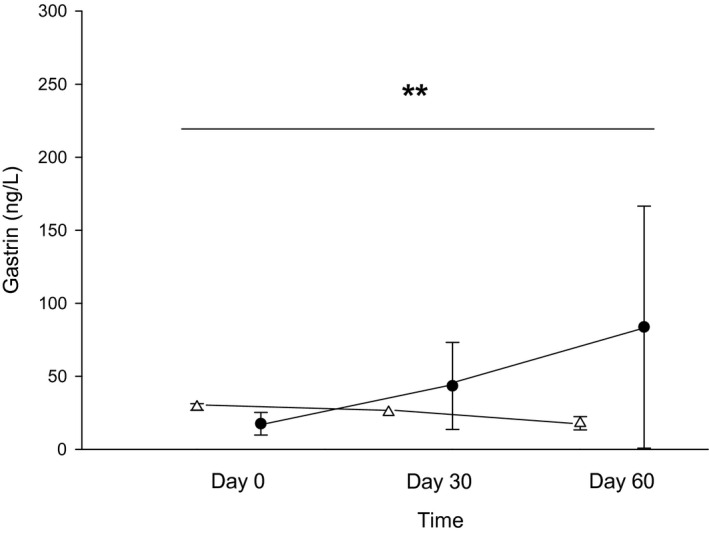
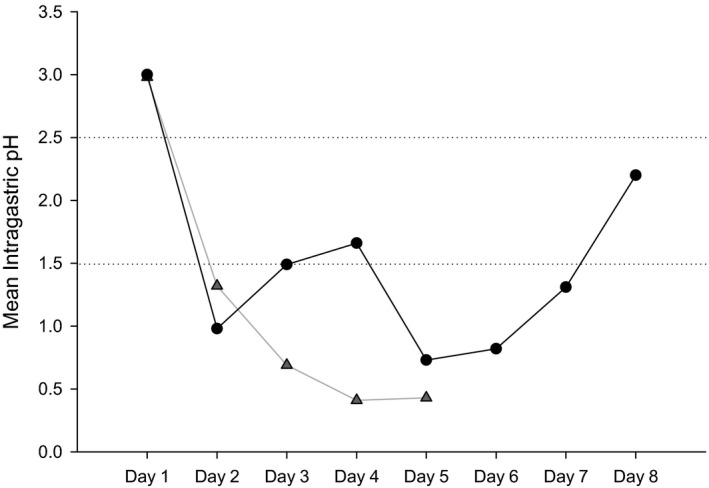
Results: No significant changes were detected between treatments for any variables, except serum gastrin, which was significantly higher during omeprazole treatment in comparison to placebo (P = 0.002). Evidence of gastric hyperacidity was seen in both cats in which intragastric pH monitoring was performed following cessation of omeprazole.

Conclusions and clinical importance: Although further studies with larger populations of cats will be needed to draw any definitive conclusions, these preliminary results suggest that prolonged PPI treatment results in hypergastrinemia and abrupt PPI withdrawal might result in RAH in cats.

Keywords: DEXA; Feline; Intragastric pH; Rebound acid hypersecretion.


Figures

Figure 1
Figure 1
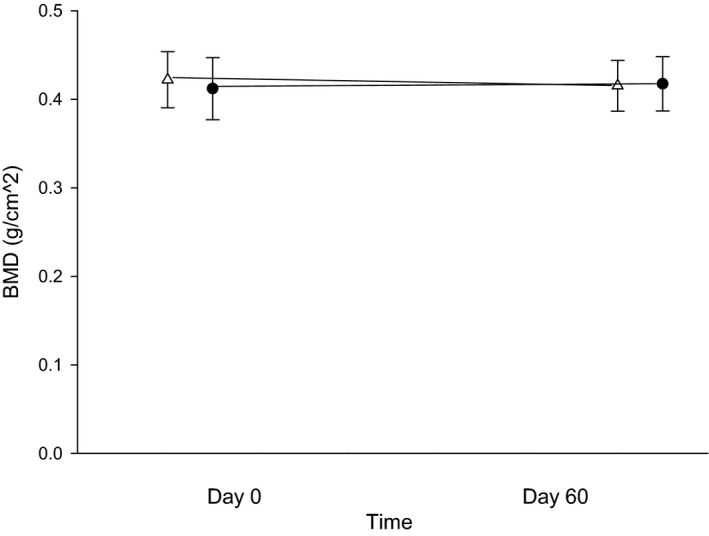
Bone mineral density (BMD) in g/cm2 between days 0 (before treatment) and 60 (after 8 weeks of treatment with either 250 mg lactose PO q12h or 5 mg omeprazole PO q12h). White triangles (placebo) and black circles (omeprazole) represent the mean ± SD of BMD for days 0 or 60 with each treatment arm.
Figure 2
Figure 2
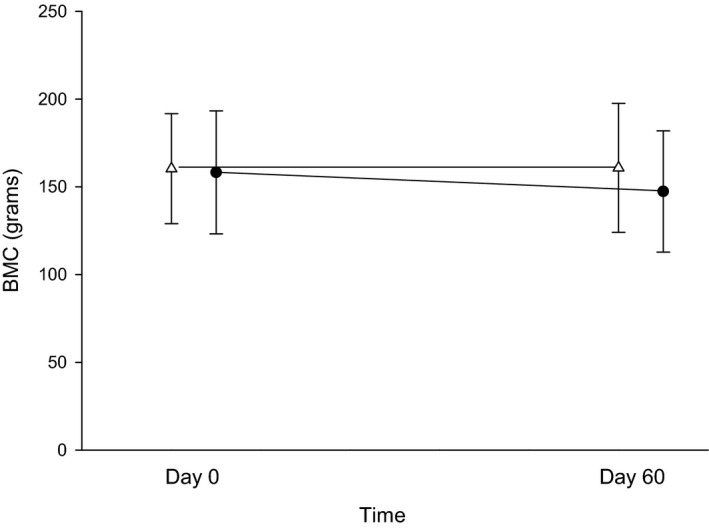
Bone mineral content (BMC) in grams between days 0 (before treatment) and 60 (after 8 weeks of treatment with either 250 mg lactose PO q12h or 5 mg omeprazole PO q12h) of each treatment arm. White triangles (placebo) and black circles (omeprazole) represent the mean ± SD of BMC for days 0 or 60 with each treatment arm.
Figure 3
Figure 3
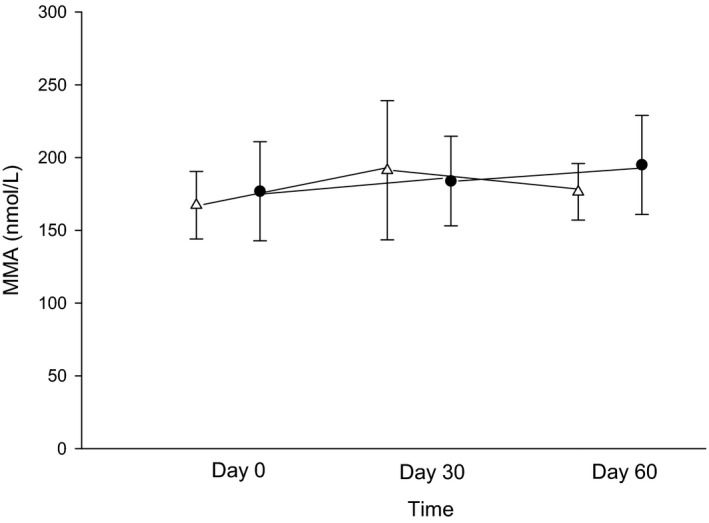
Serum methylmalonic acid concentrations (MMA; nmol/L) between days 0 (before treatment), 30 (after 4 weeks of treatment with either 250 mg lactose PO q12h or 5 mg omeprazole PO q12h), and 60 (after 8 weeks of treatment) of each treatment arm. White triangles (placebo) and black circles (omeprazole) represent the mean ± SD of serum MMA concentrations for days 0, 30, or 60 with each treatment arm.
Figure 4
Figure 4
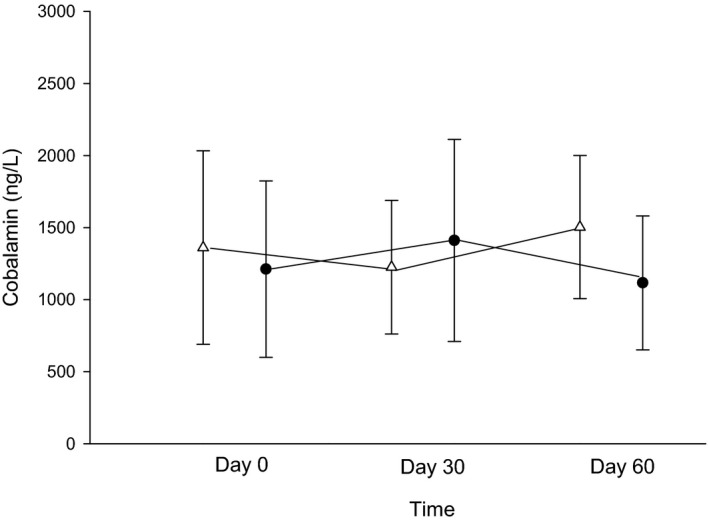
Serum cobalamin concentrations (ng/L) between days 0 (before treatment), 30 (after 4 weeks of treatment with either 250 mg lactose PO q12h or 5 mg omeprazole PO q12h), and 60 (after 8 weeks of treatment) of each treatment arm. White triangles (placebo) and black circles (omeprazole) represent the mean ± SD of serum cobalamin concentrations for days 0, 30, or 60 with each treatment arm.
Figure 5
Figure 5
Serum gastrin concentrations (ng/L) between days 0 (before treatment), 30 (after 4 weeks of treatment with either 250 mg lactose PO q12h or 5 mg omeprazole PO q12h), and 60 (after 8 weeks of treatment) of each treatment arm. White triangles (placebo) and black circles (omeprazole) represent the mean ± SD of gastrin for days 0, 30, or 60 with each treatment arm. **Omeprazole (black circles) results in a significant increase in serum gastrin compared with placebo (white triangles) (P = 0.002).
Figure 6
Figure 6
Intragastric pH in 2 cats (denoted by lines connected by gray triangles or black circles, respectively) for 8 and 5 days following cessation of omeprazole therapy. The mean ± SD intragastric pH (represented by the horizontal dashed lines) from cats (n = 6) in this colony receiving placebo in a previous study was 2.0 ± 0.5.2 Note that from days 2–5, cat 1 (gray triangles) had a mean intragastric pH more acidic than a normal cat and on days 2, 5, 6, and 7 the mean pH of cat 2 (black circles) was also below 1.5. The pH capsule passed from the stomach of cat 1 on day 6, so readings past day 5 were not evaluated.

References

    1. Tolbert K, Bissett S, King A, et al. Efficacy of oral famotidine and 2 omeprazole formulations for the control of intragastric pH in dogs. J Vet Intern Med 2011;25:47–54. - PubMed
    1. Parkinson S, Tolbert K, Messenger K, et al. Evaluation of the effect of orally administered acid suppressants on intragastric pH in cats. J Vet Intern Med 2014;29:104–112. - PMC - PubMed
    1. Sutalo S, Ruetten M, Hartnack S, et al. The effect of orally administered ranitidine and once‐daily or twice‐daily orally administered omeprazole on intragastric pH in cats. J Vet Intern Med 2015;29:840–846. - PMC - PubMed
    1. Williamson KK, Willard MD, Payton ME, et al. Efficacy of omeprazole versus high‐dose famotidine for exercise‐induced gastritis in racing alaskan sled dogs. J Vet Intern Med 2010;24:285–288. - PubMed
    1. Tolbert MK, Odunayo A, Howell RS, et al. Efficacy of intravenous administration of combined acid suppressants in healthy dogs. J Vet Intern Med 2015;29:556–560. - PMC - PubMed

LinkOut - more resources