


Plant Hormone Homeostasis, Signaling, and Function during Adventitious Root Formation in Cuttings
- PMID: 27064322
- PMCID: PMC4814496
- DOI: 10.3389/fpls.2016.00381
Plant Hormone Homeostasis, Signaling, and Function during Adventitious Root Formation in Cuttings
Abstract
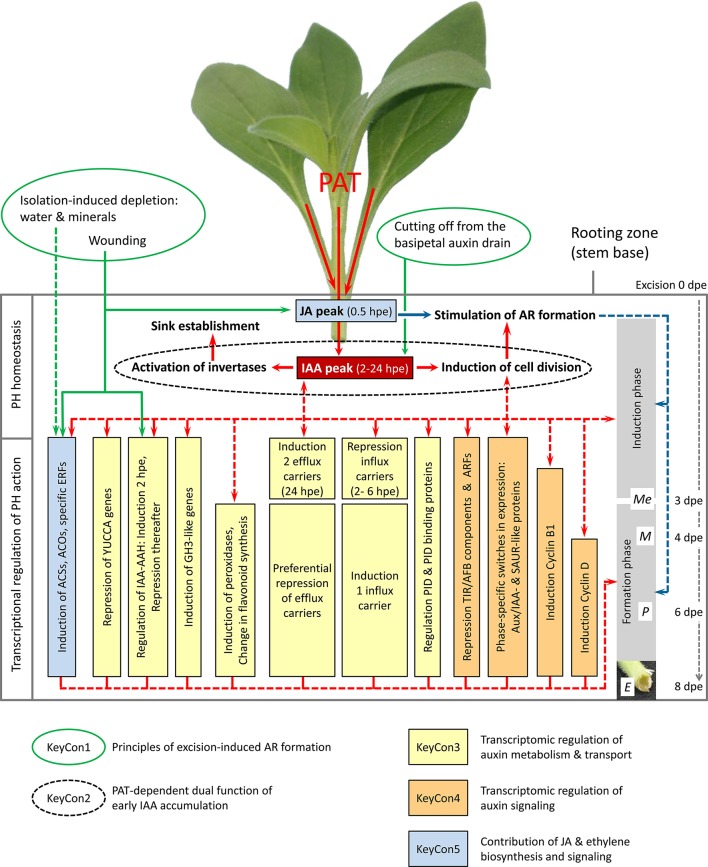
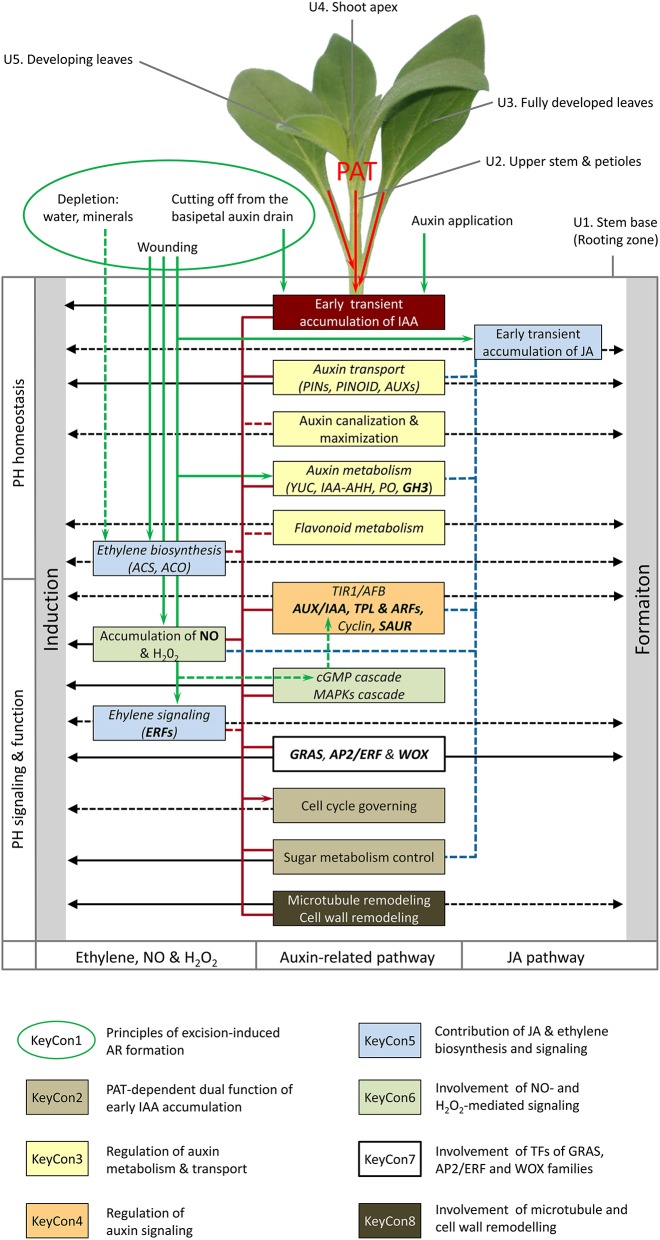
Adventitious root (AR) formation in cuttings is a multiphase developmental process, resulting from wounding at the cutting site and isolation from the resource and signal network of the whole plant. Though, promotive effects of auxins are widely used for clonal plant propagation, the regulation and function of plant hormones and their intricate signaling networks during AR formation in cuttings are poorly understood. In this focused review, we discuss our recent publications on the involvement of polar auxin transport (PAT) and transcriptional regulation of auxin and ethylene action during AR formation in petunia cuttings in a broad context. Integrating new findings on cuttings of other plant species and general models on plant hormone networks, a model on the regulation and function of auxin, ethylene, and jasmonate in AR formation of cuttings is presented. PAT and cutting off from the basipetal auxin drain are considered as initial principles generating early accumulation of IAA in the rooting zone. This is expected to trigger a self-regulatory process of auxin canalization and maximization to responding target cells, there inducing the program of AR formation. Regulation of auxin homeostasis via auxin influx and efflux carriers, GH3 proteins and peroxidases, of flavonoid metabolism, and of auxin signaling via AUX/IAA proteins, TOPLESS, ARFs, and SAUR-like proteins are postulated as key processes determining the different phases of AR formation. NO and H2O2 mediate auxin signaling via the cGMP and MAPK cascades. Transcription factors of the GRAS-, AP2/ERF-, and WOX-families link auxin signaling to cell fate specification. Cyclin-mediated governing of the cell cycle, modifications of sugar metabolism and microtubule and cell wall remodeling are considered as important implementation processes of auxin function. Induced by the initial wounding and other abiotic stress factors, up-regulation of ethylene biosynthesis, and signaling via ERFs and early accumulation of jasmonic acid stimulate AR formation, while both pathways are linked to auxin. Future research on the function of candidate genes should consider their tissue-specific role and regulation by environmental factors. Furthermore, the whole cutting should be regarded as a system of physiological units with diverse functions specifically responding to the environment and determining the rooting response.
Keywords: PIN; adventitious rooting; cell fate; cutting; hormones; plant development; signaling; wound.
Figures
References
-
- Abarca D., Pizarro A., Hernández I., Sánchez C., Solana S. P., del Amo A., et al. (2014). The GRAS gene family in pine: transcript expression patterns associated with the maturation-related decline of competence to form adventitious roots. BMC Plant Biol. 14:354. 10.1186/s12870-014-0354-8 - DOI - PMC - PubMed
-
- Abu-Abied M., Mordehaev I., Kumar G. B. S., Ophir R., Wasteneys G. O., Sadot E. (2015b). Analysis of microtubule-associated-proteins during IBA-mediated adventitious root induction reveals KATANIN dependent and independent alterations of expression patterns. PLoS ONE 10:e0143828. 10.1371/journal.pone.0143828 - DOI - PMC - PubMed
-
- Abu-Abied M., Szwerdszarf D., Mordehaev I., Levy A., Rogovoy O., Belausov E., et al. (2012). Microarray analysis revealed upregulation of nitrate reductase in juvenile cuttings of Eucalyptus grandis, which correlated with increased nitric oxide production and adventitious root formation. Plant J. 71, 787–799. 10.1111/j.1365-313X.2012.05032.x - DOI - PubMed
-
- Abu-Abied M., Szwerdszarf D., Mordehaev I., Yaniv Y., Levinkron S., Rubinstein M., et al. (2014). Gene expression profiling in juvenile and mature cuttings of Eucalyptus grandis reveals the importance of microtubule remodeling during adventitious root formation. BMC Genomics 15:826. 10.1186/1471-2164-15-826 - DOI - PMC - PubMed
Publication types
LinkOut - more resources
Full Text Sources
Other Literature Sources
Research Materials
