


Organising healthcare services for persons with an intellectual disability
- PMID: 27065018
- PMCID: PMC8720486
- DOI: 10.1002/14651858.CD007492.pub2
Organising healthcare services for persons with an intellectual disability
Abstract
Background: When compared to the general population, persons with an intellectual disability have lower life expectancy, higher morbidity, and more difficulty finding and obtaining healthcare. Organisational interventions are used to reconfigure the structure or delivery of healthcare services. This is the first update of the original review.
Objectives: To assess the effects of organisational interventions of healthcare services for the mental and physical health problems of persons with an intellectual disability.
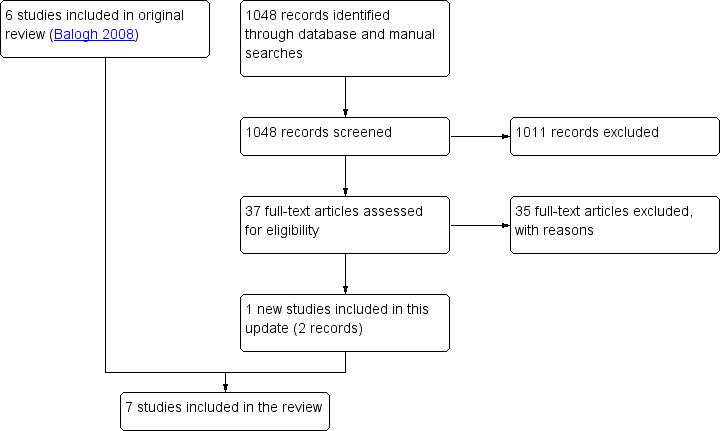
Search methods: For this update we searched CENTRAL, MEDLINE, EMBASE, CINAHL and other databases, from April 2006 to 4 September 2015. We checked reference lists of included studies and consulted experts in the field.
Selection criteria: Randomised controlled trials of organisational interventions of healthcare services aimed at improving care of mental and physical health problems of adult persons with an intellectual disability.
Data collection and analysis: We employed standard methodological procedures as outlined in the Cochrane Handbook of Systematic Reviews of Interventions, in addition to specific guidance from the Cochrane Effective Practice and Organisation of Care (EPOC) Group.
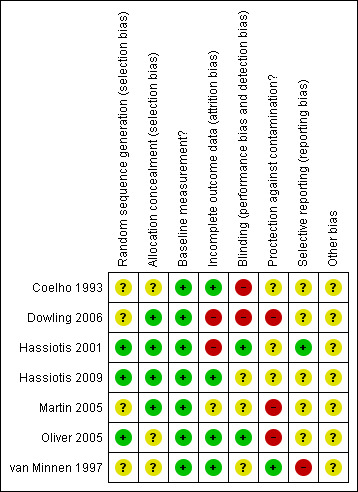
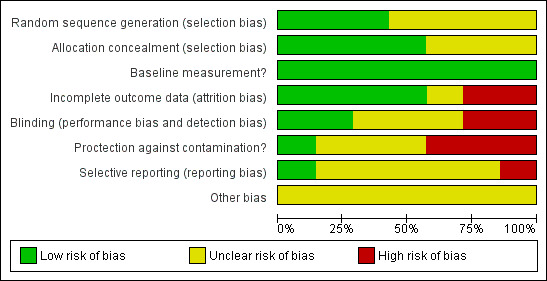
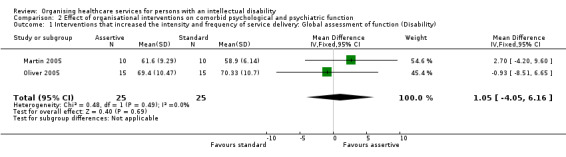
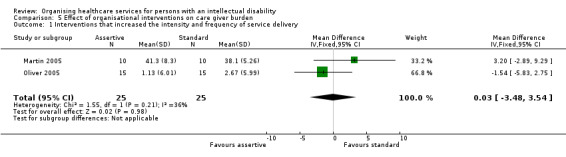
Main results: We identified one new trial from the updated searches.Seven trials (347 participants) met the selection criteria. The interventions varied but had common components: interventions that increased the intensity and frequency of service delivery (4 trials, 200 participants), community-based specialist behaviour therapy (1 trial, 63 participants), and outreach treatment (1 trial, 50 participants). Another trial compared two active arms (traditional counselling and integrated intervention for bereavement, 34 participants).The included studies investigated interventions dealing with the mental health problems of persons with an intellectual disability; none focused on physical health problems. Four studies assessed the effect of organisational interventions on behavioural problems for persons with an intellectual disability, three assessed care giver burden, and three assessed the costs associated with the interventions. None of the included studies reported data on the effect of organisational interventions on adverse events. Most studies were assessed as having low risk of bias.It is uncertain whether interventions that increase the frequency and intensity of delivery or outreach treatment decrease behavioural problems for persons with an intellectual disability (two and one trials respectively, very low certainty evidence). Behavioural problems were slightly decreased by community-based specialist behavioural therapy (one trial, low certainty evidence). Increasing the frequency and intensity of service delivery probably makes little or no difference to care giver burden (MD 0.03, 95% CI -3.48 to 3.54, two trials, moderate certainty evidence). It is uncertain whether outreach treatment makes any difference for care giver burden (one trial, very low certainty evidence). There was very limited evidence regarding costs, with low to very low certainty evidence for the different interventions.
Authors' conclusions: There is very limited evidence on the organisation of healthcare services for persons with an intellectual disability. There are currently no well-designed studies focusing on organising the health services of persons with an intellectual disability and concurrent physical problems. There are very few studies of organisational interventions targeting mental health needs and the results of those that were found need corroboration. There is an urgent need for high-quality health services research to identify optimal health services for persons with an intellectual disability and concurrent physical problem.
Conflict of interest statement
RB: none known. CAM: none known. YL: none known. HO‐K: none known. LB: none known. AC: none known. DCGB: none known.
Figures
Update of
-
Organising health care services for persons with an intellectual disability.Cochrane Database Syst Rev. 2008 Oct 8;(4):CD007492. doi: 10.1002/14651858.CD007492. Cochrane Database Syst Rev. 2008. Update in: Cochrane Database Syst Rev. 2016 Apr 11;4:CD007492. doi: 10.1002/14651858.CD007492.pub2. PMID: 18843752 Updated.
References
References to studies included in this review
Coelho 1993 {published data only}
-
- Coelho RJ, Kelley PS, DeatsmanKelley C. An experimental investigation of an innovative community treatment model for persons with a dual diagnosis (DD/MI). Journal of Rehabilitation 1993;59:37‐42.
Dowling 2006 {published data only}
-
- Dowling S, Hubert J, White S, Hollins S. Bereaved adults with intellectual disabilities: a combined randomized controlled trial and qualitative study of two community‐based interventions. Journal of Intellectual Disability Research 2006;50:277‐87. - PubMed
Hassiotis 2001 {published data only}
-
- Hassiotis A, Ukoumunne OC, Byford S, Tyrer P, Harvey K, Piachaud J, et al. Intellectual functioning and outcome of patients with severe psychotic illness randomised to intensive case management: report from the UK700 trial. British Journal of Psychiatry 2001;178:166‐71. - PubMed
Hassiotis 2009 {published data only}
-
- Hassiotis A, Robotham D, Canagasabey A, Romeo R, Langridge D, Blizard R, et al. Randomized, single‐blind, controlled trial of a specialist behavior therapy team for challenging behavior in adults with intellectual disabilities. American Journal of Psychiatry 2009;166(11):1278‐85. - PubMed
Martin 2005 {published data only}
-
- Martin G, Costello H, Leese M, Slade M, Bouras N, Higgins S, et al. An exploratory study of assertive community treatment for people with intellectual disability and psychiatric disorders: conceptual, clinical, and service issues. Journal of Intellectual Disability Research 2005;49:516‐24. - PubMed
Oliver 2005 {published data only}
-
- Oliver PC, Piachaud J, Tyrer P, Regan A, Dack M, Alexander R, et al. Randomized controlled trial of assertive community treatment in intellectual disability: the TACTILD study. Journal of Intellectual Disability Research 2005;49:507‐15. - PubMed
van Minnen 1997 {published data only}
-
- Minnen A, Hoogduin CA, Broekman TG. Hospital versus outreach treatment of patients with mental retardation and psychiatric disorders: a controlled study. Acta Psychiatrica Scandinavica 1997;95:515‐22. - PubMed
References to studies excluded from this review
Allen 1998 {published data only}
-
- Allen D. Brief report: changes in admissions to a hospital for people with intellectual disabilities following the development of alternative community services. Journal of Applied Research in Intellectual Disabilities 1998;11:156‐65.
Aronow 2005 {published data only}
-
- Aronow HU, Hahn JE. Stay well and healthy! Pilot study findings from an in‐home preventive healthcare programme for persons ageing with intellectual and/or developmental disabilities. Journal of Applied Research in Intellectual Disabilities Special Issue: Health Inequalities and People with Intellectual Disabilities 2005;18(2):163‐73.
Arya 2002 {published data only}
-
- Arya S. Delivery of services through itinerant service model. Journal of Personality and Clinical Studies 2002;18(1‐2):67‐72.
Bergström 2013 {published data only}
-
- Bergström H, Hagströmer M, Hagberg J, Elinder LS. A multi‐component universal intervention to improve diet and physical activity among adults with intellectual disabilities in community residences: a cluster randomised controlled trial. Research in Developmental Disabilities 2013;34:3847‐57. [DOI: 10.1016/j.ridd.2013.07.019] - DOI - PubMed
Caldwell 2006 {published data only}
-
- Caldwell J. Consumer‐directed supports: economic, health, and social outcomes for families. Mental Retardation: A Journal of Practices, Policy and Perspectives 2006;44(6):405‐17. - PubMed
Calkins 1994 {published data only}
-
- Calkins DR, Rubenstein LV, Cleary PD, Davies AR, Jette AM, Fink A, et al. Functional disability screening of ambulatory patients: a randomized controlled trial in a hospital‐based group practice. Journal of General Internal Medicine 1994;9(10):590‐2. - PubMed
Chadwick 2009 {published data only}
-
- Chadwick DD, Jolliffe J. A pilot investigation into the efficacy of a signing training strategy for staff working with adults with intellectual disabilities. British Journal of Learning Disabilities 2009;37(1):34‐42.
Cooper 2006 {published data only}
-
- Cooper SA, Morrison J, Melville C, Finlayson J, Allan L, Martin G, et al. Improving the health of people with intellectual disabilities: outcomes of a health screening programme after 1 year. Journal of Intellectual Disability Research 2006;50(Pt 9):667‐77. - PubMed
Darrow 2011 {published data only}
-
- Darrow SM. Examining multiple outcomes of staff training. Dissertation Abstracts International: Section B: The Sciences andEngineering 2012;72:7679.
Goldsmith 2000 {published data only}
-
- Goldsmith S, Cooray S, Johnston F, Williams G. Good practice, general practice: Identifying the health needs of people with learning disabilities. Journal of Clinical Governance 2000;8(2):83‐8.
Greenswag 1990 {published data only}
-
- Greenswag LR. A community outreach program for individuals with Prader‐Willi syndrome. Journal of Pediatric Health Care 1990;4(1):32‐8. - PubMed
Guo 2001 {published data only}
-
- Guo S, Biegel DE, Johnsen JA, Dyches H. Assessing the impact of community based mobile crisis services on preventing hospitalization. Psychiatric Services 2001;52(2):223‐8. - PubMed
Hassiotis 2011 {published data only}
Hassiotis 2014 {published data only}
-
- Hassiotis A, Strydom A, Crawford M, Hall I, Omar R, Vickerstaff V, et al. Clinical and cost effectiveness of staff training in Positive Behaviour Support (PBS) for treating challenging behaviour in adults with intellectual disability: a cluster randomised controlled trial. BMC Psychiatry 2014;14:219. [DOI: 10.1186/s12888-014-0219-6] - DOI - PMC - PubMed
Holmes 2004 {published data only}
Hylkema 2009 {published data only}
-
- Hylkema T, Vlaskamp C. Significant improvement in sleep in people with intellectual disabilities living in residential settings by non‐pharmaceutical interventions. Journal of Intellectual Disability Research 2009;53(8):695‐703. - PubMed
Jones 1997 {published data only}
-
- Jones RG, Kerr MP. A randomized control trial of an opportunistic health screening tool in primary care for people with intellectual disability. Journal of Intellectual Disability Research 1997;41(5):409‐15. - PubMed
Lennox 2008 {published data only}
-
- Lennox NG, Rey‐Conde TF, Faint SL. A pilot of interventions to improve health care in adolescents with intellectual disability. Journal of Applied Research in Intellectual Disabilities 2008;21(5):484‐9.
Lowe 1996 {published data only}
-
- Lowe K, Felce D, Blackman D. Challenging behaviour: the effectiveness of specialist support teams. Journal of Intellectual Disability Research 1996;40:336‐47. - PubMed
MacDonald 2006 {published data only}
-
- MacDonald A, Manji N, Evans S, Davies P, Daly A, Hendriksz C, et al. Home delivery of dietary products in inherited metabolic disorders reduces prescription and dispensing errors. Journal of Human Nutrition & Dietetics 2006;19(5):375‐81. - PubMed
McCabe 2006 {published data only}
-
- McCabe MP, McGillivray JA, Newton DC. Effectiveness of treatment programmes for depression among adults with mild/moderate intellectual disability. Journal of Intellectual Disability Research 2006;50(4):239‐47. - PubMed
McKee 1994 {published data only}
-
- McKee JR. Clinical pharmacy services in an intermediate care facility for the mentally retarded. Hospital Pharmacy 1994;29(3):228‐30. - PubMed
Merrick 2000 {published data only}
-
- Merrick J, Shapira J. Preventive dental health for persons with Down syndrome. International Journal of Adolescent Medicine and Health 2000;12(1):81‐4. - PubMed
Raghavan 2009 {published data only}
-
- Raghavan R, Newell R, Waseem F, Small N. A randomized controlled trial of a specialist liaison worker model for young people with intellectual disabilities with challenging behaviour and mental health needs. Journal of Applied Research in Intellectual Disabilities 2009;22(3):256‐63.
Rudolph 1998 {published data only}
-
- Rudolph C, Lakin KC, Oslund JM, Larson W. Evaluation of outcomes and cost effectiveness of a community behavioral support and crisis response demonstration project. Mental Retardation 1998;36(3):187‐97. - PubMed
Webb 1999 {published data only}
-
- Webb OJ, Rogers L. Health screening for people with intellectual disability: the New Zealand experience. Journal of Intellectual Disability Research 1999;43(6):497‐503. - PubMed
Wells 1997 {published data only}
-
- Wells MB, Turner S, Martin DM, Roy A. Health gain through screening ‐ coronary heart disease and stroke: developing primary health care services for people with intellectual disability. Journal of Intellectual and Developmental Disability 1997;22(4):251‐63.
Willner 2013 {published data only}
-
- Willner P, Rose J, Jahoda A, Stenfert Kroese B, Felce D, MacMahon P, et al. A cluster randomised controlled trial of a manualised cognitive–behavioural anger management intervention delivered by supervised lay therapists to people with intellectual disabilities. Health Technology Assessment 2013; Vol. 17, issue 21. [DOI: 10.3310/hta17210] - DOI - PMC - PubMed
Young 2006 {published data only}
-
- Young L. Community and cluster centre residential services for adults with intellectual disability: long‐term results from an Australian‐matched sample. Journal of Intellectual Disability Research 2006;50(Pt 6):419‐31. - PubMed
Additional references
Alborz 2005
Alexander 2002
-
- Alexander R, Regan A, Gangadharan S, Bhaumik S. Psychiatry of learning disability: a future with mental health?. Psychiatric Bulletin 2002;26:299‐301.
Ali 2015
Aman 1985
-
- Aman MG, Singh NN, Stewart AW, Field CJ. The aberrant behavior checklist: a behavior rating scale for the assessment of treatment effects. American Association on Mental Deficiency 1985;89(5):485‐91. - PubMed
Anderson 2003
-
- Anderson LL, Larson SA, Lakin KC, Kwak N. Health insurance coverage and health care experiences of persons with disabilities in the NHIS‐D [Report 5] [Data Brief]. University of Minnesota, Research and Training Center on Community Living 2003.
Aspray 1999
Barelds 2009
-
- Barelds A, Goor I, Bos M, Heck G, J Schols. Care and service trajectories for people with intellectual disabilities: Defining its course and quality determinants from the client's perspective. Journal of Policy and Practice in Intellectual Disabilities 2009;6(3):163‐72. [DOI: 10.1111/j.1741-1130.2009.00224.x] - DOI
Bouras 2004
-
- Bouras N, Holt G. Mental health services for adults with learning disabilities. British Journal of Psychiatry 2004;184:291‐2. - PubMed
Burns 1999
-
- Burns T, Creed F, Fahy T, Thompson S, Tyrer P, White I. Intensive versus standard case management for severe psychotic illness: a randomised trial. The Lancet 1999;353:2185‐9. - PubMed
Campbell 2000
CDCP 2004
-
- Centers for Disease Control and Prevention. Economic costs associated with mental retardation, cerebral palsy, hearing loss, and vision impairment, United States, 2003. Morbidity and Mortality Weekly Report 2004;53:57‐9. - PubMed
Chaplin 2004
-
- Chaplin R. General psychiatric services for adults with intellectual disability and mental illness. Journal of Intellectual Disability Research 2004;48:1‐10. - PubMed
Chaplin 2006
-
- Chaplin R. Assertive outreach for people with intellectual disability and mental disorders. Journal of Intellectual Disability Research 2006;50:615‐6. - PubMed
ClinicalTrials.gov 2015
-
- US National Institutes of Health Trial Registry. https://clinicaltrials.gov/ Accessed 4 September 2015.
Cooper 2007
-
- Cooper SA, Smiley E, Morrison J, Williamson A, Allan L. Mental ill‐health in adults with intellectual disabilities: prevalence and associated factors. British Journal of Psychiatry 2007;196:27‐35. - PubMed
Cooper 2011
-
- Cooper SA, McConnachie A, Allan LM, Melville C, Smiley E, Morrison J. Neighbourhood deprivation, health inequalities and service access by adults with intellectual disabilities: a cross‐sectional study. Journal of Intellectual Disability Research 2011;55(3):313‐23. [DOI: 10.1111/j.1365-2788.2010.01361.x] - DOI - PubMed
Dieckmann 2015
DSM‐5
-
- American Psychiatric Association. Diagnostic and statistical manual of mental disorders: DSM‐5. Washington, D.C.: American Psychiatric Association, 2013.
Durvasula 2001
-
- Durvasula S, Beange H. Health inequalities in people with intellectual disability: strategies for improvement. Health Promotion Journal of Australia 2001;11:27‐31.
EPOC 2012
-
- Cochrane Effective Practice and Organisation of Care Review Group. Data Collection Checklist: Risk of Bias. http://epoc.cochrane.org/resources (accessed 6 April 2012).
EPOC 2015
-
- Effective Practice, Organisation of Care (EPOC). EPOC Taxonomy. https://epoc.cochrane.org/epoc‐taxonomy 2015. Accessed 1 October 2015.
Fisher 2004
-
- Fisher K. Health disparities and mental retardation. Journal of Nursing Scholarship 2004;36:48‐53. - PubMed
Fletcher 1993
-
- Fletcher RJ. Mental illness‐mental retardation in the United States: policy and treatment changes. Journal of Intellectual Disability Research 1993;37 Suppl:25‐33. - PubMed
Frid 1999
-
- Frid C, Drott P, Lundell B, Rasmussen F, Anneren G. Mortality in Down's syndrome in relation to congenital malformations. Journal of Intellectual Disability Research 1999;43:234‐41. - PubMed
Gilbody 2003
-
- Gilbody S, Whitty P, Grimshaw J, Thomas R. Educational and organisational interventions to improve the management of depression in primary care: a systematic review. Journal of the American Medical Association 2003;289:3145‐51. - PubMed
Guyatt 2008
Hassiotis 2000
Hassiotis 2002
-
- Hassiotis, A. Community mental health services for individuals with intellectual disabilities issues and approaches to optimizing outcomes. Disease Management and Health Outcomes 2002;10:409‐17.
Havercamp 2006
Higgins 2011a
-
- Higgins JPT, Green S (editors). Cochrane Handbook for Systematic Reviews of Interventions. Version 5.1.0. The Cochrane Collaboration. Available from www.cochrane‐handbook.org, [updated March 2011].
Higgins 2011b
-
- Higgins JPT, Altman DG, Sterne JAC, on behalf of the Cochrane Statistical Methods Group and the Cochrane Bias Methods Group. Chapter 8: Assessing risk of bias in included studies. In: Higgins JPT, Green S editor(s). Cochrane Handbook of Systematic Reviews of Interventions. The Cochrane Collaboration. Available from www.cochrane‐handbook.org, [updated March 2011].
ICTRP 2015
-
- WHO International Clinical Trials Registry Platform. http://www.who.int/ictrp/en/ Accessed 4 September 2015.
Jansen 2006
-
- Jansen DEMC, Krol B, Groothoff JW, Post D. Towards improving medical care for people with intellectual disability living in the community: possibilities of integrated care. Journal of Applied Research in Intellectual Disabilities 2006;19:214‐8.
Keith 1987
-
- Keith, RA, Granger CV, Hamilton BB, Sherwin FS. The functional independence measure: a new tool for rehabilitation. Advances in Clinical Rehabilitation 1987;1:6‐18. - PubMed
Kelley 2006
-
- Kelley P. Personal communication, 11 October 2006.
Krahn 2006
-
- Krahn GL, Hammond L, Turner A. A cascade of disparities: health and health care access for people with intellectual disabilities. Mental Retardation and Developmental Disabilities Research Reviews 2006;12:70‐82. - PubMed
Lake 2014
-
- Lake JK, Palucka AM, Desarkar P, Hassiotis A, Lunsky Y. Chapter 22: inpatient mental health services. In: Tsakanikos E, McCarthy J editor(s). Handbook of Psychopathology in Intellectual Disability Research, Practice, and Policy. New York: Springer Science+Business Media, 2014.
Larson 2005
-
- Larson SA, Anderson L, Dlojanac R. Health promotion for persons with intellectual and developmental disabilities. In: Nehring W editor(s). Access to Health Care. Washington: American Association on Mental Retardation, 2005:129‐84.
Lennox 1995
-
- Lennox N, Chaplin R. The psychiatric care of people with intellectual disabilities: the perceptions of trainee psychiatrists and medical officers. Australian and New Zealand Journal of Psychiatry 1995;29:632‐37. - PubMed
Lennox 2002
-
- Lennox N. Health promotion and disease prevention. In: Prasher VP, Janicki MP editor(s). Physical Health of Adults with Intellectual Disabilities. Oxford: Blackwell Publishing Ltd, 2002:230‐49.
Lennox 2005
-
- Lennox N, Taylor M, Rey‐Conde T, Bain C, Purdie DM, Boyle F. Beating the barriers: recruitment of people with intellectual disability to participate in research. Journal of Intellectual Disability Research 2005;49:296‐305. - PubMed
Lennox 2015
Lin 2013
-
- Lin E, Selick A, Balogh RS, Isaacs BJ, Ouellette‐Kuntz HMJ, Klein‐Geltink JE, et al. Chapter 2: prevalence, demographic and disease profiles. In: Lunsky Y, Klein‐Geltink JE, Yates EA editor(s). Atlas on the Primary Care of Adults with Developmental Disabilities in Ontario. Toronto, ON: Institute for Clinical Evaluative Sciences, 2013.
Lynch 1997
-
- Lynch PS, Kellow JT, Willson VL. The impact of deinstitutionalization on the adaptive behavior of adults with mental retardation: a meta‐analysis. Education and Training in Mental Retardation and Developmental Disabilities 1997;32:255‐61.
Maulik 2011
Morgan 2008
Moss 1997
-
- Moss S, Ibbotson B, Prosser H, Goldberg D, Patel P, Simpson N. Validity of the PAS‐ADD for detecting psychiatric symptoms in adults with learning disability (mental retardation). Social Psychiatry and Psychiatric Epidemiology 1997;32(6):344‐54. - PubMed
Moss 2000
-
- Moss S, Bouras N, Holt G. Mental health services for people with intellectual disability: a conceptual framework. Journal of Intellectual Disability Research 2000;44:97‐107. - PubMed
O'Hara 2000
-
- O'Hara J. Learning disabilities services: primary care or mental health trust?. Psychiatric Bulletin 2000;24:368‐9.
Oliver 2002
-
- Oliver PC, Piachaud J, Done J, Regan A, Cooray S, Tyrer P. Difficulties in conducting a randomized controlled trial of health service interventions in intellectual disability: implications for evidence‐based practice. Journal of Intellectual Disability Research 2002;46:340‐5. - PubMed
Ouellette Kuntz 2005
Patja 2001
-
- Patja K, Molsa P, Iivanainen M. Cause‐specific mortality of people with intellectual disability in a population‐based, 35‐year follow‐up study. Journal of Intellectual Disability Research 2001;45:30‐40. - PubMed
PDQ‐Evidence 2015
-
- PDQ‐Evidence. PDQ‐Evidence for Informed Health Policymaking. http://www.pdq‐evidence.org/en/ accessed 23 September 2015.
Pruchno 1990
-
- Pruchno R. The effects of help patterns on the mental health of spouse caregivers. Research on Ageing 1990;12:57‐71. - PubMed
RevMan 2011 [Computer program]
-
- The Nordic Cochrane Centre, The Cochrane Collaboration. Review Manager (RevMan). Copenhagen: The Nordic Cochrane Centre, The Cochrane Collaboration, 2011.
RevMan 2014 [Computer program]
-
- The Nordic Cochrane Centre, The Cochrane Collaboration. Review Manager (RevMan). Version 5.3. Copenhagen: The Nordic Cochrane Centre, The Cochrane Collaboration, 2014.
Rich 1995
-
- Rich MW, Beckham V, Wittenberg C. A multidisciplinary intervention to prevent the readmission of elderly patients with congestive heart failure. The New England Journal of Medicine 1995;333:1190‐5. - PubMed
Robotham 2011
Schalock 1993
-
- Schalock RL, Keith KD. Quality of Life Questionnaire Manual. Worthington, OH: IDS Publishing Corporation, 1993.
Slevin 2008
-
- Slevin E, Truesdale‐Kennedy M, McConkey R, Barr O, Taggart L. Community learning disability teams: developments, composition and good practice. Journal of Intellectual Disabilities 2008;12:59‐79. - PubMed
Tyrer 2009
US PHS 2002
-
- United States Public Health Service Office of the Surgeon General. Closing the gap: a national blueprint to improve the health of persons with mental retardation. Report of the Surgeon General's Conference on Health Disparities and Mental Retardation 2002. - PubMed
Van Schrojenstein 1997
-
- Schrojenstein Lantman de Valk HMJ, Akker M, Maaskant MA, Haveman MJ, Urlings HFJ, Kessels AGH, et al. Prevalence and incidence of health problems in people with intellectual disability. Journal of Intellectual Disability Research 1997;41:42‐51. - PubMed
Vereenooghe 2013
Wagner 1996
-
- Wagner EH, Austin BT, Korff M. Organizing care for patients with chronic illness. Milbank Quarterly 1996;74:511‐44. - PubMed
Wagner 1998
-
- Wagner EH. Chronic disease management: what will it take to improve care for chronic illness?. Effective Clinical Practice 1998;1:2‐4. - PubMed
Young 1998
-
- Young L, Sigafoos J, Suttie J, Ashman A, Grevell P. Deinstitutionalisation of persons with intellectual disabilities: a review of Australian studies. Journal of Intellectual and Developmental Disability 1998;23:155‐70.
References to other published versions of this review
Publication types
MeSH terms
Grants and funding
LinkOut - more resources
Full Text Sources
Other Literature Sources
Medical
Miscellaneous
