


Culturally Diverse Undergraduate Researchers' Academic Outcomes and Perceptions of Their Research Mentoring Relationships
- PMID: 27065568
- PMCID: PMC4822509
- DOI: 10.1080/09500693.2015.1085133
Culturally Diverse Undergraduate Researchers' Academic Outcomes and Perceptions of Their Research Mentoring Relationships
Abstract
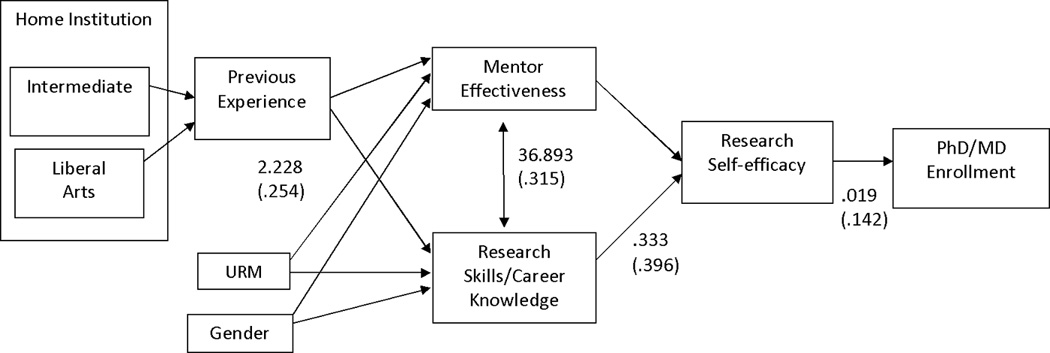
Few studies have empirically investigated the specific factors in mentoring relationships between undergraduate researchers (mentees) and their mentors in the biological and life sciences that account for mentees' positive academic and career outcomes. Using archival evaluation data from more than 400 mentees gathered over a multi-year period (2005-11) from several undergraduate biology research programs at a large, Midwestern research university, we validated existing evaluation measures of the mentored research experience and the mentor-mentee relationship. We used a subset of data from mentees (77% underrepresented racial/ethnic minorities) to test a hypothesized social cognitive career theory model of associations between mentees' academic outcomes and perceptions of their research mentoring relationships. Results from path analysis indicate that perceived mentor effectiveness indirectly predicted post-baccalaureate outcomes via research self-efficacy beliefs. Findings are discussed with implications for developing new and refining existing tools to measure this impact, programmatic interventions to increase the success of culturally diverse research mentees and future directions for research.
Keywords: mentored research experience; mentoring; social cognitive career theory; undergraduates; underrepresented minorities.
Conflict of interest statement
Disclosure: There are no conflicts of interests to declare.
Figures
References
-
- Adedokun O, Bessenbacher A, Parker L, Kirkham L, Burgess W. Research skills and STEM undergraduate research students’ aspirations for research careers: Mediating effects of research self-efficacy. Journal of Research in Science Teaching. 2013;50(8):940–951.
-
- Bakken LL, Byars-Winston AM, Wang M. Viewing clinical research career development through the lens of social cognitive career theory. Advances in Health Sciences Education. 2006;11(1):91–110. - PubMed
-
- Bandura A. Social foundations of thought and action: A social cognitive theory. Englewood Cliffs, NJ: Prentice Hall; 1986.
-
- Bandura A. Self-efficacy: The exercise of control. NY: W.H. Freeman/Times Books/Henry Holt & Co.; 1997.
-
- Bennett S, Paina L, Ssengooba F, Waswa D, M’Imunya J. Mentorship in African health research training programs: An exploratory study of Fogarty International Center Programs in Kenya and Uganda. Education for Health. 2013;26:183–187. - PubMed
Grants and funding
LinkOut - more resources
Full Text Sources
Other Literature Sources