. 2016 Mar 31:7:347.
doi: 10.3389/fpls.2016.00347. eCollection 2016.

Nitric Oxide Mitigates Salt Stress by Regulating Levels of Osmolytes and Antioxidant Enzymes in Chickpea

Affiliations

Nitric Oxide Mitigates Salt Stress by Regulating Levels of Osmolytes and Antioxidant Enzymes in Chickpea

Parvaiz Ahmad et al. Front Plant Sci. .

Abstract

This work was designed to evaluate whether external application of nitric oxide (NO) in the form of its donor S-nitroso-N-acetylpenicillamine (SNAP) could mitigate the deleterious effects of NaCl stress on chickpea (Cicer arietinum L.) plants. SNAP (50 μM) was applied to chickpea plants grown under non-saline and saline conditions (50 and 100 mM NaCl). Salt stress inhibited growth and biomass yield, leaf relative water content (LRWC) and chlorophyll content of chickpea plants. High salinity increased electrolyte leakage, carotenoid content and the levels of osmolytes (proline, glycine betaine, soluble proteins and soluble sugars), hydrogen peroxide (H2O2) and malondialdehyde (MDA), as well as the activities of antioxidant enzymes, such as superoxide dismutase (SOD), catalase (CAT), ascorbate peroxidase (APX), and glutathione reductase in chickpea plants. Expression of the representative SOD, CAT and APX genes examined was also up-regulated in chickpea plants by salt stress. On the other hand, exogenous application of NO to salinized plants enhanced the growth parameters, LRWC, photosynthetic pigment production and levels of osmolytes, as well as the activities of examined antioxidant enzymes which is correlated with up-regulation of the examined SOD, CAT and APX genes, in comparison with plants treated with NaCl only. Furthermore, electrolyte leakage, H2O2 and MDA contents showed decline in salt-stressed plants supplemented with NO as compared with those in NaCl-treated plants alone. Thus, the exogenous application of NO protected chickpea plants against salt stress-induced oxidative damage by enhancing the biosyntheses of antioxidant enzymes, thereby improving plant growth under saline stress. Taken together, our results demonstrate that NO has capability to mitigate the adverse effects of high salinity on chickpea plants by improving LRWC, photosynthetic pigment biosyntheses, osmolyte accumulation and antioxidative defense system.

Keywords: antioxidant enzymes; chickpea; gene expression; nitric oxide; osmolytes; salt stress.


Figures
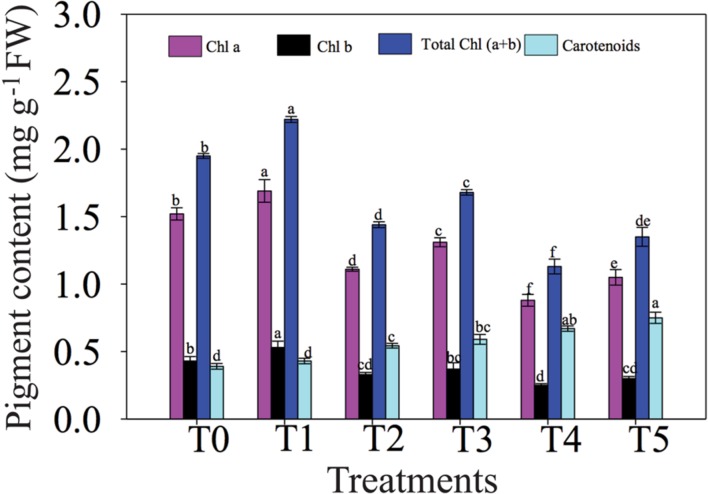
FIGURE 1
FIGURE 1
Effects of NO on chlorophyll (Chl) and carotenoid contents in leaves of chickpea plants under salt stress. Data presented are the means ± SEs (n = 5). Different letters indicate significant difference (P ≤ 0.05) among the treatments. T0 (control) = 0 mM NaCl + 0 μM SNAP; T1 = 0 mM NaCl + 50 μM SNAP; T2 = 50 mM NaCl + 0 μM SNAP; T3 = 50 mM NaCl + 50 μM SNAP; T4 = 100 mM NaCl + 0 μM SNAP; T5 = 100 mM NaCl + 50 μM SNAP. FW, fresh weight.
FIGURE 2
FIGURE 2
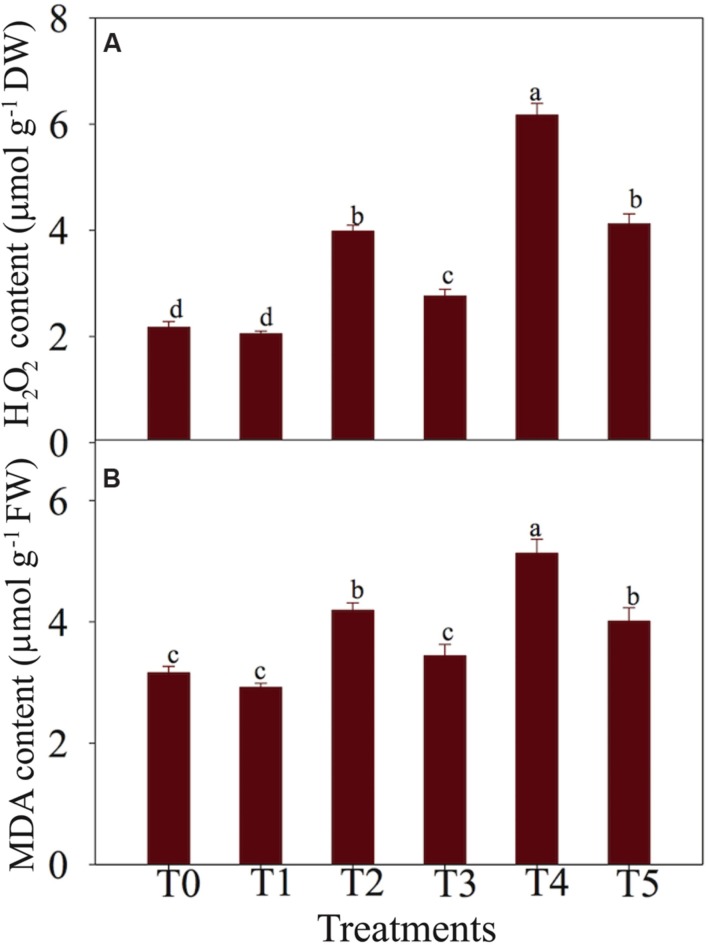
Effects of NO on (A) hydrogen peroxide (H2O2) content and (B) malondialdehyde (MDA) content in leaves of chickpea plants under salt stress. Data presented are the means ± SEs (n = 5). Different letters indicate significant difference (P ≤ 0.05) among the treatments. T0 (control) = 0 mM NaCl + 0 μM SNAP; T1 = 0 mM NaCl + 50 μM SNAP; T2 = 50 mM NaCl + 0 μM SNAP; T3 = 50 mM NaCl + 50 μM SNAP; T4 = 100 mM NaCl + 0 μM SNAP; T5 = 100 mM NaCl + 50 μM SNAP. DW, dry weight; FW, fresh weight.
FIGURE 3
FIGURE 3
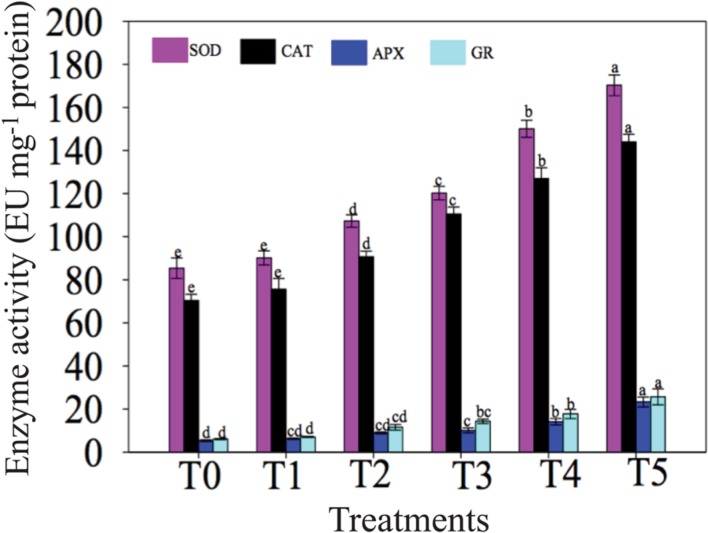
Effects of NO on activities of superoxide dismutase (SOD), catalase (CAT), ascorbate peroxidase (APX), and glutathione reductase (GR) in leaves of chickpea plants under salt stress. Data presented are the means ± SEs (n = 5). Different letters indicate significant difference (P ≤ 0.05) among the treatments. T0 (control) = 0 mM NaCl + 0 μM SNAP; T1 = 0 mM NaCl + 50 μM SNAP; T2 = 50 mM NaCl + 0 μM SNAP; T3 = 50 mM NaCl + 50 μM SNAP; T4 = 100 mM NaCl + 0 μM SNAP; T5 = 100 mM NaCl + 50 μM SNAP. EU, enzyme unit.
FIGURE 4
FIGURE 4
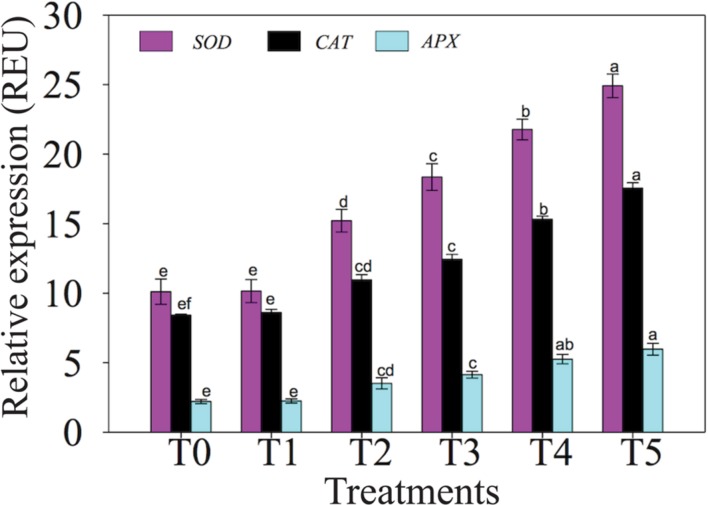
Effects of NO on expression levels of selected SOD, CAT and APX genes in leaves of chickpea plants under salt stress. Data presented are the means ± SEs (n = 5). Different letters indicate significant difference (P ≤ 0.05) among the treatments. T0 (control) = 0 mM NaCl + 0 μM SNAP; T1 = 0 mM NaCl + 50 μM SNAP; T2 = 50 mM NaCl + 0 μM SNAP; T3 = 50 mM NaCl + 50 μM SNAP; T4 = 100 mM NaCl + 0 μM SNAP; T5 = 100 mM NaCl + 50 μM SNAP. REU, relative expression unit.
FIGURE 5
FIGURE 5
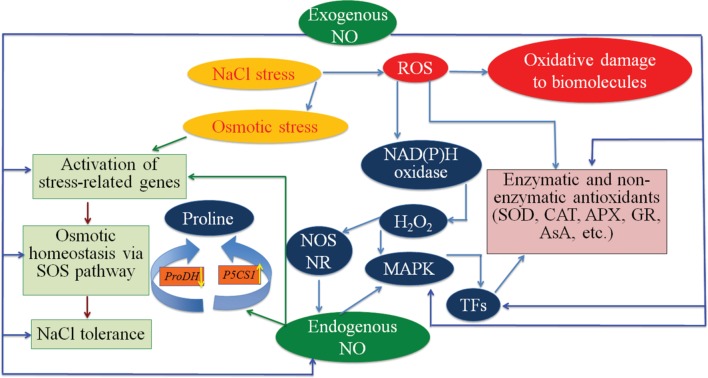
Potential mechanisms of NaCl stress mitigation by application of exogenous NO. Excessive NaCl causes osmotic and oxidative stresses in plants. Salt stress induces ABA accumulation, which promotes H2O2 generation through NAD(P)H oxidase. Stress-induced H2O2 triggers generation of endogenous NO by activating NR (nitrate reductase) and NOS (nitric oxide synthase)-like enzymes. Exogenous application of NO to plants may enhance the biosynthesis of endogenous NO, as well as that of antioxidant enzymes through MAPK (mitogen-activated protein kinase) and other unknown signaling pathways. Exogenous NO supplementation to plants can also up-regulate genes involved in proline synthesis, such as P5CS1, and other stress-related genes responsible for NaCl tolerance, whereas it might down-regulate ProDH that is involved in proline catabolism. Exogenous NO treatment may also help balance osmotic homeostasis in plants under salt stress via the SOS (salt overly sensitive) pathway, by increasing plasma membrane H+-ATPase activity. APX, ascorbate peroxidase; AsA, ascorbic acid; CAT, catalase; GR, glutathione reductase; H2O2, hydrogen peroxide; P5CS1, δ1-pyrroline-5-carboxylate synthetase; ProDH, proline dehydrogenase; ROS, reactive oxygen species; SOD, superoxide dismutase; TFs, transcription factors.

References

    1. Abdel Latef A. A., Chaoxing H. (2011). Effect of arbuscular mycorrhizal fungi on growth, mineral nutrition, antioxidant enzymes activity and fruit yield of tomato grown under salinity stress. Sci. Hortic. 127 228–233. 10.1016/j.scienta.2010.09.020 - DOI
    1. Abdel Latef A. A., Chaoxing H. (2014). Does the inoculation with Glomus mosseae improves salt tolerance in pepper plants? J. Plant Growth Regul. 33 644–653. 10.1007/s00344-014-9414-4 - DOI
    1. Abdel Latef A. A., Miransari M. (2014). “The role of arbuscular mycorrhizal fungi in alleviation of salt stress,” in Use of Microbes for the Alleviation of Soil Stresses, ed. Miransari M. (New York, NY: Springer; ), 23–38.
    1. Aebi H. (1984). Catalase in vitro. Method Enzymol. 105 121–126. 10.1016/S0076-6879(84)05016-3 - DOI - PubMed
    1. Ahmad P. (2010). Growth and antioxidant responses in mustard (Brassica juncea L.) plants subjected to combined effect of gibberellic acid and salinity. Arch. Agron. Soil Sci. 56 575–588. 10.1080/03650340903164231 - DOI

LinkOut - more resources