


Ethnic Disparities in Trends in High BMI Among California Adolescents, 2003-2012
- PMID: 27067033
- PMCID: PMC4958536
- DOI: 10.1016/j.amepre.2016.02.010
Ethnic Disparities in Trends in High BMI Among California Adolescents, 2003-2012
Abstract
Introduction: Because California is home to one in eight U.S. children and accounts for the highest Medicaid and Children's Health Insurance Program spending, childhood obesity trends in California have important implications for the entire nation. California's racial/ethnic diversity and large school-based data set provide a unique opportunity to examine trends by race/ethnicity, including understudied Asian and American Indian youth, which has not been possible using national data sets. This study examined racial/ethnic disparities in prevalence of high BMI from 2003 to 2012.
Methods: This observational study included 11,624,865 BMI records from repeated cross-sections of fifth-, seventh-, and ninth-graders who underwent California's school-based fitness testing. Analyses conducted in 2015 used logistic regression to identify trends in prevalence of high BMI (BMI ≥85th, 95th, and 97th percentiles) and differences in trends by race/ethnicity from 2003 to 2012.
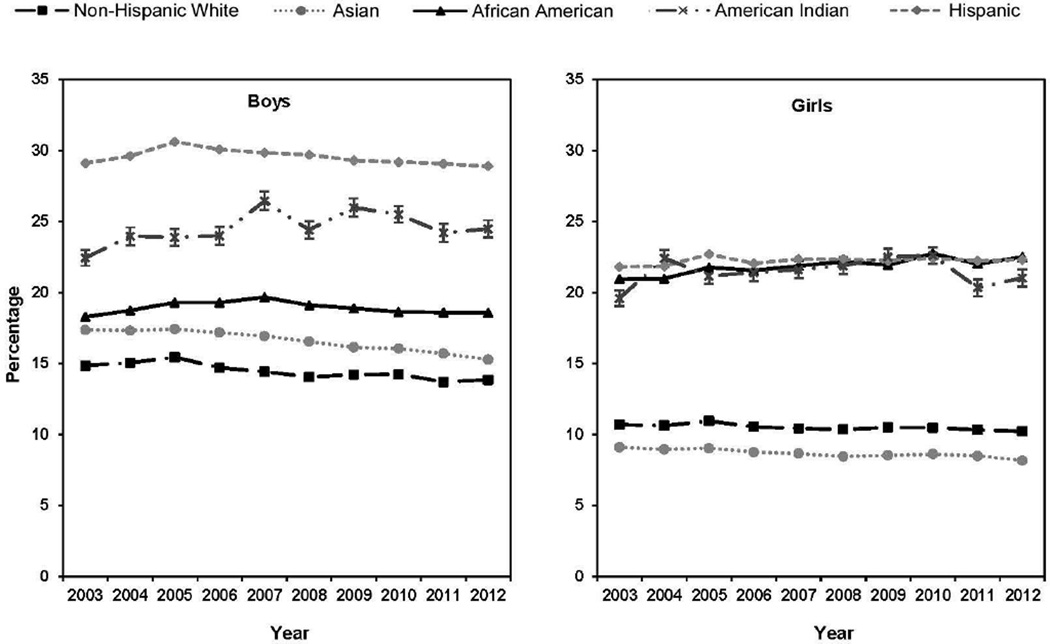
Results: African American and Hispanic girls and American Indian boys increased in prevalence of high BMI, whereas non-Hispanic white and Asian youth and Hispanic boys decreased in prevalence of high BMI (p-values<0.05) from 2003 to 2012. Over this period, African American, Hispanic, and American Indian youth had higher slopes for trends in high BMI than non-Hispanic white youth (p-values<0.05).
Conclusions: Based on California's statewide data, there is evidence that racial/ethnic disparities in prevalence of high BMI have widened over time. Minority youth have either decreased more slowly or increased in prevalence compared with non-Hispanic white youth. There continues to be an urgent need for policies and interventions that effectively reduce racial/ethnic obesity prevalence disparities.
Copyright © 2016 American Journal of Preventive Medicine. Published by Elsevier Inc. All rights reserved.
Figures
References
-
- Jolliffe D. Extent of overweight among US children and adolescents from 1971 to 2000. Int J Obes Relat Metab Disord. 2004;28(1):4–9. http://dx.doi.org/10.1038/sj.ijo.0802421. - DOI - PubMed
-
- Ogden CL, Carroll MD, Kit BK, Flegal KM. Prevalence of childhood and adult obesity in the United States, 2011–2012. JAMA. 2014;311(8):806–814. http://dx.doi.org/10.1001/jama.2014.732. - DOI - PMC - PubMed
-
- Schwartz MB, Puhl R. Childhood obesity: a societal problem to solve. Obes Rev. 2003;4(1):57–71. http://dx.doi.org/10.1046/j.1467-789X.2003.00093.x. - DOI - PubMed
-
- Freedman DS, Mei Z, Srinivasan SR, Berenson GS, Dietz WH. Cardiovascular risk factors and excess adiposity among overweight children and adolescents: the Bogalusa Heart Study. J Pediatr. 2007;150(1):12–17. e12. - PubMed
-
- Sutherland ER. Obesity and asthma. Immunol Allergy Clin North Am. 2008;28(3):589–602. ix. http://dx.doi.org/10.1016/j.iac.2008.03.003. - DOI - PMC - PubMed
Publication types
MeSH terms
Grants and funding
LinkOut - more resources
Full Text Sources
Other Literature Sources
Medical
