


doi: 10.1128/AAC.03113-15.
Print 2016 Jun.
Elucidation of Mechanisms of Ceftazidime Resistance among Clinical Isolates of Pseudomonas aeruginosa by Using Genomic Data
Affiliations
- PMID: 27067331
- PMCID: PMC4879354
- DOI: 10.1128/AAC.03113-15
Item in Clipboard
Elucidation of Mechanisms of Ceftazidime Resistance among Clinical Isolates of Pseudomonas aeruginosa by Using Genomic Data
Antimicrob Agents Chemother.
.
Abstract
Ceftazidime is one of the few cephalosporins with activity against Pseudomonas aeruginosa Using whole-genome comparative analysis, we set out to determine the prevalent mechanism(s) of resistance to ceftazidime (CAZ) using a set of 181 clinical isolates. These isolates represented various multilocus sequence types that consisted of both ceftazidime-susceptible and -resistant populations. A presumptive resistance mechanism against ceftazidime was identified in 88% of the nonsusceptible isolates using this approach.
Copyright © 2016, American Society for Microbiology. All Rights Reserved.
Figures

Changes identified within AmpD responsible for derepression of ampC. Alignment of the protein sequence of Citrobacter freundii and P. aeruginosa PAO1 for comparative purposes. Red boxes above the sequence of C. freundii denote residues identified from structural studies and mutational analysis as being important in the activity and functionality of AmpD (15, 31). Blue dots below indicate residues that had changes exclusive to the ceftazidime-resistant population and which previously have been shown to be important in increasing ampC expression in other Enterobacteriaceae (16). Yellow dots indicate newly identified changes that were exclusive to the ceftazidime-resistant P. aeruginosa population.
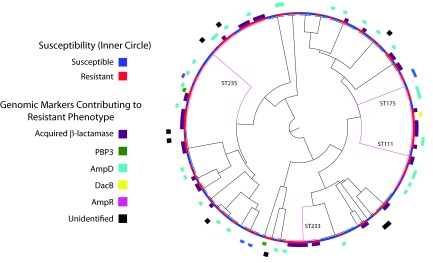
Summary of resistance mechanisms among ceftazidime-resistant clinical isolates of P. aeruginosa by MLST. Global lineages are highlighted on the MLST tree in pink and labeled accordingly. The 12 isolates for which a genomic marker for resistance could not be determined are highlighted on the outer circle with black boxes.
References
-
- Mesaros N, Nordmann P, Plesiat P, Roussel-Delvallez M, Van Eldere J, Glupczynski Y, Van Laethem Y, Jacobs F, Lebecque P, Malfroot A, Tulkens PM, Van Bambeke F. 2007. Pseudomonas aeruginosa: resistance and therapeutic options at the turn of the new millennium. Clin Microbiol Infect 13:560–578. doi: 10.1111/j.1469-0691.2007.01681.x. - DOI - PubMed
MeSH terms
Substances
LinkOut - more resources
Full Text Sources
Other Literature Sources
