. 2016 Jun 1;143(11):1914-25.
doi: 10.1242/dev.131664. Epub 2016 Apr 11.

Tissue- and stage-specific Wnt target gene expression is controlled subsequent to β-catenin recruitment to cis-regulatory modules

Affiliations

Tissue- and stage-specific Wnt target gene expression is controlled subsequent to β-catenin recruitment to cis-regulatory modules

Yukio Nakamura et al. Development. .

Abstract

Key signalling pathways, such as canonical Wnt/β-catenin signalling, operate repeatedly to regulate tissue- and stage-specific transcriptional responses during development. Although recruitment of nuclear β-catenin to target genomic loci serves as the hallmark of canonical Wnt signalling, mechanisms controlling stage- or tissue-specific transcriptional responses remain elusive. Here, a direct comparison of genome-wide occupancy of β-catenin with a stage-matched Wnt-regulated transcriptome reveals that only a subset of β-catenin-bound genomic loci are transcriptionally regulated by Wnt signalling. We demonstrate that Wnt signalling regulates β-catenin binding to Wnt target genes not only when they are transcriptionally regulated, but also in contexts in which their transcription remains unaffected. The transcriptional response to Wnt signalling depends on additional mechanisms, such as BMP or FGF signalling for the particular genes we investigated, which do not influence β-catenin recruitment. Our findings suggest a more general paradigm for Wnt-regulated transcriptional mechanisms, which is relevant for tissue-specific functions of Wnt/β-catenin signalling in embryonic development but also for stem cell-mediated homeostasis and cancer. Chromatin association of β-catenin, even to functional Wnt-response elements, can no longer be considered a proxy for identifying transcriptionally Wnt-regulated genes. Context-dependent mechanisms are crucial for transcriptional activation of Wnt/β-catenin target genes subsequent to β-catenin recruitment. Our conclusions therefore also imply that Wnt-regulated β-catenin binding in one context can mark Wnt-regulated transcriptional target genes for different contexts.

Keywords: ChIP-seq; Gastrula; RNA-seq; Wnt signalling; Xenopus; β-catenin.


Conflict of interest statement

Competing interests

The authors declare no competing or financial interests.

Figures
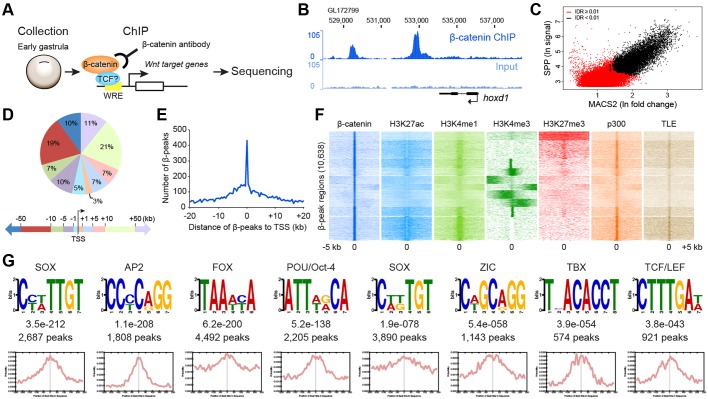
Fig. 1.
Fig. 1.
β-catenin ChIP-seq analysis of Xenopus early gastrulae. (A) Experimental design of β-catenin ChIP-seq analysis. Early gastrulae were collected and fixed. Following chromatin shearing, β-catenin antibodies were used to selectively precipitate DNA fragments bound by β-catenin-containing protein complexes. Subsequently, the precipitated DNA fragments were sequenced. (B) Genome view of example β-catenin target gene hoxd1. Note the clear β-catenin ChIP-seq peaks (β-peaks) downstream (to the left) of the hoxd1 locus. (C) Scatter plot combining peak calling analysis by SPP [considering signal strength, applying false discovery rate (FDR)≤0.1] and MACS2 (considering fold change, applying P≤0.01) software, with black dots indicating 10,638 β-peaks reproducibly called [applying an irreproducible discovery rate (IDR)≤0.01]. (D,E) β-peaks are associated with sequences throughout the genome (D) but enriched close to and just upstream (putative promoter) of the transcriptional start site (TSS) of nearby genes (E; analysed in 500 bp bins). Pie chart (D) shows the percentage of β-peaks according to their location relative to TSS (within 1 kb, 1-5 kb, 5-10 kb, 10-50 kb, over 50 kb upstream or downstream of TSS). (F) Heat map illustrating genome-wide association of β-peaks with histone modifications and transcription co-factor binding sites indicative of cis-regulatory modules (CRMs; such as promoters and enhancers) in patterns that can be clustered into ten groups. Each horizontal line represents the 5 kb downstream and upstream regions of ChIP-seq data around a β-peak. (G) Enriched motifs from de novo motif search of sequences under β-peaks. Note the identification of consensus TCF/LEF binding but also other known transcription factor binding motifs. Statistical significance (e-values) and the number of β-peaks are indicated below each motif logo. The analysis of motif distribution shows central enrichment of motifs within β-peak regions (500 bp window).
Fig. 2.
Fig. 2.
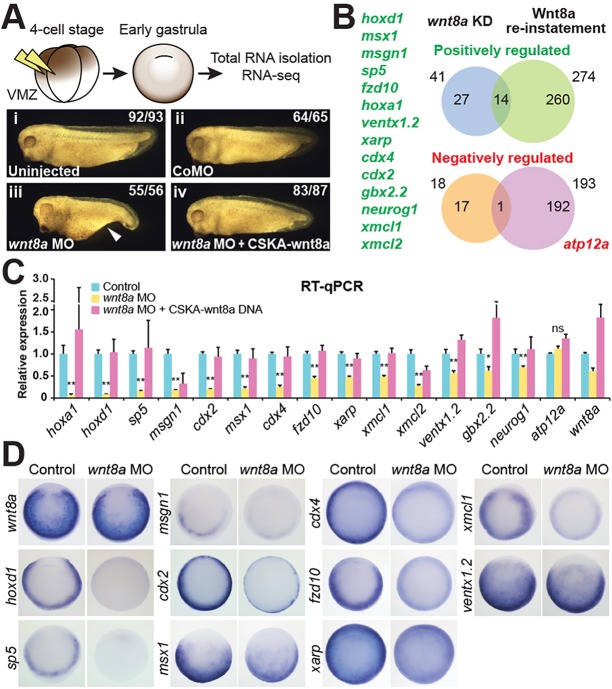
RNA-seq analysis to identify wnt8a-regulated genes. (A) Experimental design to identify wnt8a-regulated genes. wnt8a MO and a standard control MO (CoMO) were microinjected into the ventral marginal zone (VMZ) of four-cell stage embryos (prospective endogenous wnt8a-expressing and ventral mesoderm tissue). For the reinstatement experiment, wnt8a MO was co-injected together with a DNA construct driving exogenous Wnt8a (CSKA-wnt8a) in the same tissue. Three biological replicates per experimental sample were sequenced. The experimental conditions were optimised by comparing the morphology of (i) uninjected embryos with the embryos injected with (ii) CoMO, (iii) wnt8a MO or (iv) wnt8a MO plus CSKA-wnt8a DNA, as well as expected changes in expression of candidate genes (Fig. S3). (B) Venn diagrams of genes that are positively (top) or negatively (bottom) regulated by Wnt8a signalling identified by generalised linear model (GLM) statistical analysis (FDR<0.1; see the supplementary Materials and Methods) of RNA-seq results. Forty-one genes were identified with reduced expression in the wnt8a knockdown (KD; blue, compared with uninjected and CoMO-injected controls) and 274 genes with increased expression when Wnt8a expression was reinstated (green, compared with wnt8a knockdown). A shortlist of 14 wnt8a positively regulated genes (listed on the left) was selected for further analysis by the overlap between these two groups of genes (see Table S2 for full gene lists). Eighteen genes with increased expression were identified in the wnt8a knockdown (amber) and 193 genes with reduced expression when Wnt8a expression was reinstated (purple), with one gene (atp12a) in the overlap and therefore apparently negatively regulated by wnt8a. (C) Validation of RNA-seq-discovered candidate genes by RT-qPCR. Transcripts collected from embryos microinjected into all four blastomeres with wnt8a MO, or with wnt8a MO co-injected with CSKA-wnt8a DNA, were compared with control (CoMO injected). All 14 positively wnt8a-regulated candidate genes of the shortlist were confirmed; but not atp12a, which had been suggested to be negatively regulated. Note the varying extent of dependence on wnt8a function for the different genes. *P<0.1, **P<0.05; ns, not significant (P≥0.1); two-tailed Student's t-test. Error bars represent s.d. of two biological replicates. (D) Vegetal view of early gastrulae (with dorsal up) of control (uninjected) and wnt8a MO-injected embryos. Note the expression of wnt8a-regulated genes in a similar, but not always identical pattern, as wnt8a. Also note the reduced expression to varying extents in wnt8a MO-injected embryos.
Fig. 3.
Fig. 3.
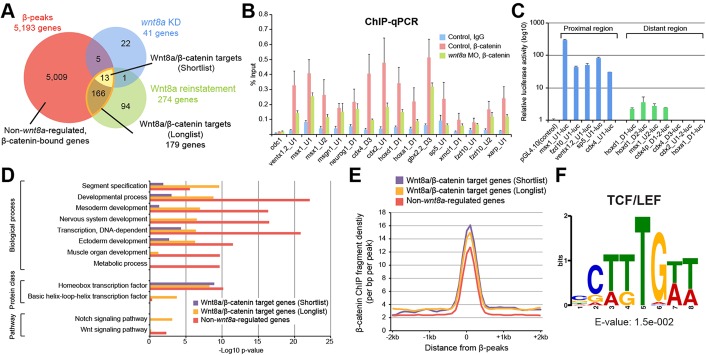
Integrating β-catenin ChIP-seq and RNA-seq analysis to identify direct Wnt8a/β-catenin target genes. (A) Venn diagram illustrating overlap between genes near β-peaks (red) and the wnt8a positively regulated genes (as in Fig. 2B). Note that from among the longlist of 274 potential wnt8a-regulated genes, 179 are associated with identified β-peaks (amber border around lens-shaped area), representing the longlist of probable direct Wnt8a/β-catenin target genes. Also note that all but one (xmcl2) of the validated shortlist of wnt8a positively regulated genes are among these and therefore represent the shortlist of 13 direct Wnt8a/β-catenin target genes (yellow). Also note that the majority of gene loci near β-peaks are not correlated with wnt8a-regulated genes and, conversely, that more than one-third of wnt8a-regulated genes in the longlist are not associated with identified β-peaks (most likely representing indirect wnt8a targets). (B) β-catenin ChIP-qPCR of identified β-peaks of our shortlist in chromatin extracted from control (uninjected) and wnt8a MO-injected embryos. Note that β-catenin association is reduced in the wnt8a loss-of-function experiment for most of the 15 β-peaks analysed. IgG antibodies were used as control. Error bars represent s.e.m. of three to five biological replicates. (C) Luciferase assays of reporter constructs containing sequences near identified β-peaks of wnt8a-regulated genes. Error bars represent s.d. of three biological replicates. (D) GO analysis suggests that β-peak-associated genes tend to encode transcription factors and also cell-to-cell signalling components, and to function in developmental processes, with different emphasis between wnt8a-regulated (purple and amber) and non-regulated genes (red). (E) DNA occupancy level of β-catenin around the peak summit shows higher enrichment in direct Wnt8a/β-catenin target gene loci [shortlist (purple) and longlist (amber)] compared with non-wnt8a-regulated genes (red). Read density was analysed using HOMER (bin size 100 bp). (F) TCF/LEF consensus motif is enriched under all 58 β-peaks associated with all 13 shortlisted Wnt8a/β-catenin target genes.
Fig. 4.
Fig. 4.
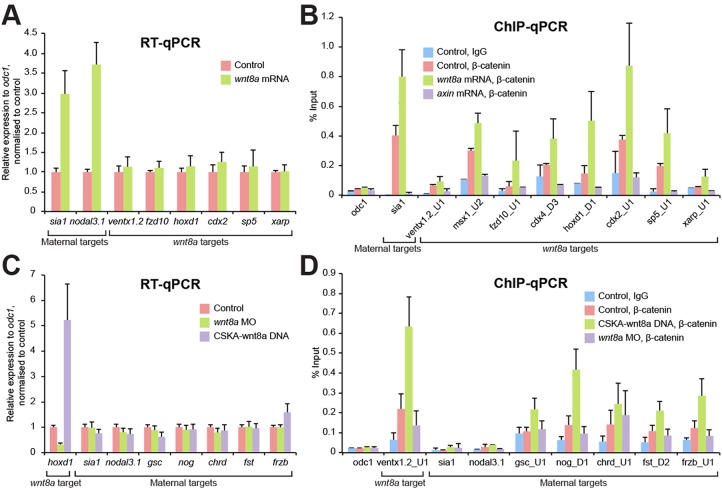
β-catenin recruitment is not sufficient for transcriptional regulation. (A,B) Maternally activated Wnt/β-catenin signalling regulates transcription of only context-specific maternal Wnt/β-catenin target genes. Experimental enhancement of maternal Wnt signalling, by injection of wnt8a mRNA at the two- to four-cell stage, increases expression of the maternal Wnt targets sia1 and nodal3.1 when analysed at the MBT, compared with the uninjected control (A). By contrast, expression levels of wnt8a target genes remain unchanged. However, β-catenin binding increases at both maternal Wnt target and zygotic wnt8a-regulated target loci at the 1000-cell stage (B). Note that the reduction of β-catenin binding following injection of axin mRNA indicates that maternally regulated endogenous β-catenin associates with not only maternal Wnt target genes but also zygotic wnt8a target genes. (C,D) Zygotically activated β-catenin controls the expression of only zygotic wnt8a targets. wnt8a MO or CSKA-wnt8a DNA were injected at the two- to four-cell stage and gene expression and β-catenin binding were analysed at the early gastrula stage. Knockdown of wnt8a reduces, and zygotic activation of Wnt8a signalling increases, expression of the wnt8a target hoxd1, as a control. Whereas wnt8a knockdown or overexpression does not affect the expression of maternal Wnt-regulated genes (C), overactivation of Wnt8a signalling increases β-catenin binding to some maternal Wnt-regulated loci (D) but not to the well-characterised direct maternal Wnt target genes sia1 and nodal3.1. Error bars indicate s.d. and s.e.m. of three biological replicates for RT-qPCR and ChIP-qPCR, respectively.
Fig. 5.
Fig. 5.
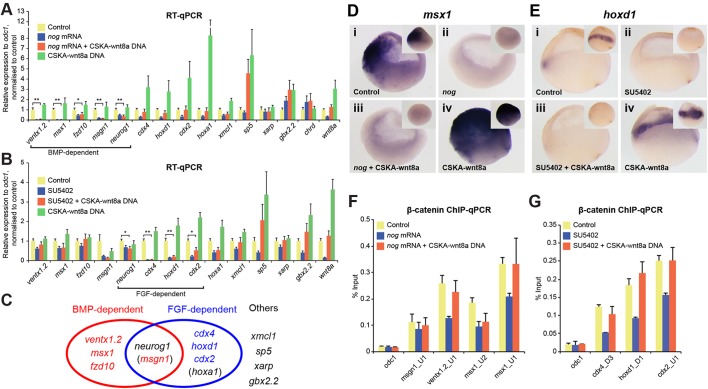
BMP or FGF signalling is required for wnt8a target gene expression but not for β-catenin recruitment. (A) BMP signalling is required for context-specific transcriptional regulation by Wnt8a signalling, but only of some wnt8a target genes. Two- to four-cell stage embryos were injected with BMP antagonist noggin (nog) mRNA. CSKA-wnt8a DNA was injected additionally to reinstate Wnt8a expression (as endogenous wnt8a expression is itself regulated by BMP signalling). Expression was analysed by RT-qPCR at the early gastrula stage. When BMP signalling is blocked, expression of BMP-dependent genes remains reduced even when Wnt8a expression is reinstated. (B) FGF signalling is required for context-specific transcriptional regulation by Wnt8a signalling, but only of some wnt8a target genes. Embryos were treated with the FGFR inhibitor SU5402 from the 1000/2000-cell stage through the early gastrula and injected where indicated with CSKA-wnt8a DNA at the two- to four-cell stages (to reinstate Wnt8a expression, as endogenous wnt8a expression is itself regulated by FGF signalling). When FGF signalling is inhibited, expression of FGF-dependent genes remains reduced, even when Wnt8a expression is reinstated. (C) wnt8a targets can therefore be classified into BMP-dependent or FGF-dependent genes. Note that some genes belong to both groups and others are neither BMP nor FGF dependent. (D,E) In situ hybridisation shows expression of msx1 (D) and hoxd1 (E) in sagittal sections and lateral views (insets) of control uninjected and experimentally manipulated embryos as indicated (dorsal to the right). (F) BMP signalling is not required for wnt8a-regulated β-catenin recruitment to BMP-dependent wnt8a target gene loci. Embryos were treated as in A and analysed by β-catenin ChIP-qPCR at the early gastrula stage. (G) FGF signalling is not essential for wnt8a-regulated β-catenin recruitment to FGF-dependent wnt8a target gene loci. Embryos were treated as in B and analysed by β-catenin ChIP-qPCR at the early gastrula stage. Uninjected, untreated embryos were used as controls in A,B,D-G. *P<0.1, **P<0.05; two-tailed Student's t-test. Error bars represent s.d. of four biological replicates (A,B) or s.e.m. of three biological replicates (F,G). Note that wnt8a gene expression itself was decreased by BMP or FGF pathway inhibition (wnt8a blue bars in A,B) but restored by co-injection of CSKA-wnt8a DNA (wnt8a orange bars in A,B) compared with controls (wnt8a yellow bars in A,B), and that higher wnt8a expression levels with CSKA-wnt8a DNA (wnt8a green bars in A,B) reflect both expression of endogenous wnt8a and expression from CSKA-wnt8a DNA, resulting in upregulation of several wnt8a target genes (in A,B).
Fig. 6.
Fig. 6.
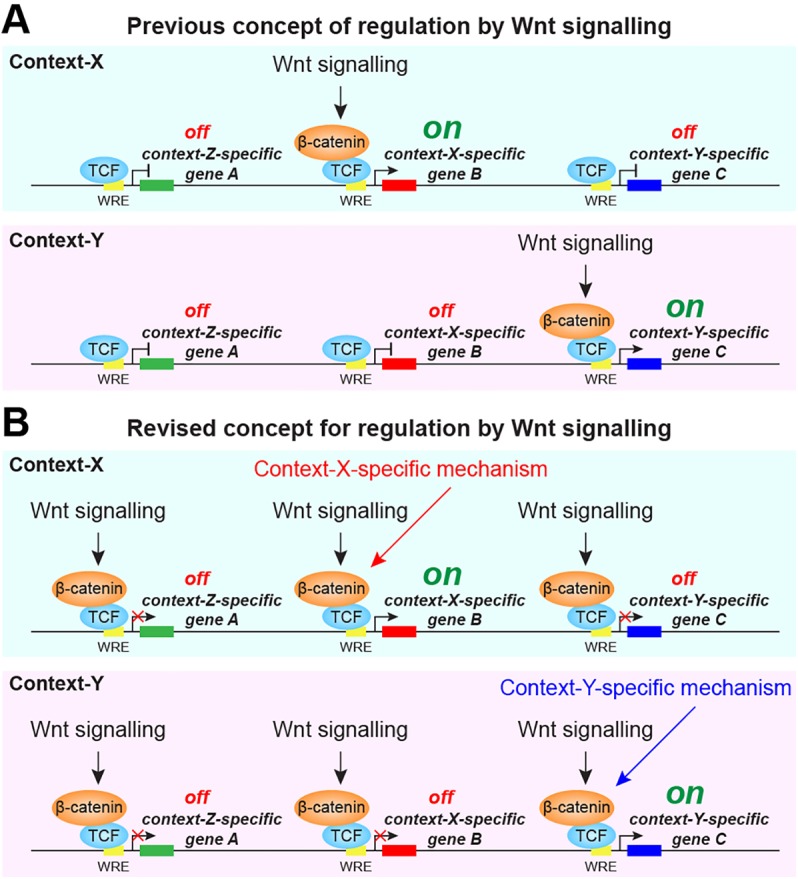
Model for context-specific Wnt/β-catenin target gene regulation. (A) In the previous concept established from studies of individual genes, Wnt signalling specifically controls β-catenin recruitment to the Wnt-response element (WRE) of context-specific target genes and leads to their transcription (e.g. gene B in the context-X). (B) In the revised concept from our studies, Wnt-regulated β-catenin recruitment takes place at numerous loci. Transcriptional activation at those loci is conditional on context-specific mechanisms (e.g. a context-X-specific mechanism for gene B in context-X).

References

    1. Abu-Remaileh M., Gerson A., Farago M., Nathan G., Alkalay I., Zins Rousso S., Gur M., Fainsod A. and Bergman Y. (2010). Oct-3/4 regulates stem cell identity and cell fate decisions by modulating Wnt/β-catenin signalling. EMBO J. 29, 3236-3248. 10.1038/emboj.2010.200 - DOI - PMC - PubMed
    1. Akkers R. C., van Heeringen S. J., Jacobi U. G., Janssen-Megens E. M., Françoijs K.-J., Stunnenberg H. G. and Veenstra G. J. C. (2009). A hierarchy of H3K4me3 and H3K27me3 acquisition in spatial gene regulation in Xenopus embryos. Dev. Cell 17, 425-434. 10.1016/j.devcel.2009.08.005 - DOI - PMC - PubMed
    1. Akkers R. C., Jacobi U. G. and Veenstra G. J. C. (2012). Chromatin immunoprecipitation analysis of Xenopus embryos. Methods Mol. Biol. 917, 279-292. 10.1007/978-1-61779-992-1_17 - DOI - PubMed
    1. Anders S. and Huber W. (2010). Differential expression analysis for sequence count data. Genome Biol. 11, R106 10.1186/gb-2010-11-10-r106 - DOI - PMC - PubMed
    1. Anders S., Pyl P. T. and Huber W. (2015). HTSeq – a Python framework to work with high-throughput sequencing data. Bioinformatics 31, 166-169. 10.1093/bioinformatics/btu638 - DOI - PMC - PubMed

Publication types

MeSH terms