. 2016 May 5;371(1693):20150376.
doi: 10.1098/rstb.2015.0376.

The role of the basolateral amygdala in the perception of faces in natural contexts

Affiliations

The role of the basolateral amygdala in the perception of faces in natural contexts

Ruud Hortensius et al. Philos Trans R Soc Lond B Biol Sci. .

Abstract

The amygdala is a complex structure that plays its role in perception and threat-related behaviour by activity of its specific nuclei and their separate networks. In the present functional magnetic resonance imaging study, we investigated the role of the basolateral amygdala in face and context processing. Five individuals with focal basolateral amygdala damage and 12 matched controls viewed fearful or neutral faces in a threatening or neutral context. We tested the hypothesis that basolateral amygdala damage modifies the relation between face and threatening context, triggering threat-related activation in the dorsal stream. The findings supported this hypothesis. First, activation was increased in the right precentral gyrus for threatening versus neutral scenes in the basolateral amygdala damage group compared with the control group. Second, activity in the bilateral middle frontal gyrus, and left anterior inferior parietal lobule was enhanced for neutral faces presented in a threatening versus neutral scene in the group with basolateral amygdala damage compared with controls. These findings provide the first evidence for the neural consequences of basolateral amygdala damage during the processing of complex emotional situations.

Keywords: Urbach–Wiethe disease; amygdala; basolateral amygdala; emotion; face perception; threat.


Figures

Figure 1.
Figure 1.
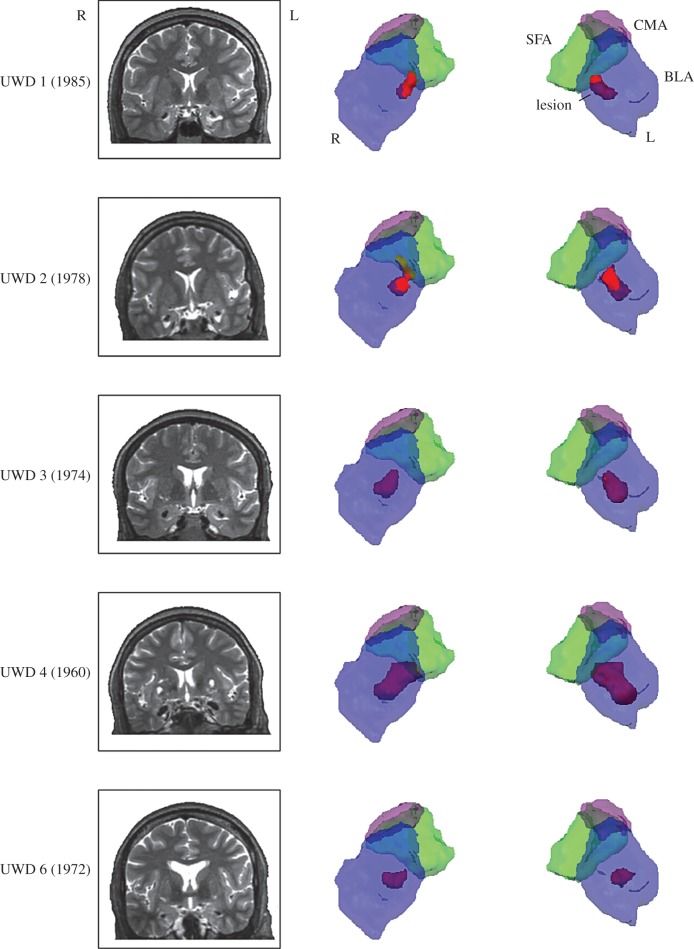
Location and size of the BLA damage. Coronal view of T2-weighted magnetic resonance images (left) and three-dimensional reconstruction (right) of the lesion for the five UWD participants with birth year indicated.
Figure 2.
Figure 2.
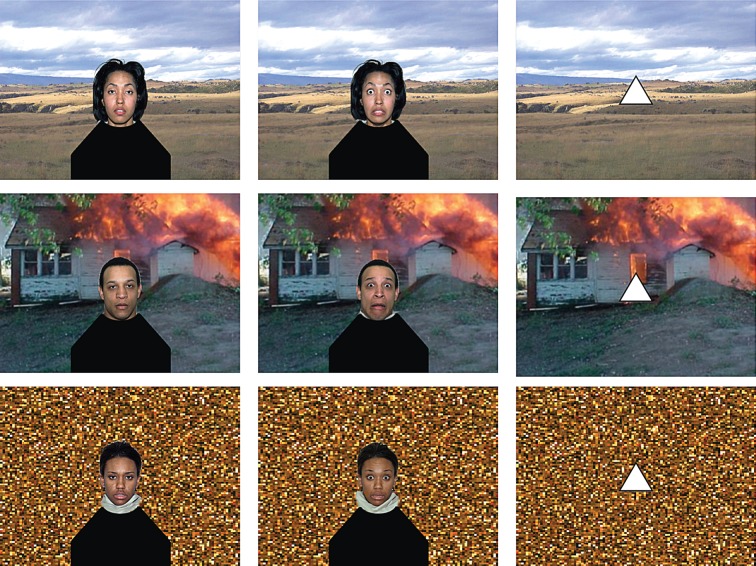
Examples of the stimuli. Neutral (first column) or fearful faces (second column) or control shapes (third column) were presented on a neutral (first row), threatening (second row) or scrambled (third row) background.
Figure 3.
Figure 3.
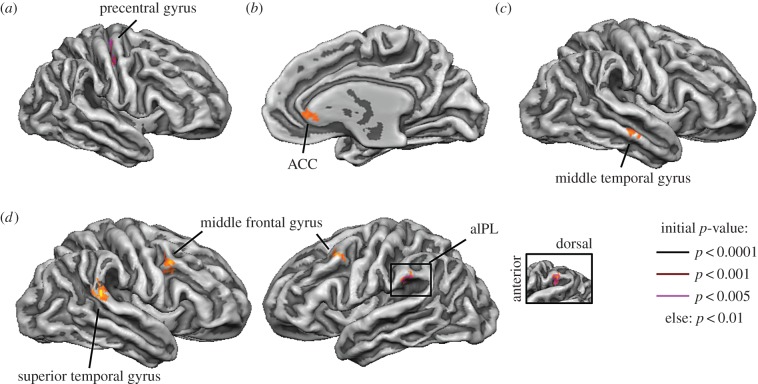
Basolateral amygdala damage and neural activation during contextual emotional face processing. UWDs compared with controls showed increased activation in the right precentral gyrus for threatening versus neutral scenes (a). UWDs in contrast with controls showed increased activation in the right ACC for fearful versus neutral faces (b), the middle temporal gyrus for fearful faces presented in a neutral compared with a threatening scene (c), and the right superior temporal gyrus, left aIPL and the bilateral middle frontal gyrus for neutral faces presented in a threatening compared with a neutral scene (d). Inset shows the location of the IPL cluster. All activations are cluster-size corrected and lines denote if clusters survive a more stringent initial single voxel threshold.

References

    1. de Gelder B, Meeren HKM, Righart R, Van den Stock J, van de Riet WAC, Tamietto M. 2006. Beyond the face: exploring rapid influences of context on face processing. Prog. Brain Res. 155, 37–48. (10.1016/S0079-6123(06)55003-4) - DOI - PubMed
    1. Van den Stock J, Vandenbulcke M, Sinke CBA, de Gelder B. 2014. Affective scenes influence fear perception of individual body expressions. Hum. Brain Mapp. 35, 492–502. (10.1002/hbm.22195) - DOI - PMC - PubMed
    1. Righart R, de Gelder B. 2008. Rapid influence of emotional scenes on encoding of facial expressions: an ERP study. Soc. Cogn. Affect. Neurosci. 3, 270–278. (10.1093/scan/nsn021) - DOI - PMC - PubMed
    1. Kret ME, de Gelder B. 2010. Social context influences recognition of bodily expressions. Exp. Brain Res. 203, 169–180. (10.1007/s00221-010-2220-8) - DOI - PMC - PubMed
    1. Wieser MJ, Brosch T. 2012. Faces in context: a review and systematization of contextual influences on affective face processing. Front. Psychol. 3, 471 (10.3389/fpsyg.2012.00471) - DOI - PMC - PubMed

Publication types