


Outcomes of Noninvasive and Invasive Ventilation in Patients Hospitalized with Asthma Exacerbation
- PMID: 27070493
- PMCID: PMC5015747
- DOI: 10.1513/AnnalsATS.201510-701OC
Outcomes of Noninvasive and Invasive Ventilation in Patients Hospitalized with Asthma Exacerbation
Abstract
Rationale: Little is known about the effectiveness of noninvasive ventilation for patients hospitalized with asthma exacerbation.
Objectives: To assess clinical outcomes of noninvasive (NIV) and invasive mechanical ventilation (IMV) and examine predictors for NIV use in patients hospitalized with asthma.
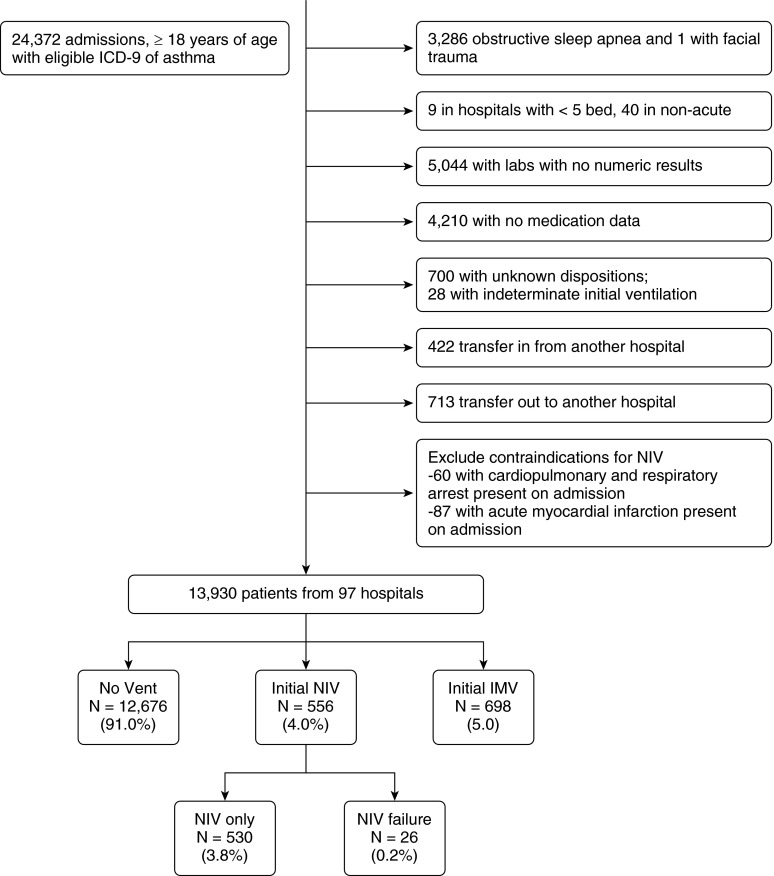
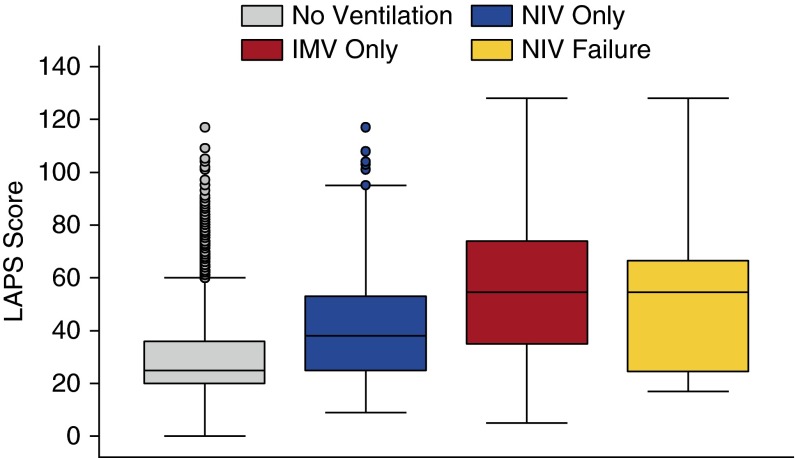
Methods: This was a retrospective cohort study at 97 U.S. hospitals using an electronic medical record database. We developed a hierarchical regression model to identify factors associated with the choice of initial ventilation and used the Laboratory Acute Physiological Score to adjust for differences in the severity of illness. We assessed the outcomes of patients treated with initial NIV or IMV in a propensity-matched cohort.
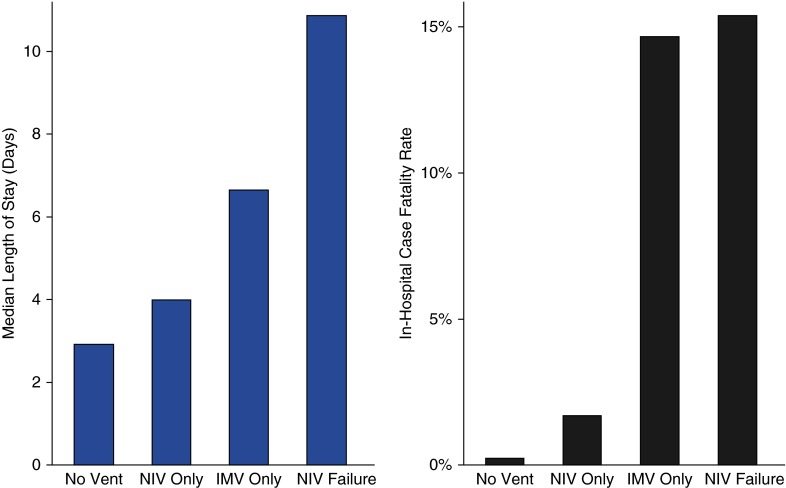
Measurements and main results: Among 13,930 subjects, 73% were women and 54% were white. The median age was 53 years. Overall, 1,254 patients (9%) required ventilatory support (NIV or IMV). NIV was the initial ventilation method for 556 patients (4.0%) and IMV for 668 (5.0%). Twenty-six patients (4.7% of patients treated with NIV) had to be intubated (NIV failure). The in-hospital mortality was 0.2, 2.3, 14.5, and 15.4%, and the median length of stay was 2.9, 4.1, 6.7, and 10.9 days among those not ventilated, ventilated with NIV, ventilated with IMV, and with NIV failure, respectively. Older patients were more likely to receive NIV (odds ratio, 1.06 per 5 yr; 95% confidence interval [CI], 1.01-1.11), whereas those with higher acuity (Laboratory Acute Physiological Score per 5 units: odds ratio, 0.85; 95% CI, 0.82-0.88) and those with concomitant pneumonia were less likely to receive NIV. In a propensity-matched sample, NIV was associated with a lower inpatient risk of dying (risk ratio, 0.12; 95% CI, 0.03-0.51) and shorter lengths of stay (4.3 d less; 95% CI, 2.9-5.8) than IMV.
Conclusions: Among patients hospitalized with asthma exacerbation and requiring ventilatory support (NIV or IMV), more than 40% received NIV. Although patients successfully treated with NIV appear to have better outcomes than those treated with IMV, the low rate of NIV failure suggests that NIV was being used selectively in a lower risk group. The increased risk of mortality for patients who fail NIV highlights the need for careful monitoring to avoid possible delay in intubation.
Keywords: electronic medical records; length of stay; mortality; outcomes research; respiratory insufficiency.
Figures
Comment in
-
Noninvasive Ventilation for Acute Asthma. "Spill-over" or "Lighted Windows"?Ann Am Thorac Soc. 2016 Jul;13(7):1005-7. doi: 10.1513/AnnalsATS.201604-279ED. Ann Am Thorac Soc. 2016. PMID: 27388399 No abstract available.
References
-
- National Hospital Ambulatory Medical Care survey: 2010 emergency summary tables. 2010 [accessed 2015 May 29]. Available from: http://www.cdc.gov/nchs/data/ahcd/nhamcs_emergency/2010_ed_web_tables.pdf
-
- McFadden ER., Jr. Acute severe asthma. Am J Respir Crit Care Med. 2003;168:740–759. - PubMed
-
- Pendergraft TB, Stanford RH, Beasley R, Stempel DA, Roberts C, McLaughlin T. Rates and characteristics of intensive care unit admissions and intubations among asthma-related hospitalizations. Ann Allergy Asthma Immunol. 2004;93:29–35. - PubMed
-
- Gupta D, Nath A, Agarwal R, Behera D. A prospective randomized controlled trial on the efficacy of noninvasive ventilation in severe acute asthma. Respir Care. 2010;55:536–543. - PubMed
-
- Shapiro JM. Intensive care management of status asthmaticus. Chest. 2001;120:1439–1441. - PubMed
Publication types
MeSH terms
Grants and funding
LinkOut - more resources
Full Text Sources
Other Literature Sources
Medical
