


The FoxO3 gene and cause-specific mortality
- PMID: 27071935
- PMCID: PMC4933667
- DOI: 10.1111/acel.12452
The FoxO3 gene and cause-specific mortality
Abstract
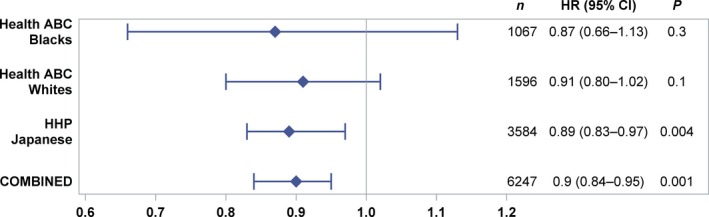
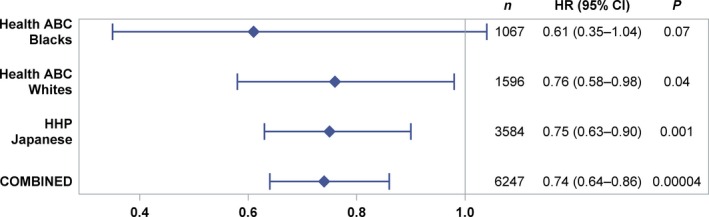
The G allele of the FOXO3 single nucleotide polymorphism (SNP) rs2802292 exhibits a consistently replicated genetic association with longevity in multiple populations worldwide. The aims of this study were to quantify the mortality risk for the longevity-associated genotype and to discover the particular cause(s) of death associated with this allele in older Americans of diverse ancestry. It involved a 17-year prospective cohort study of 3584 older American men of Japanese ancestry from the Honolulu Heart Program cohort, followed by a 17-year prospective replication study of 1595 white and 1056 black elderly individuals from the Health Aging and Body Composition cohort. The relation between FOXO3 genotype and cause-specific mortality was ascertained for major causes of death including coronary heart disease (CHD), cancer, and stroke. Age-adjusted and multivariable Cox proportional hazards models were used to compute hazard ratios (HRs) for all-cause and cause-specific mortality. We found G allele carriers had a combined (Japanese, white, and black populations) risk reduction of 10% for total (all-cause) mortality (HR = 0.90; 95% CI, 0.84-0.95; P = 0.001). This effect size was consistent across populations and mostly contributed by 26% lower risk for CHD death (HR = 0.74; 95% CI, 0.64-0.86; P = 0.00004). No other causes of death made a significant contribution to the survival advantage for G allele carriers. In conclusion, at older age, there is a large risk reduction in mortality for G allele carriers, mostly due to lower CHD mortality. The findings support further research on FOXO3 and FoxO3 protein as potential targets for therapeutic intervention in aging-related diseases, particularly cardiovascular disease.
Keywords: FOXO3; heart disease; longevity; mortality.
© 2016 The Authors. Aging Cell published by the Anatomical Society and John Wiley & Sons Ltd.
Figures
References
-
- Blagosklonny MV (2010) Revisiting the antagonistic pleiotropy theory of aging: TOR‐driven program and quasi‐program. Cell Cycle 9, 3151–3156. - PubMed
-
- Broer L, Buchman AS, Deelen J, Evans DS, Faul JD, Lunetta KL, Sebastiani P, Smith JA, Smith AV, Tanaka T, Yu L, Arnold AM, Aspelund T, Benjamin EJ, De Jager PL, Eirkisdottir G, Evans DA, Garcia ME, Hofman A, Kaplan RC, Kardia SL, Kiel DP, Oostra BA, Orwoll ES, Parimi N, Psaty BM, Rivadeneira F, Rotter JI, Seshadri S, Singleton A, Tiemeier H, Uitterlinden AG, Zhao W, Bandinelli S, Bennett DA, Ferrucci L, Gudnason V, Harris TB, Karasik D, Launer LJ, Perls TT, Slagboom PE, Tranah GJ, Weir DR, Newman AB, van Duijn CM, Murabito JM (2015) GWAS of longevity in CHARGE consortium confirms APOE and FOXO3 candidacy. J. Gerontol. A Biol. Sci. Med. Sci. 70, 110–118. - PMC - PubMed
-
- Database of Single Nucleotide Polymorphisms (dbSNP). Bethesda (MD): National Center for Biotechnology Information, National Library of Medicine. dbSNP accession on 2/9/2016:{rs2802292}, (dbSNP Build ID: {100/146). Available from: http://www.ncbi.nlm.nih.gov/SNP/.
MeSH terms
Substances
Grants and funding
- N01 AG062101/AG/NIA NIH HHS/United States
- U19 AG023122/AG/NIA NIH HHS/United States
- P20 GM103466/GM/NIGMS NIH HHS/United States
- N01 AG062106/AG/NIA NIH HHS/United States
- R01 AG038707/AG/NIA NIH HHS/United States
- N01 AG042149/AG/NIA NIH HHS/United States
- P20 GM103457/GM/NIGMS NIH HHS/United States
- N01 HC005102/HC/NHLBI NIH HHS/United States
- P30 AG024827/AG/NIA NIH HHS/United States
- U01 AG019349/AG/NIA NIH HHS/United States
- R01 AG032098/AG/NIA NIH HHS/United States
- N01 AG062103/AG/NIA NIH HHS/United States
- R01 AG027060/AG/NIA NIH HHS/United States
- HHSN268200782096C/HG/NHGRI NIH HHS/United States
- U24 AG051129/AG/NIA NIH HHS/United States
LinkOut - more resources
Full Text Sources
Other Literature Sources
Research Materials
