Review
. 2016;16(25):2753-64.
doi: 10.2174/1568026616666160413141911.

Heat Shock Protein (HSP) Drug Discovery and Development: Targeting Heat Shock Proteins in Disease

Affiliations
Review

Heat Shock Protein (HSP) Drug Discovery and Development: Targeting Heat Shock Proteins in Disease

Liza Shrestha et al. Curr Top Med Chem. 2016.

Abstract

Heat shock proteins (HSPs) present as a double edged sword. While they play an important role in maintaining protein homeostasis in a normal cell, cancer cells have evolved to co-opt HSP function to promote their own survival. As a result, HSPs such as HSP90 have attracted a great deal of interest as a potential anticancer target. These efforts have resulted in over 20 distinct compounds entering clinical evaluation for the treatment of cancer. However, despite the potent anticancer activity demonstrated in preclinical models, to date no HSP90 inhibitor has obtained regulatory approval. In this review we discuss the unique challenges faced in targeting HSPs that have likely contributed to their lack of progress in the clinic and suggest ways to overcome these so that the enormous potential of these compounds to benefit patients can finally be realized. We also provide a guideline for the future development of HSP-targeted agents based on the many lessons learned during the last two decades in developing HSP90 inhibitors.


Figures
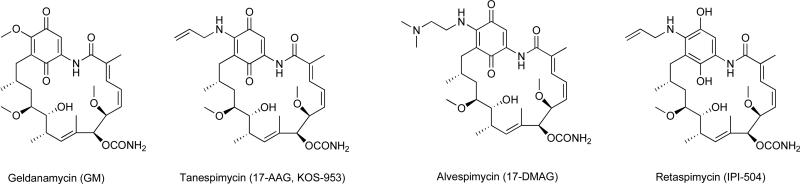
Fig. 1
Fig. 1. Geldanamycin derivatives as HSP90 inhibitors
Represented here are the chemical structures of inhibitors that are based on the benzoquinone ansamycin antibiotic geldanamycin. These inhibitors bind to the nucleotide-binding pocket situated at the N-terminal domain of HSP90.
Fig. 2
Fig. 2. Resorcinol derivatives as Hsp90 inhibitors
Represented here are the chemical structures of compounds consisting of a common resorcinol core. This series of compounds bind to the nucleotide-binding pocket situated at the N-terminal domain of HSP90.
Fig. 3
Fig. 3. Purine derivatives as Hsp90 inhibitors
Represented here are the chemical structures of HSP90 inhibitors that are based on the purine scaffold. These inhibitors target the nucleotide-binding pocket situated at the N-terminal domain of HSP90.
Fig. 4
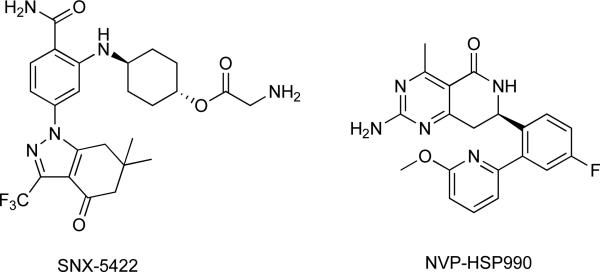
Fig. 4. Hsp90 inhibitors
Both compounds represented here were discovered via lead optimization of hits obtained from HTS screening.
Fig. 5
Fig. 5. Hsp90 inhibitors that exhibit alternative modes of action
These inhibitors are reported to interact with the C-terminal binding domain of HSP90 and/or disrupt HSP90-cochaperone interaction.

References

    1. Kim YE, Hipp MS, Bracher A, Hayer-Hartl M, Hartl FU. Molecular chaperone functions in protein folding and proteostasis. Annu. Rev. Biochem. 2013;82:323–355. - PubMed
    1. Saibil H. Chaperone machines for protein folding, unfolding and disaggregation. Nat. Rev. Cancer. 2013;13:630–642. - PMC - PubMed
    1. Hartl FU, Bracher A, Hayer-Hartl M. Molecular chaperones in protein folding and proteostasis. Nature. 2011;475:324–332. - PubMed
    1. Miyata Y, Nakamoto H, Neckers L. The therapeutic target Hsp90 and cancer hallmarks. Curr. Pharm. Des. 2013;19:347–365. - PMC - PubMed
    1. Mahalingam D, Swords R, Carew JS, Nawrocki ST, Bhalla K, Giles FJ. Targeting HSP90 for cancer therapy. Br. J. Cancer. 2009;100:1523–1529. - PMC - PubMed

MeSH terms

LinkOut - more resources