


Effect of retro and forward walking on quadriceps muscle strength, pain, function, and mobility in patients with knee osteoarthritis: a protocol for a randomized controlled trial
- PMID: 27072798
- PMCID: PMC4830006
- DOI: 10.1186/s12891-016-1021-z
Effect of retro and forward walking on quadriceps muscle strength, pain, function, and mobility in patients with knee osteoarthritis: a protocol for a randomized controlled trial
Abstract
Background: Walking, a closed kinetic chain (CKC) activity, is widely used in knee rehabilitation as it allows early weight bearing and movement. It has been suggested that retro-walking may provide additional benefits beyond those experienced by forward-walking. The present study will investigate the effect of retro- and forward-walking on quadriceps muscle strength, pain, function, balance and mobility in knee Osteoarthritis (OA) subjects.
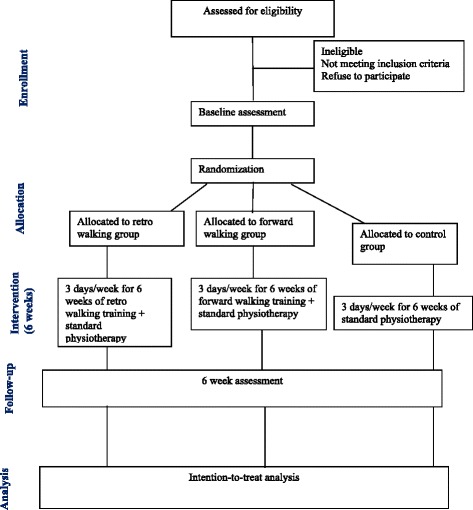
Methods/design: Sixty-nine participants with knee OA will be recruited from the outpatient department in this randomized controlled trial. The participants will be randomly assigned to one of three groups; retro walking, forward walking or control group. The training program will be 3 days/week for 6 weeks. In addition, all the participants will receive a standard physiotherapy training program. An independent assessor blinded to group assignment will measure quadriceps muscle strength, knee pain intensity, functional disability, and mobility at baseline and 6 weeks after training.
Discussion: The results of this study will enhance our understanding on the therapeutic effects of walking (retro- or forward-walking) in knee OA. The findings from this study will help determine whether retro- or forward-walking or both are effective in the rehabilitation of subjects with knee OA.
Trial registration: Controlled Trials ISRCTN12850845, Registered 26 January 2015.
Keywords: Exercise; Knee; Osteoarthritis; Walking.
Figures
References
-
- Burckhardt CS. Chronic pain. Nurs Clin North Am. 1990;25:863–70. - PubMed
Publication types
MeSH terms
Associated data
LinkOut - more resources
Full Text Sources
Other Literature Sources
Medical
