


Dietary mineral intake and lung cancer risk: the Rotterdam Study
- PMID: 27073037
- PMCID: PMC5486639
- DOI: 10.1007/s00394-016-1210-4
Dietary mineral intake and lung cancer risk: the Rotterdam Study
Abstract
Objective: Limited data are available on the role of mineral intake in the development of lung cancer (LC). We investigated whether dietary calcium, copper, iron, magnesium, selenium and zinc intake were associated with LC risk.
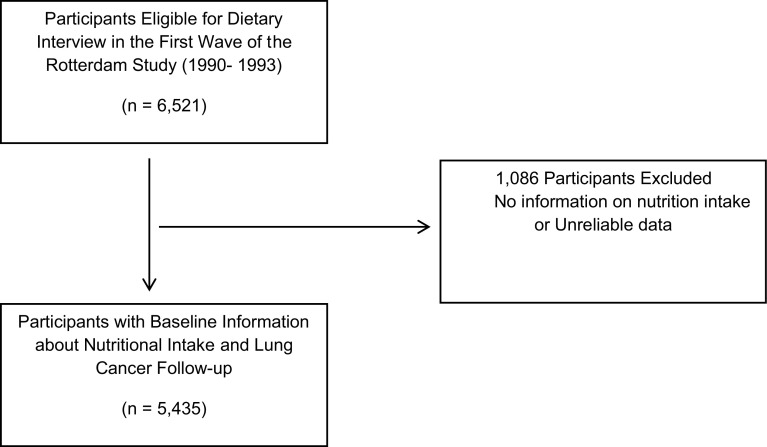
Methods: We analyzed data from 5435 participants of the Rotterdam Study, a prospective population-based cohort study among subjects aged 55 years and older. At baseline (1990-1993), diet was measured by a validated food frequency questionnaire. LC events were diagnosed on the basis of pathology data and medical records. Hazard ratios (HRs) on LC for energy-adjusted mineral intake were calculated using Cox regression models while adjusting for potential confounders.
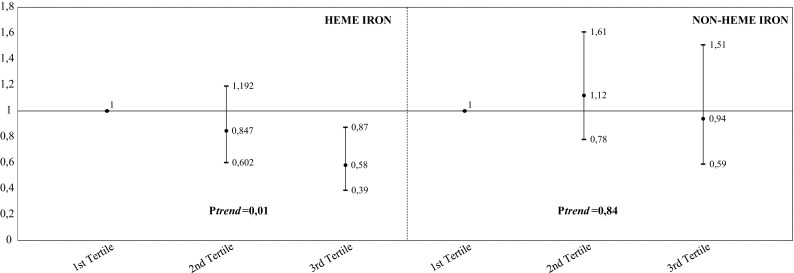
Results: During a follow-up period of 22 years, we identified 211 incident cases of LC. A higher zinc intake was associated with 42 % reduction in risk of LC (top tertile vs. first tertile: HR 0.58, 95 % CI 0.35; 0.94, P-for trend = 0.039). Similarly, high intake of iron was associated with reduced risk of LC (top tertile vs. first tertile: HR 0.58, 95 % CI 0.37; 0.92, P-for trend = 0.021). There was no association between dietary intake of calcium, copper, magnesium and selenium and LC risk.
Conclusions: Our results suggest that dietary zinc and iron intake are associated with reduced risk of LC. No evidence was found for an association between calcium, copper, magnesium and selenium intake and LC risk.
Keywords: Calcium; Copper; Iron; Lung cancer; Magnesium; Selenium; Zinc.
Conflict of interest statement
All participants gave informed consent to participate in the study and to obtain information from treating physicians and pharmacies, separately. The Rotterdam Study has been approved by the medical ethics committee according to the Wet Bevolkingsonderzoek: ERGO (Population Study Act: Rotterdam Study), executed by the Ministry of Health, Welfare and Sports of the Netherlands.
Figures
References
-
- Muka T, Imo D, Jaspers L, Colpani V, Chaker L, van der Lee SJ, Mendis S, Chowdhury R, Bramer WM, Falla A, Pazoki R, Franco OH. The global impact of non-communicable diseases on healthcare spending and national income: a systematic review. Eur J Epidemiol. 2015;30(4):251–277. doi: 10.1007/s10654-014-9984-2. - DOI - PubMed
-
- Ohno M, Miura T, Furuichi M, Tominaga Y, Tsuchimoto D, Sakumi K, Nakabeppu Y. A genome-wide distribution of 8-oxoguanine correlates with the preferred regions for recombination and single nucleotide polymorphism in the human genome. Genome Res. 2006;16(5):567–575. doi: 10.1101/gr.4769606. - DOI - PMC - PubMed
MeSH terms
Substances
LinkOut - more resources
Full Text Sources
Other Literature Sources
Medical
