


Association of Ideal Cardiovascular Health With Vascular Brain Injury and Incident Dementia
- PMID: 27073239
- PMCID: PMC5006676
- DOI: 10.1161/STROKEAHA.115.012608
Association of Ideal Cardiovascular Health With Vascular Brain Injury and Incident Dementia
Abstract
Background and purpose: The American Heart Association developed the ideal cardiovascular health (CVH) index as a simple tool to promote CVH; yet, its association with brain atrophy and dementia remains unexamined.
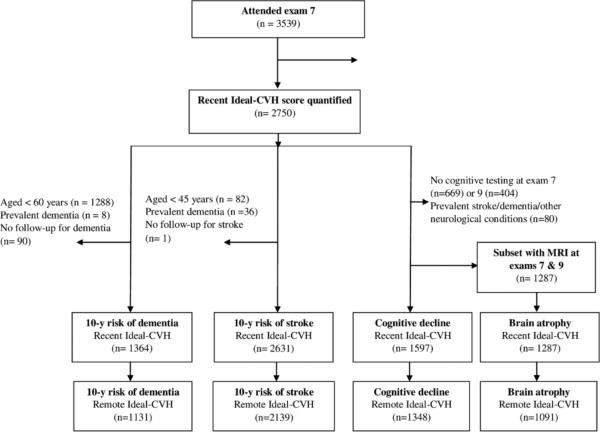
Methods: Our aim was to investigate the prospective association of ideal CVH with vascular brain injury, including the 10-year risks of incident stroke and dementia, as well as cognitive decline and brain atrophy on magnetic resonance imaging, measured for ≈7 years. We studied 2750 stroke- and dementia-free Framingham Heart Study Offspring cohort participants (mean age, 62±9 years; 45% men). Ideal CVH was quantified on a 7-point scale with 1 point awarded for each of the following: nonsmoking status, ideal body mass index, regular physical activity, healthy diet, as well as optimum blood pressure, cholesterol, and fasting blood glucose. Both recent (baseline) and remote (6.9 years earlier) ideal CVH scores were examined.
Results: Recent ideal CVH was associated with stroke (hazard ratio, 0.80; 95% confidence interval, 0.67-0.95), vascular dementia (hazard ratio, 0.49; 95% confidence interval, 0.30-0.81), frontal brain atrophy (P=0.003), and cognitive decline on tasks measuring visual memory and reasoning (P<0.05). In addition to predicting stroke, vascular dementia, whole-brain atrophy, and cognitive decline, remote ideal CVH was associated with the incidence of all-cause dementia (hazard ratio, 0.80; 95% confidence interval, 0.67-0.97) and Alzheimer disease (hazard ratio, 0.79; 95% confidence interval, 0.64-0.98).
Conclusions: Adherence to the American Heart Association's ideal CVH factors and behaviors, particularly in midlife, may protect against cerebrovascular disease and dementia.
Keywords: American Heart Association; brain; cerebrovascular disorders; epidemiology; risk factors.
© 2016 American Heart Association, Inc.
References
-
- Prince M, Bryce R, Albanese E, Wimo A, Ribeiro W, Ferri CP. The global prevalence of dementia: A systematic review and metaanalysis. Alzheimer's & Dementia: The Journal of the Alzheimer's Association. 2013;9:63–75. e2. - PubMed
-
- Alzhiemer's Associataion 2015 Alzheimer's disease facts and figures. Alzheimer's & Dementia: The Journal of the Alzheimer's Association. 2015;11:332–384. - PubMed
-
- Wolf PA, D'Agostino RB, Belanger AJ, Kannel WB. Probability of stroke: a risk profile from the Framingham Study. Stroke. 1991;22:312–8. - PubMed
Publication types
MeSH terms
Grants and funding
LinkOut - more resources
Full Text Sources
Other Literature Sources
Medical
