. 2016 Feb;11(2):345-51.
doi: 10.4103/1673-5374.177745.

Epalrestat protects against diabetic peripheral neuropathy by alleviating oxidative stress and inhibiting polyol pathway

Affiliations

Epalrestat protects against diabetic peripheral neuropathy by alleviating oxidative stress and inhibiting polyol pathway

Qing-Rong Li et al. Neural Regen Res. 2016 Feb.

Erratum in

Abstract

Epalrestat is a noncompetitive and reversible aldose reductase inhibitor used for the treatment of diabetic neuropathy. This study assumed that epalrestat had a protective effect on diabetic peripheral nerve injury by suppressing the expression of aldose reductase in peripheral nerves of diabetes mellitus rats. The high-fat and high-carbohydrate model rats were established by intraperitoneal injection of streptozotocin. Peripheral neuropathy occurred in these rats after sustaining high blood glucose for 8 weeks. At 12 weeks after streptozotocin injection, rats were intragastrically administered epalrestat 100 mg/kg daily for 6 weeks. Transmission electron microscope revealed that the injuries to myelinated nerve fibers, non-myelinated nerve fibers and Schwann cells of rat sciatic nerves had reduced compared to rats without epalrestat administuation. Western blot assay and immunohistochemical results demonstrated that after intervention with epalrestat, the activities of antioxidant enzymes such as superoxide dismutase, catalase and glutathione peroxidase gradually increased, but aldose reductase protein expression gradually diminished. Results confirmed that epalrestat could protect against diabetic peripheral neuropathy by relieving oxidative stress and suppressing the polyol pathway.

Keywords: NSFC grant; aldose reductase; aldose reductase inhibitor; antioxidant enzymes; catalase; diabetic neuropathy; glutathione peroxidase; nerve regeneration; neural regeneration; oxidative stress; peripheral nerve injury; polyol pathway; rats; reactive oxygen species; streptozotocin; superoxide dismutase.


Conflict of interest statement

Conflicts of interest: None declared.

Figures

Figure 1
Figure 1
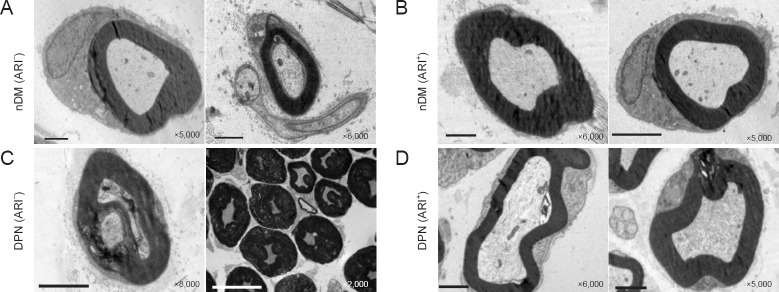
Effects of epalrestat, an ARI, on the ultrastructure of sciatic nerve cells in DM rats. Pathological changes at various stages of DM induced by streptozotocin. Sciatic nerves were analyzed using electron microscopy. (Scales: A, D: left and right, 2 μm; B: left 2 μm, right 5 μm; C: left 2 μm, right 10 μm). (A, B) The nDM (ARI) and nDM (ARI+) groups: myelinated nerve fiber layers are clear, myelin sheath structure is smooth, full, and complete without distorting variant form. Schwann cell membrane is intact; the nucleus is clearly visible and the nuclear membrane is unbroken. (C) DPN (ARI) group: myelin sheath cells become deranged in the medullated fibers of sciatic nerves; shrinkage, deformity and inhomogeneity can be observed in neurites. Structures of Schwann cells is blurred and vacuoles degenerated, but the integrity of cell membrane was not lost. Cells of non-myelinated nerves swelled, with the presence of irregular morphology and widened cellular spaces. Schwann cells have shrunk. (D) DPN (ARI+) group: pathological structures of neurites and myelin are significantly improved after treatment with epalrestat. Deranged myelin sheath cells recover and Schwann cell swelling is attenuated. DM: Diabetes mellitus; nDM: non-diabetes mellitus; DPN: diabetic peripheral neuropathy; ARI: aldose reductase inhibitor.
Figure 2
Figure 2
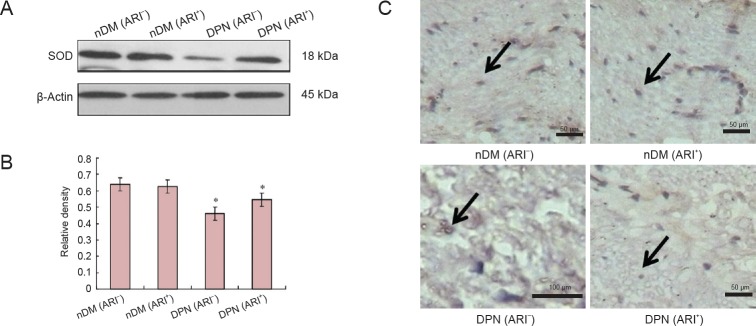
Effects of epalrestat, an ARI, on SOD activity in sciatic nerve of DM rats. (A) Western blot assay of SOD protein levels in sciatic nerves in nDM (ARI) group, nDM (ARI+) group, DPN (ARI) group and DPN (ARI+) group. (B) Relative density (SOD/β-actin gray Value) of SOD in nDM (ARI) group, nDM (ARI+) group, DPN (ARI) group and DPN (ARI+) group. Western blot assay showed that SOD protein levels were lower in the DPN (ARI) group than in the nDM (ARI) group. SOD protein levels were higher in the DPN (ARI+) group compared with DPN (ARI) group (*P < 0.05; data are expressed as the mean ± SEM, with five rats in each group, one-way analysis of variance and the least significant difference post hoc test were used). No significant difference in SOD protein levels was found between the nDM (ARI) and nDM (ARI+) groups (P > 0.05). (C) Pathological changes at various stages of DM induced by streptozotocin. Immunohistochemical results showed that SOD-positive signals were mainly expressed in the cytoplasm and cell membranes, particularly Schwann cell nucleus, Schwann cytoplasm and myelin sheath (× 40, arrows indicate the position of SOD-positive cells). DM: Diabetes mellitus; nDM: non-diabetes mellitus; DPN: diabetic peripheral neuropathy; ARI: aldose reductase inhibitor; SOD: superoxide dismutase.
Figure 3
Figure 3
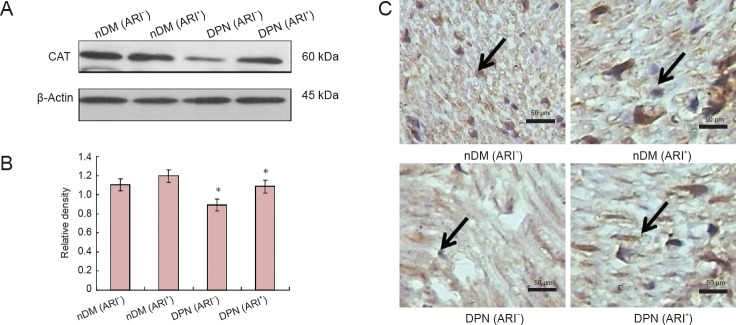
Effects of epalrestat, an ARI, on CAT activity in sciatic nerve of DM rats. (A) Western blot assay of CAT protein levels in sciatic nerves in nDM (ARI) group, nDM (ARI+) group, DPN (ARI) group and DPN (ARI+) group. (B) Relative density (CAT/β-actin gray value) of CAT in nDM (ARI) group, nDM (ARI+) group, DPN (ARI) group and DPN (ARI+) group. CAT activity was lower in the DPN (ARI) group compared with the nDM (ARI) group (P < 0.05). CAT protein levels were higher in the DPN (ARI+) group than in the DPN (ARI) group (*P < 0.05; data are expressed as the mean ± SEM, with five rats in each group, one-way analysis of variance and the least significant difference post hoc test). No significant difference in CAT activity was found between the nDM (ARI) and nDM (ARI+) groups (P > 0.05). (C) Pathological changes at various stages of DM induced by streptozotocin. Immunohistochemical results showed that CAT expressed in the cytoplasm and cell membranes, particularly Schwann cell nucleus, Schwann cytoplasm and myelin sheath (× 40, arrows indicate the position of CAT-positive cells). DM: Diabetes mellitus; nDM: non-diabetes mellitus; DPN: diabetic peripheral neuropathy; ARI: aldose reductase inhibitor; CAT: catalase.
Figure 4
Figure 4
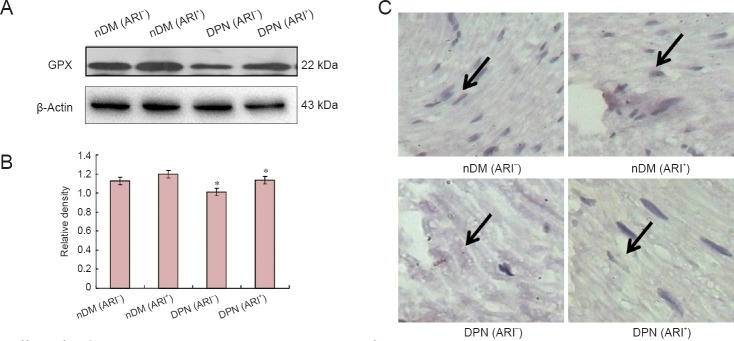
Effects of epalrestat, an ARI, on GPX activity in sciatic nerve of DM rats. (A) Western blot assay of GPX protein levels in sciatic nerves in nDM (ARI) group, nDM (ARI+) group, DPN (ARI) group and DPN (ARI+) group. (B) Relative density (gray value ratio of GPX/β-actin) of GPX in nDM (ARI) group, nDM (ARI+) group, DPN (ARI) group and DPN (ARI+) group. GPX activity was lower in DPN (ARI) group than in nDM (ARI) group (*P < 0.05; data are expressed as the mean ± SEM, with five rats in each group, one-way analysis of variance and the least significant difference post hoc test). GPX activity was higher in the DPN (ARI+) group than in the DPN (ARI) group (P < 0.05). There was no significant difference in GPX activity between the nDM (ARI) and nDM (ARI+) groups (P > 0.05). (C) Immunohistochemical results showed that GPX expressed in the cytoplasm and cell membranes, particularly Schwann cell nucleus, Schwann cytoplasm and myelin sheath (× 40; arrows indicated the position of the GPX-positive cells). DM: Diabetes mellitus; nDM: non-diabetes mellitus; DPN: diabetic peripheral neuropathy; ARI: aldose reductase inhibitor; GPX: glutathione peroxidase.
Figure 5
Figure 5
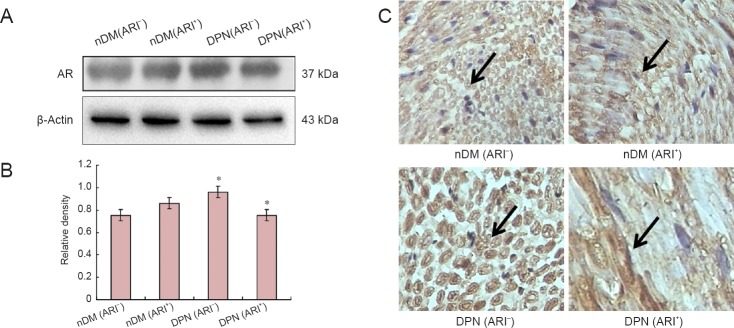
Effects of epalrestat, an ARI, on AR activity in sciatic nerve of DM rats. (A) Western blot assay of AR protein levels in sciatic nerves in the nDM (ARI) group, nDM (ARI+) group, DPN (ARI) group and DPN (ARI+) group. (B) Relative density (gray value ratio of AR/β-actin of AR in nDM (ARI) group, nDM (ARI+) group, DPN (ARI) group and DPN (ARI+) group. The protein levels of AR significantly increased in sciatic nerve of DM rats in the DPN (ARI) group (*P < 0.05; data are expressed as the mean ± SEM, with five rats in each group, one-way analysis of variance and the least significant difference post hoc test). Protein levels of AR were lower in the DPN (ARI+) group than in the DPN (ARI) group (P < 0.05). There was no significant difference in protein levels of AR between the nDM (ARI) and nDM (ARI+) groups (P > 0.05). (C) AR immunostaining revealed an accumulation of AR protein in Schwann cells of sciatic nerve. AR expression was very low in the myelin sheath and axon (× 40; arrows indicate the position of AR-positive cells). DM: Diabetes mellitus; nDM: non-diabetes mellitus; DPN: diabetic peripheral neuropathy; ARI: aldose reductase inhibitor; AR: aldose reductase.

References

    1. Babizhayev MA, Strokov IA, Nosikov VV, Savel’yeva EL, Sitnikov VF, Yegor EY, Lankin VZ. The role of oxidative stress in diabetic neuropathy: generation of free radical species in the glycation reaction and gene polymorphisms encoding antioxidant enzymes to genetic susceptibility to diabetic neuropathy in population of type i diabetic patients. Cell Biochem Biophys. 2014;71:1425–1443. - PubMed
    1. Brownlee M. The pathobiology of diabetic complications: a unifying mechanism. Diabetes. 2005;54:1615–1625. - PubMed
    1. Chen K, Xu J, He H, Zhao L, Xiong J, Mo Z. Protective effect of silibinin on islet beta cells in C57BL/6J mice fed a highfat diet. Zhong Nan Da Xue Xue Bao Yi Xue Ban. 2015;40:165–170. - PubMed
    1. Colciago A, Negri-Cesi P, Celotti F. Pathogenesis of diabetic neuropathy-do hyperglycemia and aldose reductase inhibitors affect neuroactive steroid formation in the rat sciatic nerves? Exp Clin Endocrinol Diabetes. 2002;110:22–26. - PubMed
    1. Cui XP, Li BY, Gao HQ, Wei N, Wang WL, Lu M. Effects of grape seed proanthocyanidin extracts on peripheral nerves in streptozocin-induced diabetic rats. J Nutr Sci Vitaminol (Tokyo) 2008;54:321–328. - PubMed