Review
. 2016:2016:6067349.
doi: 10.1155/2016/6067349. Epub 2016 Mar 17.

Mitochondria in White, Brown, and Beige Adipocytes

Affiliations
Review

Mitochondria in White, Brown, and Beige Adipocytes

Miroslava Cedikova et al. Stem Cells Int. 2016.

Abstract

Mitochondria play a key role in energy metabolism in many tissues, including cardiac and skeletal muscle, brain, liver, and adipose tissue. Three types of adipose depots can be identified in mammals, commonly classified according to their colour appearance: the white (WAT), the brown (BAT), and the beige/brite/brown-like (bAT) adipose tissues. WAT is mainly involved in the storage and mobilization of energy and BAT is predominantly responsible for nonshivering thermogenesis. Recent data suggest that adipocyte mitochondria might play an important role in the development of obesity through defects in mitochondrial lipogenesis and lipolysis, regulation of adipocyte differentiation, apoptosis, production of oxygen radicals, efficiency of oxidative phosphorylation, and regulation of conversion of white adipocytes into brown-like adipocytes. This review summarizes the main characteristics of each adipose tissue subtype and describes morphological and functional modifications focusing on mitochondria and their activity in healthy and unhealthy adipocytes.


Figures
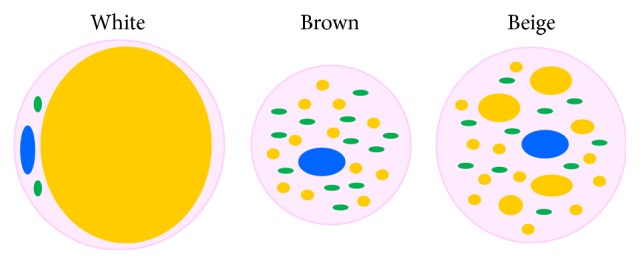
Figure 1
Figure 1
Main morphological characteristics of white, brown, and beige adipose tissues. White adipocyte cell is classically spherical, it is full of single lipid droplet, and it contains few mitochondria. Brown adipocyte is usually smaller than white and beige ones. It contains a large number of mitochondria and contains multiple small lipid droplets. Blue: nucleus, green: mitochondria, and yellow: lipid droplets.
Figure 2
Figure 2
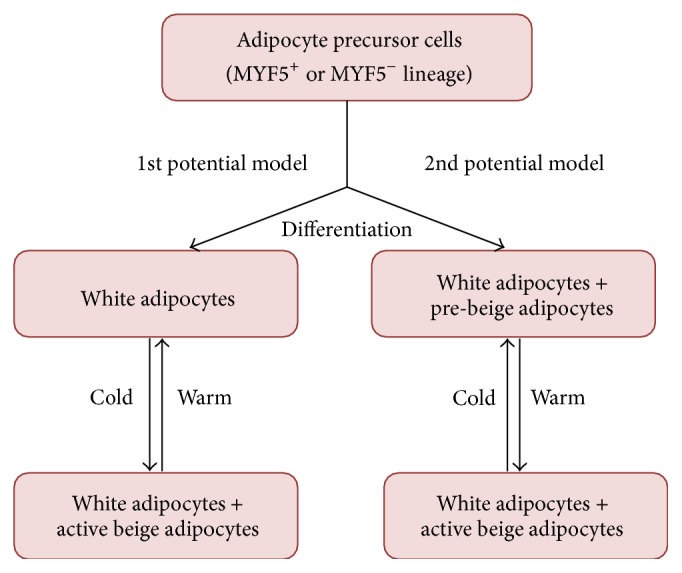
Two potential models of how WAT can be transformed into beige adipocytes [23, 25, 26].

References

    1. Castro A. V. B., Kolka C. M., Kim S. P., Bergman R. N. Obesity, insulin resistance and comorbidities—mechanisms of association. Arquivos Brasileiros de Endocrinologia e Metabologia. 2014;58(6):600–609. doi: 10.1590/0004-2730000003223. - DOI - PMC - PubMed
    1. Luna-Luna M., Medina-Urrutia A., Vargas-Alarcón G., Coss-Rovirosa F., Vargas-Barrón J., Pérez-Méndez Ó. Adipose tissue in metabolic syndrome: onset and progression of atherosclerosis. Archives of Medical Research. 2015;46(5):392–407. doi: 10.1016/j.arcmed.2015.05.007. - DOI - PubMed
    1. Mission J. F., Marshall N. E., Caughey A. B. Pregnancy risks associated with obesity. Obstetrics and Gynecology Clinics of North America. 2015;42(2):335–353. doi: 10.1016/j.ogc.2015.01.008. - DOI - PubMed
    1. Zimmet P., Alberti K. G. M. M., Shaw J. Global and societal implications of the diabetes epidemic. Nature. 2001;414(6865):782–787. doi: 10.1038/414782a. - DOI - PubMed
    1. Cai L., Lubitz J., Flegal K. M., Pamuk E. R. The predicted effects of chronic obesity in middle age on medicare costs and mortality. Medical Care. 2010;48(6):510–517. doi: 10.1097/mlr.0b013e3181dbdb20. - DOI - PubMed