. 2016 Apr;11(4):2635-2643.
doi: 10.3892/ol.2016.4274. Epub 2016 Feb 24.

CDH1 promoter methylation correlates with decreased gene expression and poor prognosis in patients with breast cancer

Affiliations

CDH1 promoter methylation correlates with decreased gene expression and poor prognosis in patients with breast cancer

Jian Liu et al. Oncol Lett. 2016 Apr.

Abstract

The E-cadherin gene (CDH1) is associated with poor prognosis and metastasis in patients with breast cancer, and methylation of its promoter is correlated with decreased gene expression. However, there is currently no direct evidence that CDH1 promoter methylation indicates poor prognosis in patients with breast cancer. In the present study, methylation-specific polymerase chain reaction (PCR) was applied to detect the methylation status of the CDH1 promoter in 137 primary breast cancer, 85 matched normal breast tissue and 13 lung metastasis specimens. Reverse transcription-quantitative PCR was used to assess the relative expression levels of CDH1 mRNA, and correlation analysis between CDH1 methylation status, and gene expression, clinicopathological characteristics and patient survival was performed. Methylation of CDH1 was identified in 40.9% (56/137) of primary breast cancer specimens, 61.5% (8/13) of lung metastasis specimens and none of the matched normal breast specimens. The downregulation of CDH1 mRNA and E-cadherin protein expression were identified to be significantly correlated with CDH1 methylation (P<0.05). In addition, CDH1 methylation was significantly associated with lymph node metastasis and estrogen receptor status of patients (P<0.05). In univariate analyses, patients with CDH1 methylation exhibited poor overall survival (OS) and disease-free survival (DFS; P<0.05). Furthermore, multivariate analyses revealed that CDH1 methylation was an independent prognostic factor predicting poor OS (HR, 1.737; 95% CI, 0.957-3.766; P=0.041) and DFS (HR, 2.018; 95% CI, 2.057-3.845; P=0.033) in patients with breast cancer. Therefore, the present study suggests that CDH1 promoter methylation may be correlated with breast carcinogenesis and indicates poor prognosis in patients with breast cancer.

Keywords: E-cadherin gene; breast cancer; lymph node metastasis; methylation; prognosis.


Figures
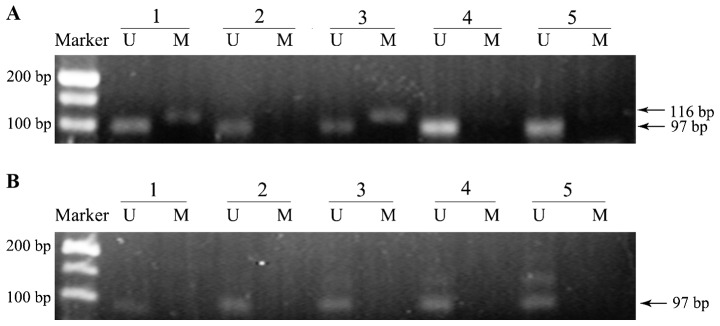
Figure 1.
Figure 1.
Representative example of methylation-specific polymerase chain reaction for E-cadherin gene promoter sequence in (A) breast cancer samples and (B) matched normal tissues samples. Lanes M and U correspond to specific amplification products for methylated (116 bp) and unmethylated (97 bp) alleles, respectively. Marker, DL500 DNA Marker. The presence of a methylated allele amplicon was used as standard for methylation positivity. Two of the five breast cancer samples exhibited promoter methylation and no methylation was observed in matched normal tissues.
Figure 2.
Figure 2.
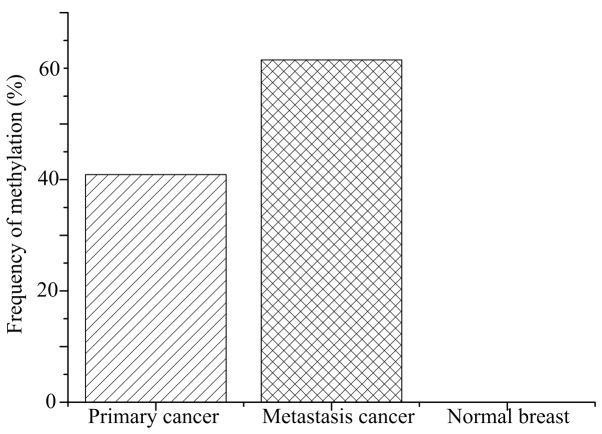
Frequency of E-cadherin gene methylation in primary breast cancer (40.9%), metastatic lung cancer (61.5%) and matched normal tissues (0%). The frequency of matched normal samples was decreased compared with the other groups (P<0.001; primary cancer vs. normal breast and metastasis cancer vs. normal breast), while no significant difference was identified between the primary and metastatic cancer groups (P=0.150; primary cancer vs. metastasis cancer).
Figure 3.
Figure 3.
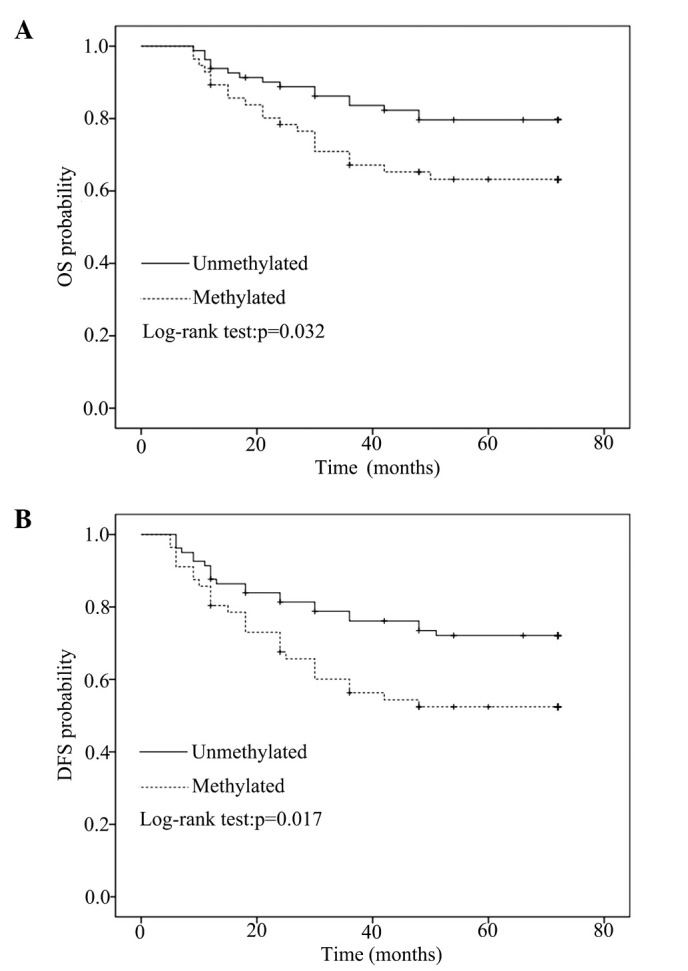
(A) OS (P=0.032) and (B) DFS (P=0.017) were analyzed by Kaplan-Meier survival analysis, according to the methylation status of the primary tumor. OS, overall survival; DFS, disease-free survival.
Figure 4.
Figure 4.
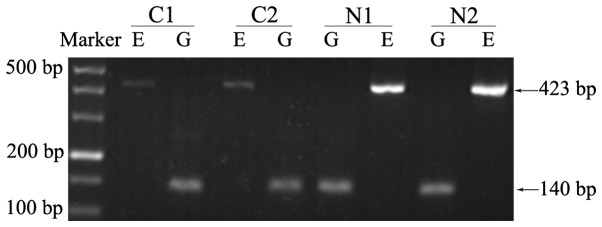
Reverse transcription-polymerase chain reaction analysis of E-cadherin gene mRNA levels in breast cancer samples and matched normal tissues. The normal tissues exhibited higher expression levels of CDH1 mRNA than the matched primary cancer tissues. E, CDH1 mRNA (423 bp); G, internal control GAPDH (140 bp); C, cancer sample; N, matched normal sample.
Figure 5.
Figure 5.
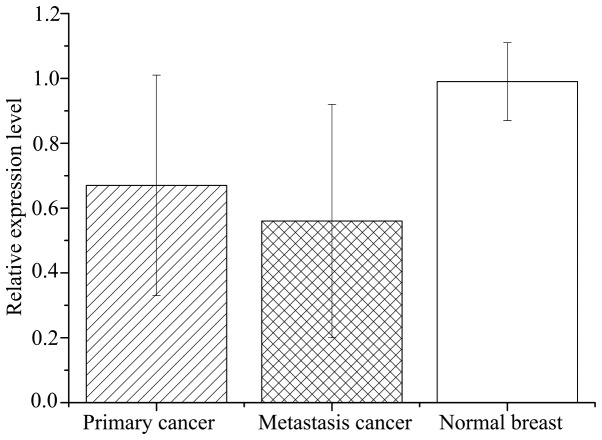
Relative expression level of E-cadherin gene (CDH1) mRNA was detected by reverse transcription-quantitative polymerase chain reaction analysis in primary breast cancer, lung metastatic cancer and matched normal breast tissue samples. The average expression level of CDH1 in normal breast tissue derived from patients with benign lesions was used as the control and the relative expression level was calculated as the ratio of the control. The bars and error bars represent the mean±standard deviation. The matched normal tissues exhibited higher expression (0.99±0.12) than the metastatic (0.56±0.36) and primary (0.67±0.34; P<0.001) cancer samples; however, no significant difference was observed between the primary and metastatic cancer (P>0.05). P<0.001, primary cancer vs. normal breast and metastasis cancer vs. normal breast.
Figure 6.
Figure 6.
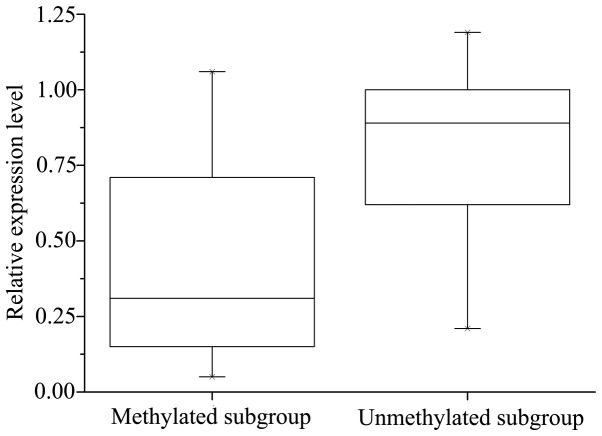
Relative expression level of E-cadherin gene messenger RNA in methylated and unmethylated breast cancer subgroup, according to reverse transcription-quantitative polymerase chain reaction. The data is presented as an interquartile range. The unmethylated subgroup exhibited higher expression level than the methylated subgroup (P=0.020). P=0.020, Methylated vs. Unmethylated subgroups.

References

    1. Jemal A, Bray F, Center MM, Ferlay J, Ward E, Forman D. Global cancer statistics. CA Cancer J Clin. 2011;61:69–90. doi: 10.3322/caac.20107. - DOI - PubMed
    1. Lorincz AT. Cancer diagnostic classifiers based on quantitative DNA methylation. Expert Rev Mol Diagn. 2014;14:293–305. doi: 10.1586/14737159.2014.897610. - DOI - PMC - PubMed
    1. Kanwal R, Gupta S. Epigenetics and cancer. J Appl Physiol (1985) 2010;109:598–605. doi: 10.1152/japplphysiol.00066.2010. - DOI - PMC - PubMed
    1. Huang Y, Nayak S, Jankowitz R, Davidson NE, Oesterreich S. Epigenetics in breast cancer: What's new? Breast Cancer Res. 2011;13:225. doi: 10.1186/bcr2925. - DOI - PMC - PubMed
    1. Spitzwieser M, Holzweber E, Pfeiler G, Hacker S, Cichna-Markl M. Applicability of HIN-1, MGMT and RASSF1A promoter methylation as biomarkers for detecting field cancerization in breast cancer. Breast Cancer Res. 2015;17:125. doi: 10.1186/s13058-015-0637-5. - DOI - PMC - PubMed