. 2016 Apr 13;11(4):e0147311.
doi: 10.1371/journal.pone.0147311. eCollection 2016.

Bayesian Estimation of Small Effects in Exercise and Sports Science

Affiliations

Bayesian Estimation of Small Effects in Exercise and Sports Science

Kerrie L Mengersen et al. PLoS One. .

Abstract

The aim of this paper is to provide a Bayesian formulation of the so-called magnitude-based inference approach to quantifying and interpreting effects, and in a case study example provide accurate probabilistic statements that correspond to the intended magnitude-based inferences. The model is described in the context of a published small-scale athlete study which employed a magnitude-based inference approach to compare the effect of two altitude training regimens (live high-train low (LHTL), and intermittent hypoxic exposure (IHE)) on running performance and blood measurements of elite triathletes. The posterior distributions, and corresponding point and interval estimates, for the parameters and associated effects and comparisons of interest, were estimated using Markov chain Monte Carlo simulations. The Bayesian analysis was shown to provide more direct probabilistic comparisons of treatments and able to identify small effects of interest. The approach avoided asymptotic assumptions and overcame issues such as multiple testing. Bayesian analysis of unscaled effects showed a probability of 0.96 that LHTL yields a substantially greater increase in hemoglobin mass than IHE, a 0.93 probability of a substantially greater improvement in running economy and a greater than 0.96 probability that both IHE and LHTL yield a substantially greater improvement in maximum blood lactate concentration compared to a Placebo. The conclusions are consistent with those obtained using a 'magnitude-based inference' approach that has been promoted in the field. The paper demonstrates that a fully Bayesian analysis is a simple and effective way of analysing small effects, providing a rich set of results that are straightforward to interpret in terms of probabilistic statements.


Conflict of interest statement

Competing Interests: The authors have declared that no competing interests exist.

Figures

Fig 1
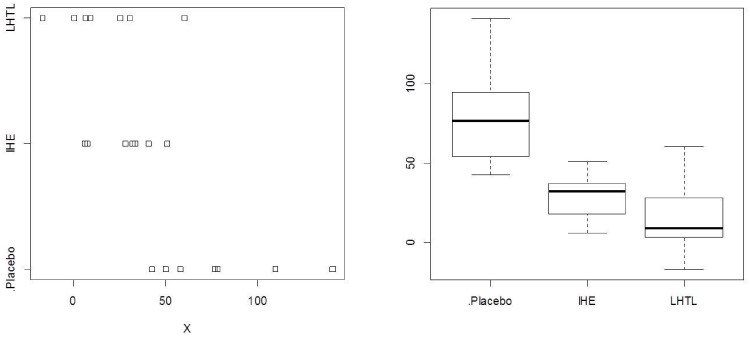
Fig 1. Exploratory analyses comprising stripcharts (left) and boxplots (right) for the covariate X in the three training regimens (Placebo, Intermittent Hypoxic Exposure (IHE), Live High Train Low (LHTL)), where X is a measure of the percent change in training load for each of the 23 individuals in the study.
(See text for details.).
Fig 2
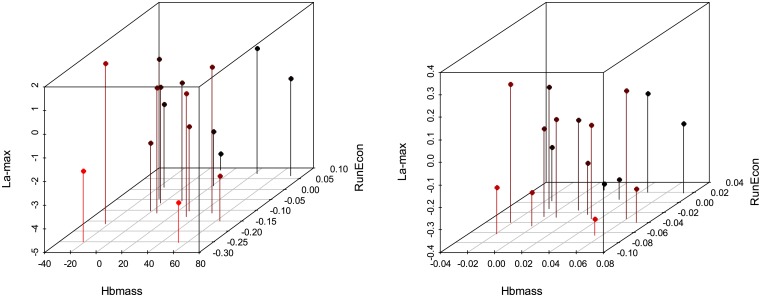
Fig 2. Three-dimensional scatterplot of the three measurements, Hemoglobin Mass (Hbmass), Running Economy (RunEcon) and maximum blood lactate concentration (La-max), unscaled data (left) and scaled data (right).
Unscaled data are calculated as posti−pre, and scaled data are calculated as (posti−prei) / prei.
Fig 3
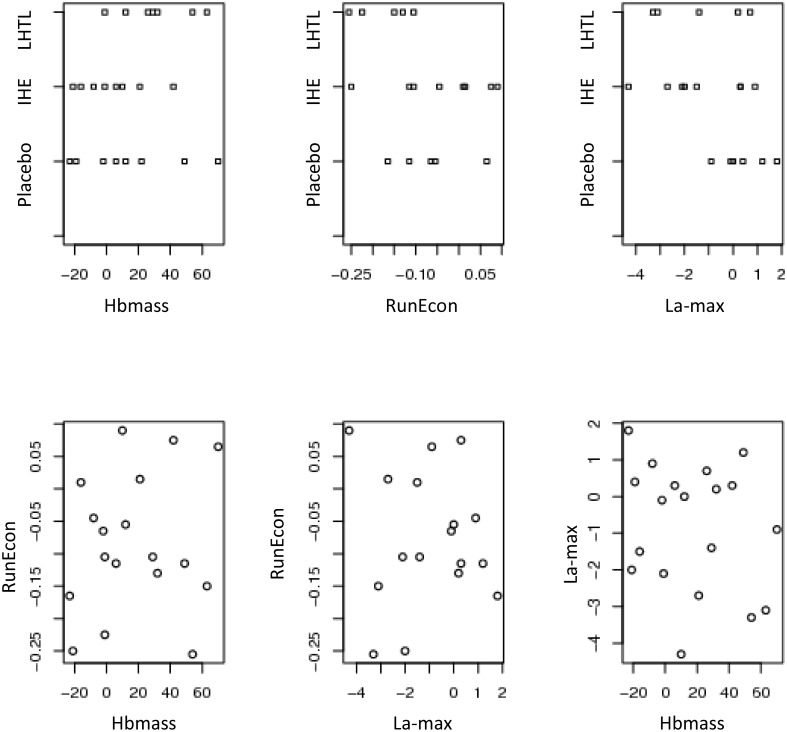
Fig 3. Two-dimensional scatterplots of the three measurements of Hbmass, RunEcon and La-max, under three regimes Placebo, Intermittent Hypoxic Exposure (IHE) and Live High Train Low (LHTL), unscaled data.
Fig 4
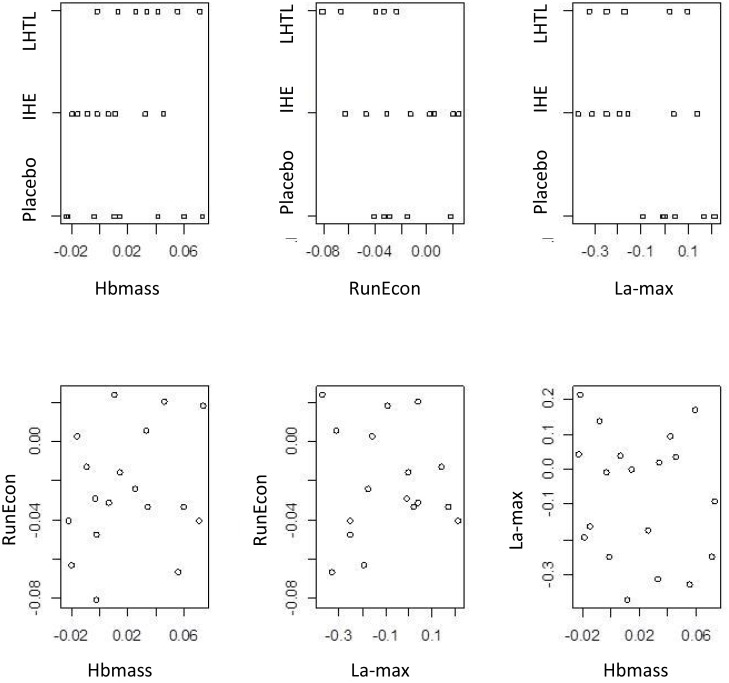
Fig 4. Two-dimensional scatterplots of the three measurements of Hbmass, RunEcon and La-max, under three regimes Placebo, Intermittent Hypoxic Exposure (IHE) and Live High Train Low (LHTL), scaled data.
Fig 5
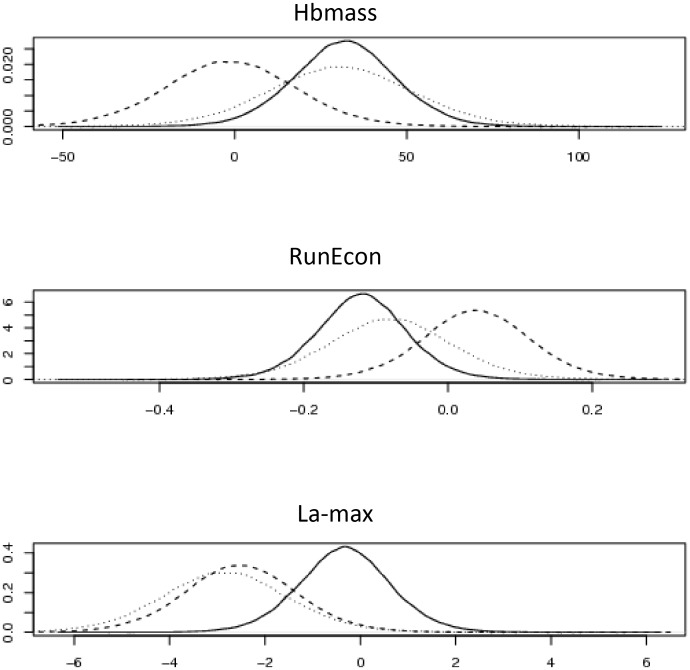
Fig 5. Posterior densities of the three measurements, Haemoglobin Mass, Running Economy and Running Maximum Lactate, comparing Live High Train Low (LHTL) vs Intermittent Hypoxic Exposure (IHE) (solid line), LHTL vs Placebo (dotted line) and IHE vs Placebo (dashed line), unscaled data.
Fig 6
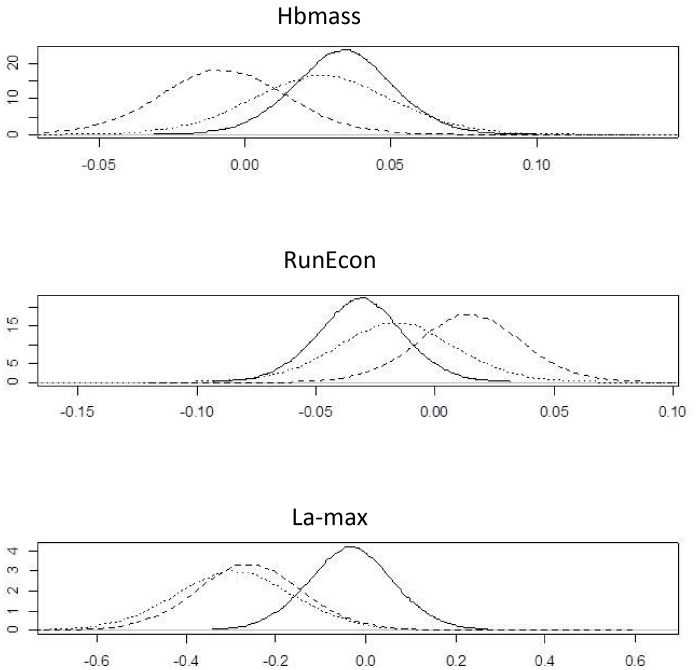
Fig 6. Posterior densities of the three measurements, Haemoglobin Mass, Running Economy and Running Maximum Lactate, comparing Live High Train Low (LHTL) vs Intermittent Hypoxic Exposure (IHE) (solid line), LHTL vs Placebo (dotted line) and IHE vs Placebo (dashed line), scaled data.
Fig 7
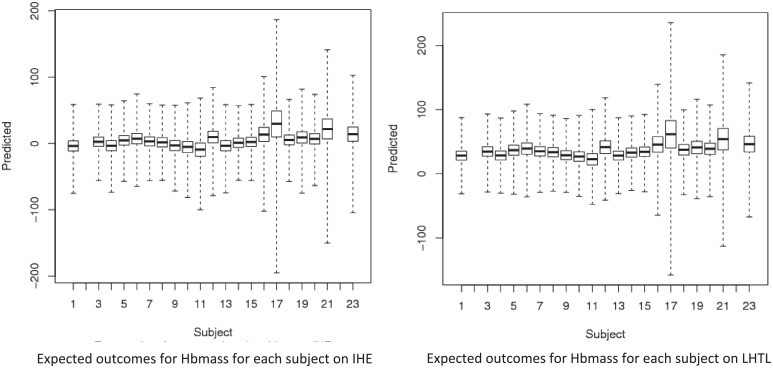
Fig 7. Boxplots of the posterior expected outcomes for Hbmass for each individual in the study, under each of the two training regimens Intermittent Hypoxic Exposure (left) and Live High Train Low (right).
Fig 8
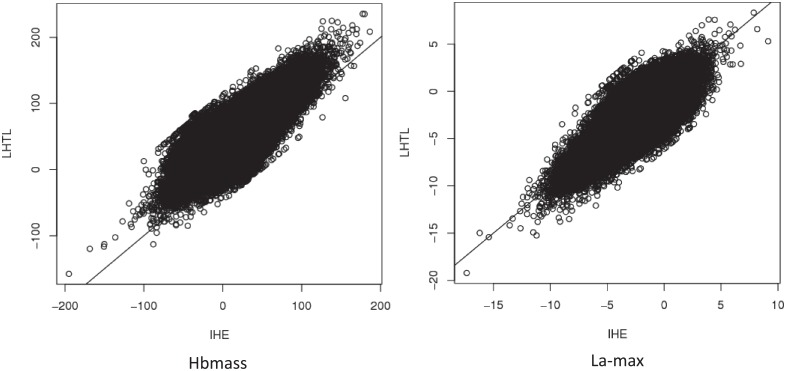
Fig 8. Comparison of the posterior distributions of the expected measurements of Hbmass (left) and La-max (right) under each of the training regimens Intermittent Hypoxic Exposure (IHE) and Live High Train Low (LHTL), unscaled data.

References

    1. Atkinson G, Batterham AM, Hopkins WG. Sports performance research under the spotlight. Int J Sports Med. 2012;33: 949 10.1055/s-0032-1327755 - DOI - PubMed
    1. Ploutz-Snyder RJ, Fiedler J, Feiveson AH. Justifying small-n research in scientifically amazing settings: challenging the notion that only "big-n" studies are worthwhile. J Appl Physiol. 2014;116: 1251–2. 10.1152/japplphysiol.01335.2013 - DOI - PubMed
    1. Bacchetti P. Current sample size conventions: flaws, harms, and alternatives. BMC Medicine. 2010;8: 17 10.1186/1741-7015-8-17 - DOI - PMC - PubMed
    1. Bacchetti P, Deeks SG, McCune JM. Breaking free of sample size dogma to perform innovative translational research. Sci Transl Med. 2011;3(87): 87sp24. - PMC - PubMed
    1. Beck TW. The importance of a priori sample size estimation in strength and conditioning research. J Str Cond Res. 2013;27: 2323–37. - PubMed