. 2016 Apr 13;12(4):e1005976.
doi: 10.1371/journal.pgen.1005976. eCollection 2016 Apr.

Role of Double-Strand Break End-Tethering during Gene Conversion in Saccharomyces cerevisiae

Affiliations

Role of Double-Strand Break End-Tethering during Gene Conversion in Saccharomyces cerevisiae

Suvi Jain et al. PLoS Genet. .

Abstract

Correct repair of DNA double-strand breaks (DSBs) is critical for maintaining genome stability. Whereas gene conversion (GC)-mediated repair is mostly error-free, repair by break-induced replication (BIR) is associated with non-reciprocal translocations and loss of heterozygosity. We have previously shown that a Recombination Execution Checkpoint (REC) mediates this competition by preventing the BIR pathway from acting on DSBs that can be repaired by GC. Here, we asked if the REC can also determine whether the ends that are engaged in a GC-compatible configuration belong to the same break, since repair involving ends from different breaks will produce potentially deleterious translocations. We report that the kinetics of repair are markedly delayed when the two DSB ends that participate in GC belong to different DSBs (termed Trans) compared to the case when both DSB ends come from the same break (Cis). However, repair in Trans still occurs by GC rather than BIR, and the overall efficiency of repair is comparable. Hence, the REC is not sensitive to the "origin" of the DSB ends. When the homologous ends for GC are in Trans, the delay in repair appears to reflect their tethering to sequences on the other side of the DSB that themselves recombine with other genomic locations with which they share sequence homology. These data support previous observations that the two ends of a DSB are usually tethered to each other and that this tethering facilitates both ends encountering the same donor sequence. We also found that the presence of homeologous/repetitive sequences in the vicinity of a DSB can distract the DSB end from finding its bona fide homologous donor, and that inhibition of GC by such homeologous sequences is markedly increased upon deleting Sgs1 but not Msh6.


Conflict of interest statement

The authors have declared that no competing interests exist.

Figures
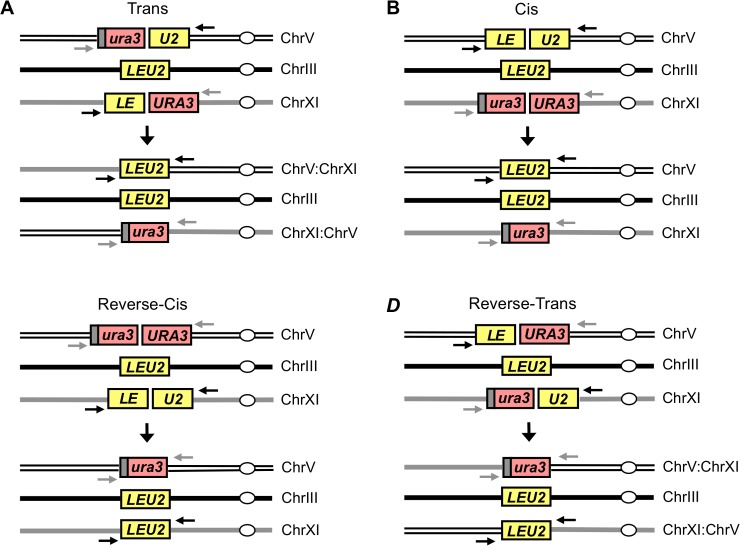
Fig 1
Fig 1. Schematic representation of the strains used to study repair in different configurations.
(A) Schematic of the strain used to study repair in Trans (strain YSJ379). A 5’ truncated ura3-HOcs-U2 cassette is present at the can1 locus on the left arm of Chr V, a LEU2 donor is present distal to the YCL048W-A locus on the left arm of Chr III and an LE-HOcs-URA3 cassette is present distal to the BUD2 locus on the left arm of Chr XI. Bottom panel indicates the repair outcome in which the LE end from the break on Chr XI and the U2 end from the break on Chr V are repaired by GC (using the LEU2 donor on Chr III), and the ura3 end from the break on Chr V and the URA3 end from the break on Chr XI are repaired by interchromosomal SSA resulting in deletion of one of the URA3 repeats. Both repair events in the Trans strain are associated with a reciprocal translocation between chromosomes V and XI. (B) Schematic of the strain used to study repair in Cis (YSJ357). Bottom panel indicates the repair outcome in which the HO break within leu2 on Chr V is repaired by GC (using the LEU2 donor on Chr III), and the HO break on Chr XI is repaired by intrachromosomal SSA resulting in deletion of one of the URA3 repeats. (C) Schematic of the Reverse-Cis strain (tNS2614) in which the positions of the LE-HOcs-U2 and ura3-HOcs-URA3 cassettes have been reversed relative to the Cis arrangement. The HO break within leu2 on Chr XI is repaired by GC (using the LEU2 donor on Chr III), and the HO break on Chr V is repaired by intrachromosomal SSA resulting in deletion of one of the URA3 repeats. (D) Schematic of the Reverse-Trans strain (tNS2638) in which the positions of the 5’ truncated ura3-HOcs-U2 cassette and the LE-HOcs-URA3 cassette are switched relative to the Trans strain. Bottom panel indicates the repair outcome in which the LE end from the break on Chr V and the U2 end from the break on Chr XI are repaired by GC (using the LEU2 donor on Chr III), and the ura3 end from the break on Chr XI and the URA3 end from the break on Chr V are repaired by interchromosomal SSA resulting in deletion of one of the URA3 repeats. Both repair events in this strain are also associated with a reciprocal translocation between chromosomes V and XI. Black arrows indicate the positions of the PCR primers used to study the kinetics of LEU2 repair while the gray arrows indicate the position of primers used to examine the SSA repair.
Fig 2
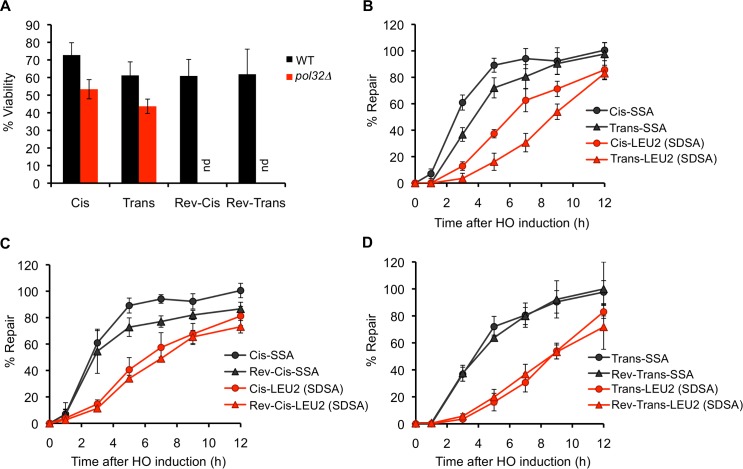
Fig 2. Repair in Trans is kinetically slower than repair in Cis.
(A) Viabilities of the indicated strains (nd indicates not done). Data represent mean ± S.D. (n ≥ 6). (B-D) Kinetics of DSB repair in (B) Cis and Trans configurations, (C) Cis and Reverse-Cis configurations, and (D) Trans and Reverse-Trans configurations as determined by a quantitative PCR assay using primers shown schematically in Fig 1 and listed in S1 Table. The repair of LE and U2 ends, which occurs predominantly by synthesis-dependent strand annealing, is indicated in the figure as SDSA, while the repair of the URA3 and ura3 ends, which occurs by single-strand annealing, is indicated as SSA. The amount of PCR product obtained from a repaired colony was used to make the standard curve for quantification. For Cis and Trans, data represent mean of a total of 6 PCR reactions from two independent time courses ± S.D. For Reverse-Cis and Reverse-Trans, data represent mean of three independent time courses ± S.D.
Fig 3
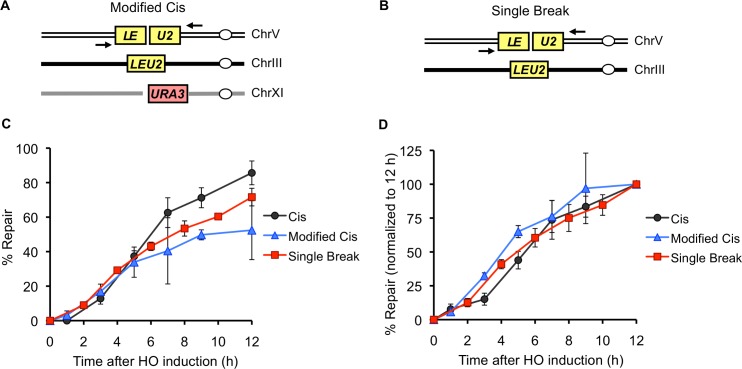
Fig 3. The kinetics of LEU2 repair are independent of the repair outcome of another break.
(A) Schematic representation of a modified Cis strain, tNS2607, which carries an LE-HOcs-U2 cassette at the can1 locus on Chr V, a LEU2 donor on Chr III and an unrepairable HOcs-URA3 break (instead of a ura3-HOcs-URA3 cassette) on Chr XI. (B) Schematic representation of a strain which carries a LE-HOcs-U2 cassette at the can1 locus on Chr V and a LEU2 donor on Chr III (YSJ119 [13]). This strain harbors a single HO break. (C) Kinetics of LEU2 repair in the indicated strains, as determined by a quantitative PCR assay using primers shown schematically (black arrows) in Figs 1(B) and 3(A) and 3(B). The amount of PCR product obtained from a repaired colony was used to make the standard curve for quantification. (D) Data from (C) plotted after normalizing the amount of PCR product obtained at 12h time point for each strain to 100%. For Cis and Single Break, data represent mean of a total of 6 PCR reactions from two independent time courses ± S.D. For Modified Cis, data represent mean of three independent time courses ± S.D. The Single Break data shown in (C) has been published in [13].
Fig 4
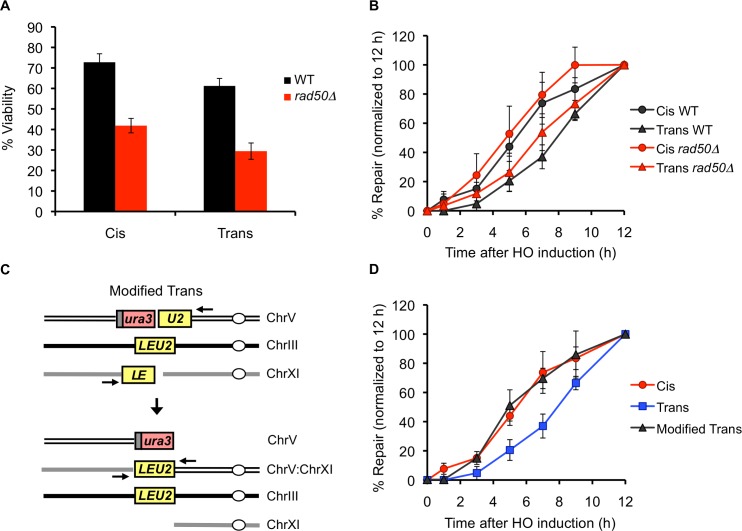
Fig 4. Eliminating the SSA substrate accelerates the kinetics of GC repair in Trans.
(A) Viabilities of WT (black bars) and rad50Δ (red bars) Cis and Trans strains. Data represent mean ± S.D. (n ≥ 5). (B) Kinetics of LEU2 repair in the indicated WT (black curves) and rad50Δ (red curves) strains, as determined by a quantitative PCR assay using primers shown schematically (black arrows) in Fig 1(A) and 1(B). The amount of PCR product obtained from a repaired colony was used to make the standard curve for quantification, and the data was plotted after normalizing the amount of product obtained at the 12 h time point to 100% in each case. For the repair kinetics in the WT background, data represent mean of a total of 6 PCR reactions from two independent time courses ± S.D. For the repair kinetics in the rad50Δ background, data represent mean of three independent time courses ± S.D. (C) Schematic representation of a modified Trans strain, tNS2628, which carries a 5’ truncated ura3-HOcs-U2 cassette at the can1 locus on Chr V, a LEU2 donor on Chr III and an unrepairable LE-HOcs break (instead of an LE-HOcs-URA3 cassette) on Chr XI. Bottom panel indicates the repair outcome in which the LE end from the break on Chr XI and the U2 end from the break on Chr V are repaired by GC using the LEU2 donor on Chr III. However, the other two ends of these breaks cannot be repaired due to the lack of a URA3 substrate on the Chr XI. (D) Kinetics of LEU2 repair in the indicated strains as determined by a quantitative PCR assay using primers shown schematically (black arrows) in Figs 1(A) and 1(B) and 4(C). The amount of PCR product obtained from a repaired colony was used to generate a standard curve for quantification, and the data was plotted after normalizing the amount of product obtained at the 12 h time point to 100% in each case. For Cis and Trans, data represent mean of a total of 6 PCR reactions from two independent time courses ± S.D. For the Modified Trans, data represent mean of three independent time courses ± S.D.
Fig 5
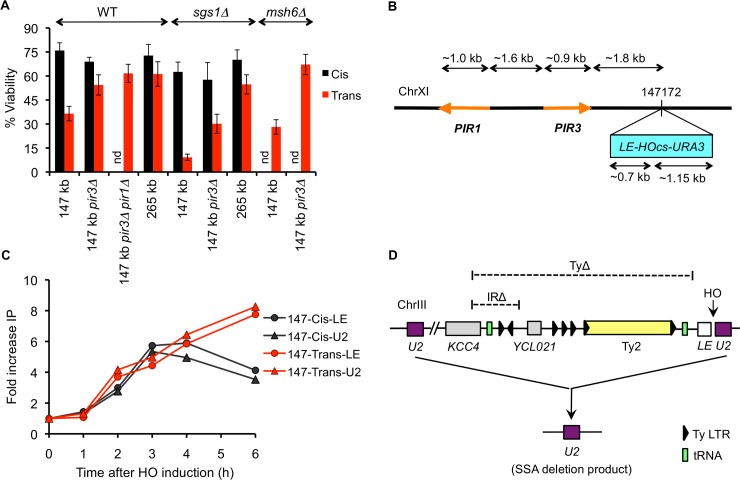
Fig 5. Adjacent PIR sequences interfere with GC repair in Trans.
(A) Viabilities of the indicated WT, sgs1Δ and msh6Δ 147- and 265- Cis and Trans strains (nd indicates not done). Data represent mean ± S.D. (n ≥ 5). (B) Schematic representation of Chr XI features surrounding the site of insertion of the LE-HOcs-URA3 cassette in the 147-Trans strain. The LE-HOcs-URA3 cassette was inserted at position 147142 on the left arm of Chr XI. Orange lines represent the PIR genes and the arrowheads indicate their relative orientations. The distance of PIR3 gene from PIR1 and LE-HOcs-URA3 cassette is indicated. The corresponding Cis strain contains a NAT-marked 5’ truncated ura3-HOcs-URA3 cassette at position 147172. (C) Rad51 ChIP signal at the LEU2 donor on Chr III representing the kinetics of strand-invasion by LE and U2 ends in 147- Cis and Trans strains. Primers 300 bp and 200 bp upstream of the LEU2 donor and 150 bp and 25 bp downstream of the LEU2 donor were used to study the kinetics of strand-invasion by the LE and U2 ends, respectively. (D) Schematic representation of the YMV80 SSA strain harboring an HOcs within the leu2 gene at its endogenous locus, and a homologous U2 sequence at the his4 locus ~25 kb distal to the LE-HOcs-U2. Dotted lines indicate the regions spanning the Ty2 retrotransposon element, Ty1 LTRs (long terminal repeats) and tRNA genes that have been deleted in the TyΔ and IRΔ strains, respectively. TyΔ results in a net deletion of 4.7 kb. Figure not drawn to scale.

References

    1. Krogh BO, Symington LS (2004) Recombination proteins in yeast. Annu Rev Genet 38: 233–271. - PubMed
    1. McEachern MJ, Haber JE (2006) Break-induced replication and recombinational telomere elongation in yeast. Annu Rev Biochem 75: 111–135. - PubMed
    1. Pâques F, Haber JE (1999) Multiple pathways of recombination induced by double-strand breaks in Saccharomyces cerevisiae. Microbiol Mol Biol Rev 63: 349–404. - PMC - PubMed
    1. Haber JE (2013) Genome Stability: DNA Repair and Recombination: Garland Science. 396 p.
    1. Malkova A, Ivanov EL, Haber JE (1996) Double-strand break repair in the absence of RAD51 in yeast: a possible role for break-induced DNA replication. Proc Natl Acad Sci U S A 93: 7131–7136. - PMC - PubMed

Publication types

MeSH terms

LinkOut - more resources