Differential Diagnosis of Skin Ulcers in a Mycobacterium ulcerans Endemic Area: Data from a Prospective Study in Cameroon
- PMID: 27074157
- PMCID: PMC4830608
- DOI: 10.1371/journal.pntd.0004385
Differential Diagnosis of Skin Ulcers in a Mycobacterium ulcerans Endemic Area: Data from a Prospective Study in Cameroon
Abstract
Background: Clinical diagnosis of Buruli ulcer (BU) due to Mycobacterium ulcerans can be challenging. We aimed to specify the differential diagnosis of skin lesions in a BU endemic area.
Method: We conducted a prospective diagnostic study in Akonolinga, Cameroon. Patients presenting with a skin ulcer suspect of BU were included. M. ulcerans was detected using swabs for Ziehl-Neelsen staining, PCR and culture. Skin punch biopsies were taken and reviewed by two histopathologists. Photographs of the lesions were taken and independently reviewed by two dermatologists. Final diagnosis was based on consensus, combining the results of laboratory tests and expert opinion.
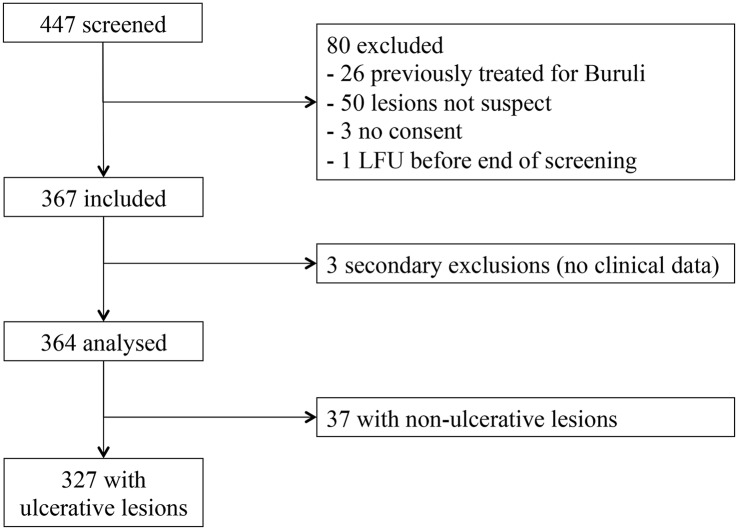
Results/ discussion: Between October 2011 and December 2013, 327 patients with ulcerative lesions were included. Median age was 37 years (0 to 87), 65% were males, and 19% HIV-positive. BU was considered the final diagnosis for 27% of the lesions, 85% of which had at least one positive laboratory test. Differential diagnoses were vascular lesions (22%), bacterial infections (21%), post-traumatic (8%), fistulated osteomyelitis (6%), neoplasia (5%), inflammatory lesions (3%), hemopathies and other systemic diseases (2%) and others (2%). The proportion of BU was similar between HIV-positive and HIV-negative patients (27.0% vs. 26.5%; p = 0.940). Half of children below 15 years of age were diagnosed with BU, compared to 26.8% and 13.9% among individuals 15 to 44 years of age and above, respectively (chi2 p<0.001). Children had more superficial bacterial infections (24.3%) and osteomyelitis (11.4%).
Conclusion: We described differential diagnosis of skin lesions in a BU endemic area, stratifying results by age and HIV-status.
Conflict of interest statement
The authors have declared that no competing interests exist.
Figures
References
-
- Buruli ulcer (Mycobacterium ulcerans infection), Fact sheet Nø 199. World Health Organization 2014; Available from: http://www.who.int/mediacentre/factsheets/fs199/en/.
-
- Ellen DE, Strienstra Y, Teelken MA, Dijkstra PU, van der Graaf WT, van der Werf TS. Assessment of functional limitations caused by Mycobacterium ulcerans infection: towards a Buruli ulcer functional limitation score. Trop Med Int Health, 2003; 8: 90–96. - PubMed
-
- World Health Organization. Treatment of Mycobacterium ulcerans disease (Buruli ulcer): guidance for health care workers. 2012
-
- Mensah-Quainoo E, Yeboah-Manu D, Asebi C, Patafuor F, Ofori-Adjei D, Junghauss T et al. Diagnosis of Mycobacterium ulcerans infection (Buruli ulcer) at a treatment centre in Ghana: a retrospective analysis of laboratory results of clinically diagnosed cases. Trop Med Int Health, 2008; 13: 191–198. 10.1111/j.1365-3156.2007.01990.x - DOI - PubMed
-
- Portaels F and World Health Organization. Laboratory diagnosis of buruli ulcer: a manual for health care providers. World Health Organization; 2014
Publication types
MeSH terms
LinkOut - more resources
Full Text Sources
Other Literature Sources