Review
. 2016 May 11;116(9):5301-37.
doi: 10.1021/acs.chemrev.5b00584. Epub 2016 Apr 13.

Semiempirical Quantum Mechanical Methods for Noncovalent Interactions for Chemical and Biochemical Applications

Affiliations
Review

Semiempirical Quantum Mechanical Methods for Noncovalent Interactions for Chemical and Biochemical Applications

Anders S Christensen et al. Chem Rev. .

Abstract

Semiempirical (SE) methods can be derived from either Hartree-Fock or density functional theory by applying systematic approximations, leading to efficient computational schemes that are several orders of magnitude faster than ab initio calculations. Such numerical efficiency, in combination with modern computational facilities and linear scaling algorithms, allows application of SE methods to very large molecular systems with extensive conformational sampling. To reliably model the structure, dynamics, and reactivity of biological and other soft matter systems, however, good accuracy for the description of noncovalent interactions is required. In this review, we analyze popular SE approaches in terms of their ability to model noncovalent interactions, especially in the context of describing biomolecules, water solution, and organic materials. We discuss the most significant errors and proposed correction schemes, and we review their performance using standard test sets of molecular systems for quantum chemical methods and several recent applications. The general goal is to highlight both the value and limitations of SE methods and stimulate further developments that allow them to effectively complement ab initio methods in the analysis of complex molecular systems.


Conflict of interest statement

The authors declare no competing financial interest.

Figures
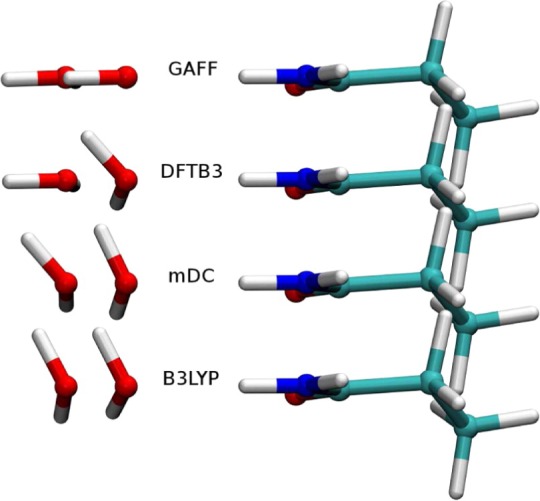
Figure 1
Figure 1
Effect of multipoles on hydrogen-bonding interactions at different distances. Although the angular dependence of the water–amide interaction is described by DFTB3 at short distance correctly, the description reduces to that of an MM force field at longer distances due to the use of charge monopoles in the second-order term. Reproduced from ref (134). Copyright 2014 American Chemical Society.
Figure 2
Figure 2
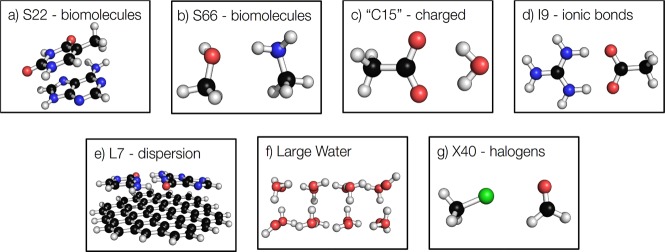
Representative systems from the data sets discussed in Tables 1 and 2. The data sets are discussed in detail in section 7.1.
Figure 3
Figure 3
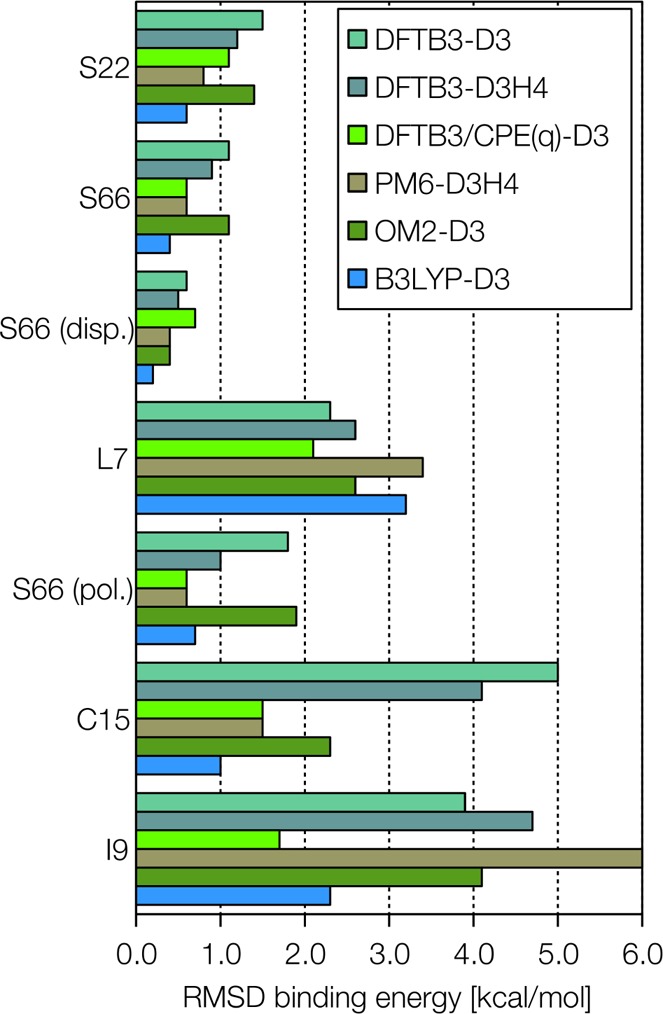
Root-mean-squared deviation (RMSD) of the binding energy for seven different data sets is shown for five selected semiempirical methods involving the empirical corrections D3 and D3H4. Results obtained with B3LYP/def2-QZVP/D3 are shown for reference.
Figure 4
Figure 4
Halogen bond in the complex F3C–Br···O=CH2. The electrostatic potential on the surface of the molecules is color-coded (red, negative; blue, positive). The light blue cap on the bromine atom is the σ-hole. Note the nonlinear orientation of the molecules, such that the σ-hole can point directly at one of the lone pairs of the formaldehyde oxygen atom.
Figure 5
Figure 5
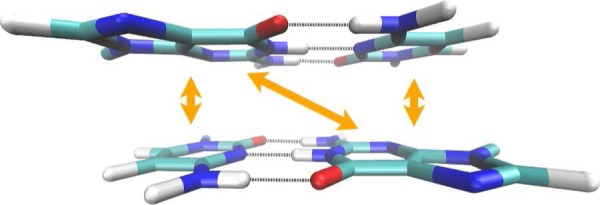
A DNA base pair step in the B-DNA configuration, viewed from the major groove. Major noncovalent interactions highlighted are hydrogen bonds (gray shaded lines) and dispersion contacts (orange arrows).
Figure 6
Figure 6
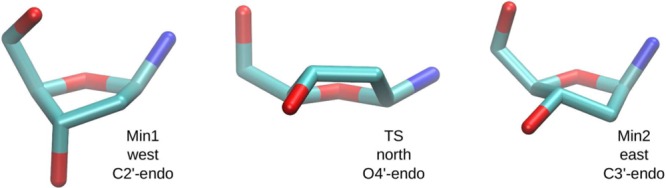
Relevant conformations of the sugar ring of guanine deoxyribonucleoside: the two energy minima (Min1 and Min2) as well as the lower-energy transition state (TS).
Figure 7
Figure 7
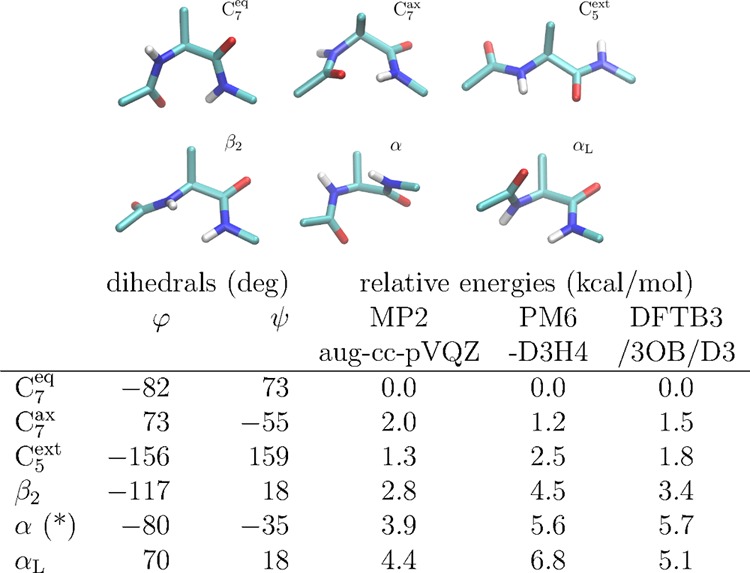
Considered gas-phase structures of alanine dipeptide. The relative conformational energies were obtained with dispersion-corrected PM6 and DFTB3, as well as with RI-MP2 for reference. Prior to that, the geometries were optimized on the DFT level BLYP/def2-TZVP/D3. (*) The structure α is not a stationary point on the BLYP/D3 PES; therefore, the geometry was obtained with restrained minimization to keep the dihedrals φ and ψ fixed.
Figure 8
Figure 8
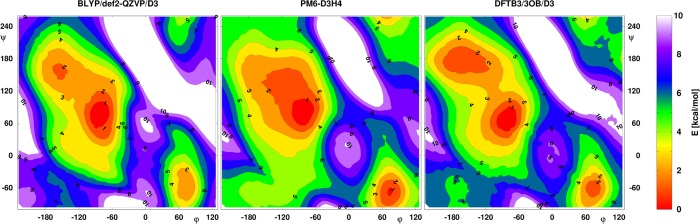
Potential energy surface of AD in the space of dihedral angles φ and ψ: (left) BLYP/def2-QZVP/D3 (reference), (center) PM6-D3H4, (right) DFTB3/3OB/D3. Energies from single-point calculations performed with the respective methods on structures obtained from restrained optimization on the B3LYP/def2-TZVP level.
Figure 9
Figure 9
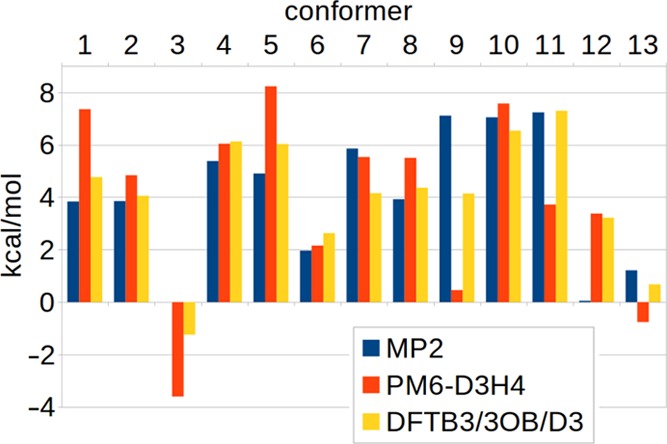
Energies of the conformers of alanine tetrapeptide obtained with the considered SE methods as well as on the ab initio level RI-MP2/aug-cc-pVQZ. Conformers 1–10 are those considered by Friesner and co-workers, while 11, 12, and 13 are the α- and 310-helical conformations and the sequence of three C7eq pseudocycles, respectively. Following the work of Friesner and colleagues, the MP2 energy of conformer 3 was set to zero arbitrarily, and the PM6 and DFTB3 energies were shifted to minimize the root-mean-squared deviation from the MP2 data.
Figure 10
Figure 10
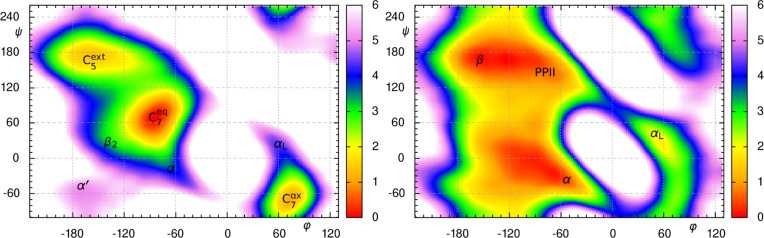
Free energy maps of alanine dipeptide obtained from well-tempered metadynamics simulations performed with DFTB3/3OB/D3: (left) AD in a vacuum (Helmholtz function) and (right) AD in aqueous solution simulated with QM/MM using TIP3P water (Gibbs function). The color codes the free energy, ΔF or ΔG, in kcal/mol.

References

    1. Ponder J. W.; Wu C. J.; Ren P. Y.; Pande V. S.; Chodera J. D.; Schnieders M. J.; Haque I.; Mobley D. L.; Lambrecht D. S.; DiStasio R. A.; et al. Current Status of the AMOEBA Polarizable Force Field. J. Phys. Chem. B 2010, 114, 2549–2564. 10.1021/jp910674d. - DOI - PMC - PubMed
    1. Lopes P. E. M.; Huang J.; Shim J.; Luo Y.; Li H.; Roux B.; MacKerell A. D. Jr. Polarizable Force Field for Peptides and Proteins Based On the Classical Drude Oscillator. J. Chem. Theory Comput. 2013, 9, 5430–5449. 10.1021/ct400781b. - DOI - PMC - PubMed
    1. Banks J. L.; Kaminski G. A.; Zhou R. H.; Mainz D. T.; Berne B. J.; Friesner R. A. Parametrizing a Polarizable Force Field From Ab Initio Data. I. The Fluctuating Point Charge Model. J. Chem. Phys. 1999, 110, 741–754. 10.1063/1.478043. - DOI
    1. Gresh N.; Cisneros G. A.; Darden T. A.; Piquemal J. P. Anisotropic, Polarizable Molecular Mechanics Studies of Inter- and Intramoecular Interactions and Ligand-macromolecule Complexes. A Bottom-up Strategy. J. Chem. Theory Comput. 2007, 3, 1960–1986. 10.1021/ct700134r. - DOI - PMC - PubMed
    1. Schmidt J. R.; Yu K.; McDaniel J. G. Transferable Next-Generation Force Fields From Simple Liquids to Complex Materials. Acc. Chem. Res. 2015, 48, 548–556. 10.1021/ar500272n. - DOI - PubMed

Publication types