Validity and Reliability of Dermoscopic Criteria Used to Differentiate Nevi From Melanoma: A Web-Based International Dermoscopy Society Study
- PMID: 27074267
- PMCID: PMC5451089
- DOI: 10.1001/jamadermatol.2016.0624
Validity and Reliability of Dermoscopic Criteria Used to Differentiate Nevi From Melanoma: A Web-Based International Dermoscopy Society Study
Abstract
Importance: The comparative diagnostic performance of dermoscopic algorithms and their individual criteria are not well studied.
Objectives: To analyze the discriminatory power and reliability of dermoscopic criteria used in melanoma detection and compare the diagnostic accuracy of existing algorithms.
Design, setting, and participants: This was a retrospective, observational study of 477 lesions (119 melanomas [24.9%] and 358 nevi [75.1%]), which were divided into 12 image sets that consisted of 39 or 40 images per set. A link on the International Dermoscopy Society website from January 1, 2011, through December 31, 2011, directed participants to the study website. Data analysis was performed from June 1, 2013, through May 31, 2015. Participants included physicians, residents, and medical students, and there were no specialty-type or experience-level restrictions. Participants were randomly assigned to evaluate 1 of the 12 image sets.
Main outcomes and measures: Associations with melanoma and intraclass correlation coefficients (ICCs) were evaluated for the presence of dermoscopic criteria. Diagnostic accuracy measures were estimated for the following algorithms: the ABCD rule, the Menzies method, the 7-point checklist, the 3-point checklist, chaos and clues, and CASH (color, architecture, symmetry, and homogeneity).
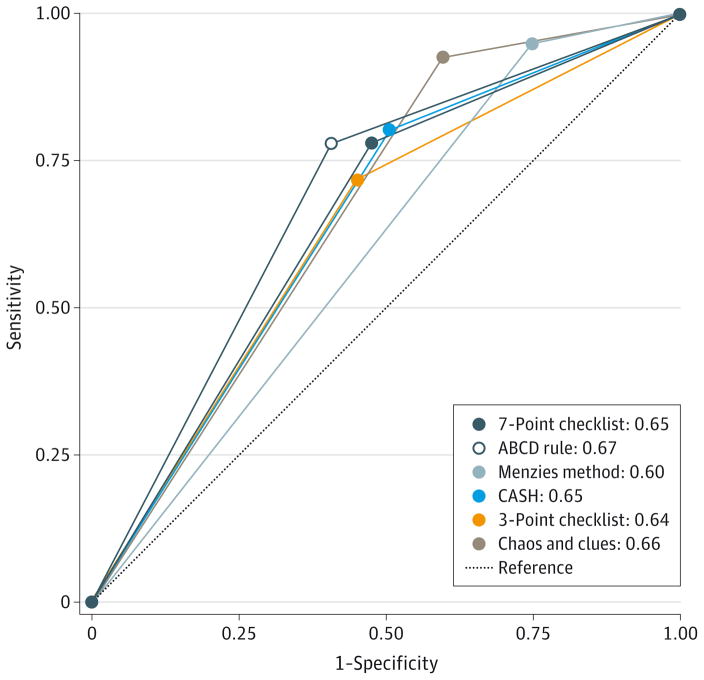
Results: A total of 240 participants registered, and 103 (42.9%) evaluated all images. The 110 participants (45.8%) who evaluated fewer than 20 lesions were excluded, resulting in data from 130 participants (54.2%), 121 (93.1%) of whom were regular dermoscopy users. Criteria associated with melanoma included marked architectural disorder (odds ratio [OR], 6.6; 95% CI, 5.6-7.8), pattern asymmetry (OR, 4.9; 95% CI, 4.1-5.8), nonorganized pattern (OR, 3.3; 95% CI, 2.9-3.7), border score of 6 (OR, 3.3; 95% CI, 2.5-4.3), and contour asymmetry (OR, 3.2; 95% CI, 2.7-3.7) (P < .001 for all). Most dermoscopic criteria had poor to fair interobserver agreement. Criteria that reached moderate levels of agreement included comma vessels (ICC, 0.44; 95% CI, 0.40-0.49), absence of vessels (ICC, 0.46; 95% CI, 0.42-0.51), dark brown color (ICC, 0.40; 95% CI, 0.35-0.44), and architectural disorder (ICC, 0.43; 95% CI, 0.39-0.48). The Menzies method had the highest sensitivity for melanoma diagnosis (95.1%) but the lowest specificity (24.8%) compared with any other method (P < .001). The ABCD rule had the highest specificity (59.4%). All methods had similar areas under the receiver operating characteristic curves.
Conclusions and relevance: Important dermoscopic criteria for melanoma recognition were revalidated by participants with varied experience. Six algorithms tested had similar but modest levels of diagnostic accuracy, and the interobserver agreement of most individual criteria was poor.
Conflict of interest statement
Figures
References
-
- Kittler H, Pehamberger H, Wolff K, Binder M. Diagnostic accuracy of dermoscopy. Lancet Oncol. 2002;3(3):159–165. - PubMed
-
- Argenziano G, Fabbrocini G, Carli P, De Giorgi V, Sammarco E, Delfino M. Epiluminescence microscopy for the diagnosis of doubtful melanocytic skin lesions: comparison of the ABCD rule of dermatoscopy and a new 7-point checklist based on pattern analysis. Arch Dermatol. 1998;134(12):1563–1570. - PubMed
-
- Stolz W, Riemann A, Cognetta AB, et al. ABCD rule of dermoscopy: a new practical method for early recognition of malignant melanoma. Eur J Dermatol. 1994;4(7):521–527.
-
- Soyer HP, Argenziano G, Zalaudek I, et al. Three-point checklist of dermoscopy: a new screening method for early detection of melanoma. Dermatology. 2004;208(1):27–31. - PubMed
-
- Henning JS, Dusza SW, Wang SQ, et al. The CASH (color, architecture, symmetry, and homogeneity) algorithm for dermoscopy. J Am Acad Dermatol. 2007;56(1):45–52. - PubMed
Publication types
MeSH terms
Grants and funding
LinkOut - more resources
Full Text Sources
Other Literature Sources
Medical