


The suitability of common metrics for assessing parotid and larynx autosegmentation accuracy
- PMID: 27074471
- PMCID: PMC5875550
- DOI: 10.1120/jacmp.v17i2.5889
The suitability of common metrics for assessing parotid and larynx autosegmentation accuracy
Abstract
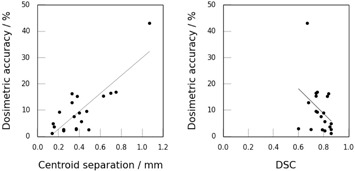
Contouring structures in the head and neck is time-consuming, and automatic seg-mentation is an important part of an adaptive radiotherapy workflow. Geometric accuracy of automatic segmentation algorithms has been widely reported, but there is no consensus as to which metrics provide clinically meaningful results. This study investigated whether geometric accuracy (as quantified by several commonly used metrics) was associated with dosimetric differences for the parotid and larynx, comparing automatically generated contours against manually drawn ground truth contours. This enabled the suitability of different commonly used metrics to be assessed for measuring automatic segmentation accuracy of the parotid and larynx. Parotid and larynx structures for 10 head and neck patients were outlined by five clinicians to create ground truth structures. An automatic segmentation algorithm was used to create automatically generated normal structures, which were then used to create volumetric-modulated arc therapy plans. The mean doses to the automatically generated structures were compared with those of the corresponding ground truth structures, and the relative difference in mean dose was calculated for each structure. It was found that this difference did not correlate with the geometric accuracy provided by several metrics, notably the Dice similarity coefficient, which is a commonly used measure of spatial overlap. Surface-based metrics provided stronger correlation and are, therefore, more suitable for assessing automatic seg-mentation of the parotid and larynx.
Figures
References
-
- Cozzi L, Fogliata A, Bolsi A, Nicolini G, Bernier J. Three‐dimensional conformal vs. intensity‐modulated radiotherapy in head‐and‐neck cancer patients: Comparative analysis of dosimetric and technical parameters. Int J Radiat Oncol Biol Phys. 2004;58(2):617–24. - PubMed
-
- Vanetti E, Clivio A, Nicolini G, et al. Volumetric modulated arc radiotherapy for carcinomas of the oropharynx, hypo‐pharynx and larynx: a treatment planning comparison with fixed field IMRT. Radiother Oncol. 2009;92(1):111–17. - PubMed
-
- Chao LS, Deasy JO, Markman J, et al. A prospective study of salivary function sparing in patients with head‐and‐neck cancers receiving intensity‐modulated or three‐dimensional radiation therapy: initial results. Int J Radiat Oncol Biol Phys. 2001;49(4):907–16. - PubMed
-
- Saarilahti K, Kouri M, Collan J, et al. Intensity modulated radiotherapy for head and neck cancer: evidence for preserved salivary gland function. Radiother Oncol. 2005;74(3):251–58. - PubMed
-
- Saarilahti K, Kouri M, Collan J, et al. Sparing of the submandibular glands by intensity modulated radiotherapy in the treatment of head and neck cancer Radiother Oncol. 2006;78(3):270–75. - PubMed
MeSH terms
LinkOut - more resources
Full Text Sources
Other Literature Sources
Medical
