


The effects of exercise modality and intensity on energy expenditure and cardiorespiratory response in adults with obesity and treated obstructive sleep apnoea
- PMID: 27075360
- PMCID: PMC5729727
- DOI: 10.1177/1479972316643699
The effects of exercise modality and intensity on energy expenditure and cardiorespiratory response in adults with obesity and treated obstructive sleep apnoea
Abstract
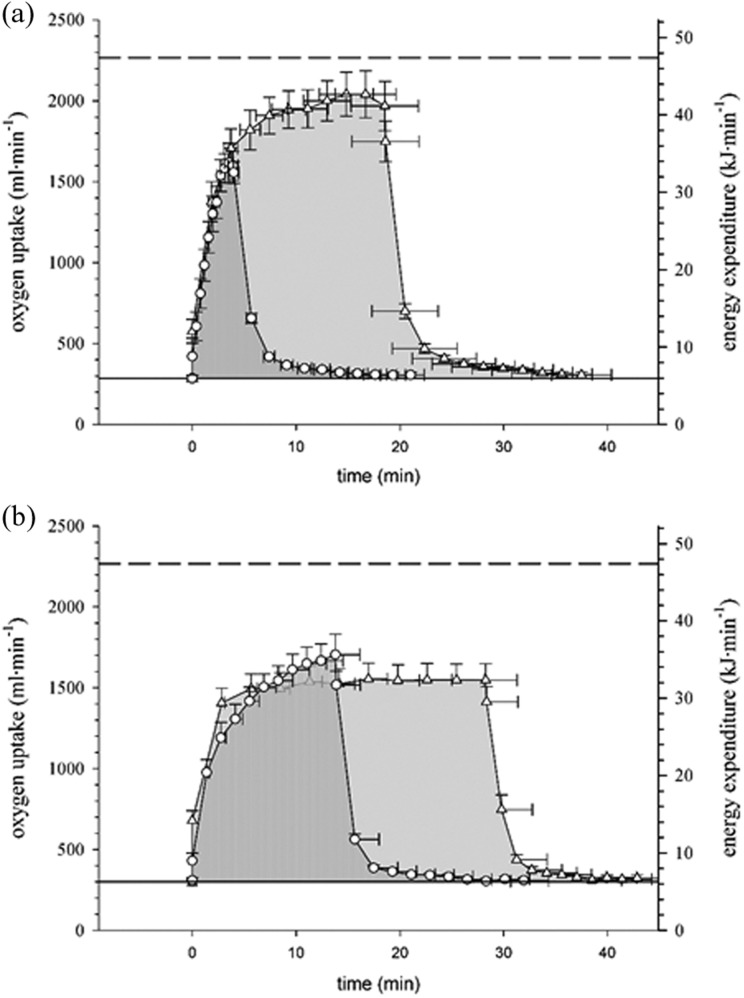
To inform recommendations for the exercise component of a healthy lifestyle intervention for adults with obesity and treated obstructive sleep apnoea (OSA), we investigated the total energy expenditure (EE) and cardiorespiratory response to weight-supported (cycling) and unsupported (walking) exercise. Individuals with treated OSA and a body mass index (BMI) > 30 kg/m2 performed an incremental cardiopulmonary exercise test on a cycle ergometer and a treadmill to determine the peak oxygen uptake [Formula: see text]. Participants subsequently completed two endurance tests on each modality, matched at 80% and 60% of the highest [Formula: see text] determined by the incremental tests, to intolerance. The cardiorespiratory response was measured and total EE was estimated from the [Formula: see text]. Sixteen participants completed all six tests: mean [SD] age 57 [13] years and median [IQ range] BMI 33.3 [30.8-35.3] kg/m2. Total EE during treadmill walking was greater than cycling at both high (158 [101] vs. 29 [15] kcal; p < 0.001) and moderate (178 [100] vs. 85 [59] kcal; p = 0.002) intensities, respectively, with similar cardiorespiratory responses and pattern of EE during rest, exercise and recovery. Contrary to current guidelines, walking might be the preferred training modality to achieve the combination of weight loss and increased cardiorespiratory fitness in adults with obesity and treated OSA.
Keywords: Energy expenditure; exercise; obesity; obstructive sleep apnoea; weight supported; weight unsupported.
Conflict of interest statement
Figures


References
-
- World Health Organisation. Available at: http://www.who.int/mediacentre/factsheets/fs311/en/index.html# (accessed 30 October 2013).
-
- Barlow CE, Kohl HW, III, Gibbons LW, et al. Physical fitness, mortality and obesity. Int J Obes Relat Metab Disord 1995; 19(Suppl 4): S41–S44. - PubMed
-
- Haskell WL, Lee IM, Pate RR, et al. Physical activity and public health: updated recommendation for adults from the American College of Sports Medicine and the American Heart Association. Circulation 2007; 116(9): 1081–1093. - PubMed
-
- Davis JN, Hodges VA, Gillham MB. Physical activity compliance: differences between overweight/obese and normal-weight adults. Obesity (Silver Spring) 2006; 14(12): 2259–2265. - PubMed
-
- West SD, Kohler M, Nicoll DJ, et al. The effect of continuous positive airway pressure treatment on physical activity in patients with obstructive sleep apnoea: a randomised controlled trial. Sleep Med 2009; 10(9): 1056–1058. - PubMed
MeSH terms
LinkOut - more resources
Full Text Sources
Other Literature Sources
Medical
