Review
. 2016 Oct;45(6):635-48.
doi: 10.1007/s13280-016-0778-5. Epub 2016 Apr 13.

Importance of coastal primary production in the northern Baltic Sea

Affiliations
Review

Importance of coastal primary production in the northern Baltic Sea

Jenny Ask et al. Ambio. 2016 Oct.

Abstract

In this study, we measured depth-dependent benthic microalgal primary production in a Bothnian Bay estuary to estimate the benthic contribution to total primary production. In addition, we compiled data on benthic microalgal primary production in the entire Baltic Sea. In the estuary, the benthic habitat contributed 17 % to the total annual primary production, and when upscaling our data to the entire Bothnian Bay, the corresponding value was 31 %. This estimated benthic share (31 %) is three times higher compared to past estimates of 10 %. The main reason for this discrepancy is the lack of data regarding benthic primary production in the northern Baltic Sea, but also that past studies overestimated the importance of pelagic primary production by not correcting for system-specific bathymetric variation. Our study thus highlights the importance of benthic communities for the northern Baltic Sea ecosystem in general and for future management strategies and ecosystem studies in particular.

Keywords: Benthic contribution; Benthic primary production; Bothnian Bay; Coastal ecosystems; Northern Baltic Sea; Pelagic primary production.


Figures
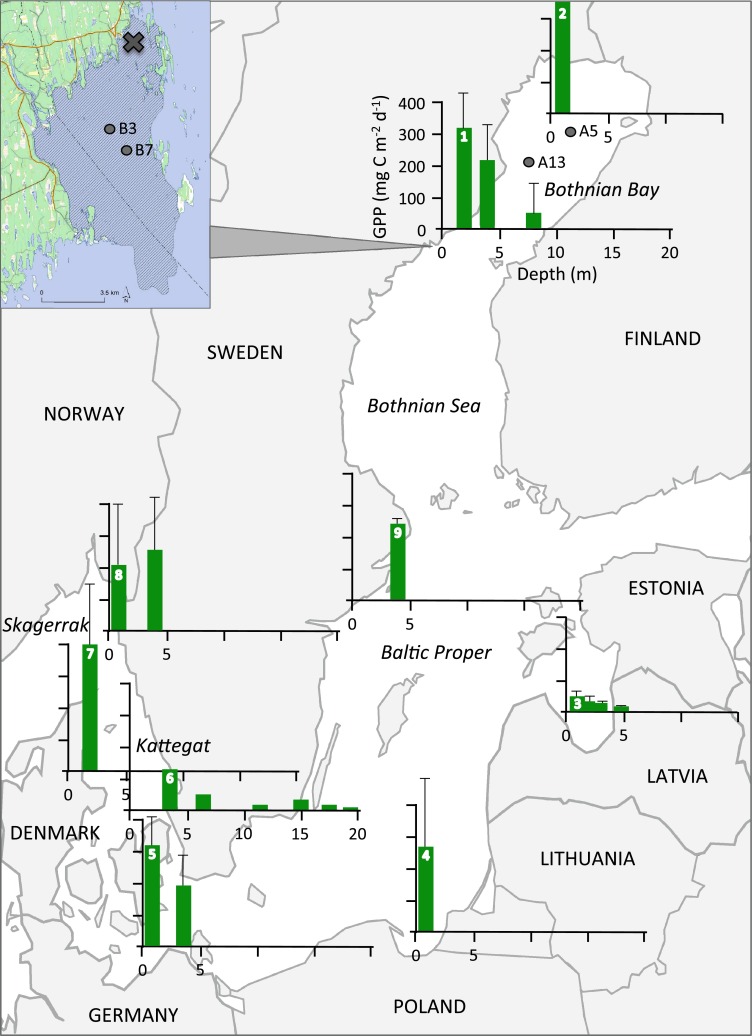
Fig. 1
Fig. 1
A compilation of studies measuring primary production by benthic microalgae in the Baltic Sea, here divided into five main areas: Bothnian Bay, Bothnian Sea, Baltic Proper, Kattegat and Skagerrak. The insert shows the extension of the Öre estuary (shaded area), and the sampling site for this study is marked with an X. The monitoring stations used for pelagic primary production are shown in the map (A5 and A13) and in the insert (B3 and B7). For the graphs, benthic gross primary production (GPP, mg C m−2 day−1) is presented on the y-axis and depth (m) on the x-axis. All graphs are plotted on the same scale as graph 1 (this study) and arranged so that the bar representing the most shallow depth is placed on or close to the sampling site. Error bars represent the standard deviation for a seasonal mean (here March–October), and were calculated when possible. The graphs are numbered (on the bar representing the most shallow depth) and the sources of the data are described accordingly in Table 1
Fig. 2
Fig. 2
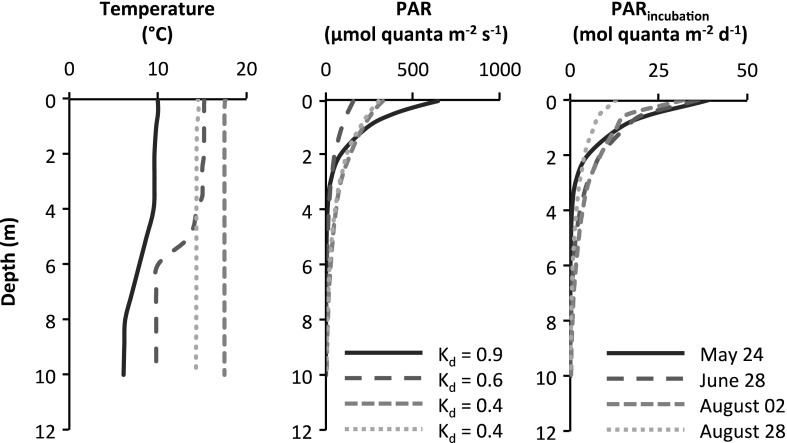
Profiles for temperature, photosynthetically active radiation (PAR) and the cumulative amount of PAR during the benthic incubation period (24 h, PARincubation) for the different sampling occasions. The vertical light attenuation coefficient (K d, m−1) was calculated as the slope of the depth–ln(PAR) linear relationship between 2 and 8 m. PAR at 10 m was also calculated from the extension of this relationship (i.e. not measured)
Fig. 3
Fig. 3
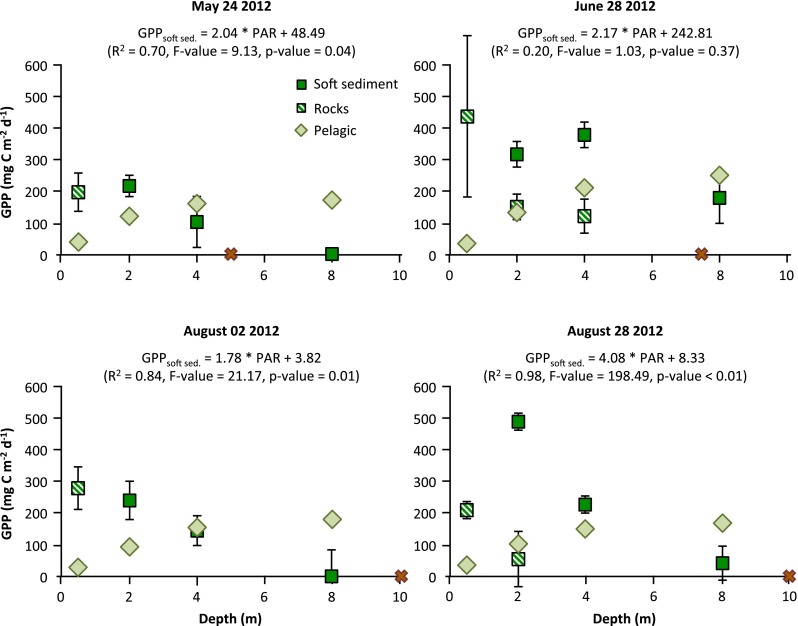
Benthic gross primary production (GPP) on soft sediment and rocks, and pelagic GPP, measured on four occasions during the 2012 summer season in the Öre estuary, Umeå, Sweden. The benthic values are the un-treated measured values, whereas the pelagic values are depth-integrated, and error bars (not always visible) for the benthic samples represent the standard deviation based on two replicates. The depth at which 1 % of surface PAR remains is marked with a red X. The linear relationship between soft sediment GPP (GPPsoft sed.) and PAR is given for each sampling occasion, however, the low number of replicates for these relationships (and for the benthic sample error bars) should be noted

References

    1. Albertsson, J. 2014. Övervakning av makrovegetation i Bottniska viken – en utvärdering av pågående undersökningar och underlag för vidareutveckling. Havsmiljöinstitutet, Länsstyrelsen i Västerbotten (Naturvårdsenheten).
    1. Andersson A, Hajdu S, Haecky P, Kuparinen J, Wikner J. Succession and growth limitation of phytoplankton in the Gulf of Bothnia (Baltic Sea) Marine Biology. 1996;126:791–801. doi: 10.1007/BF00351346. - DOI
    1. Andersson A, Meier HEM, Ripszam M, Rowe O, Wikner J, Haglund P, Eilola K, Legrand C, et al. Projected future climate change and Baltic Sea ecosystem management. Ambio. 2015;44:S345–S356. doi: 10.1007/s13280-015-0654-8. - DOI - PMC - PubMed
    1. Ask J, Karlsson J, Persson L, Ask P, Byström P, Jansson M. Terrestrial organic matter and light penetration: Effects on bacterial and primary production in lakes. Limnology and Oceanography. 2009;54:2034–2040. doi: 10.4319/lo.2009.54.6.2034. - DOI
    1. Ask J, Karlsson J, Persson L, Ask P, Byström P, Jansson M. Whole-lake estimates of carbon flux through algae and bacteria in benthic and pelagic habitats of clear-water lakes. Ecology. 2009;90:1923–1932. doi: 10.1890/07-1855.1. - DOI - PubMed

LinkOut - more resources