


Relations between Household Livestock Ownership, Livestock Disease, and Young Child Growth
- PMID: 27075911
- PMCID: PMC4841921
- DOI: 10.3945/jn.115.225961
Relations between Household Livestock Ownership, Livestock Disease, and Young Child Growth
Abstract
Background: In resource-limited settings in which child malnutrition is prevalent, humans live in close proximity to household livestock. However, the relation between household livestock and child nutrition represents a considerable knowledge gap.
Objective: We assessed whether household livestock ownership or livestock disease episodes were associated with growth in young children in western Kenya.
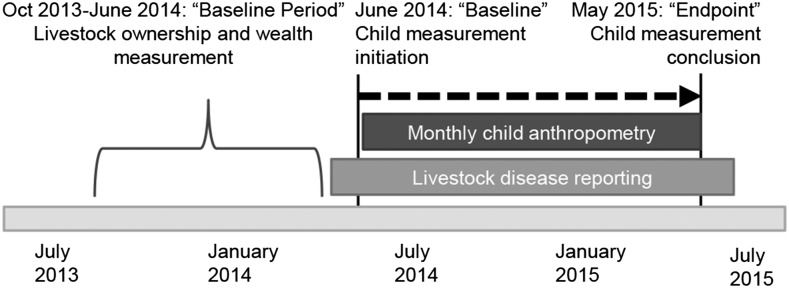
Methods: We incorporated monthly anthropometric measurements for children <5 y of age into an ongoing linked human and animal surveillance cohort in rural western Kenya. Using linear mixed models adjusted for age, sex, and household wealth, we tested whether baseline household livestock ownership was related to baseline child height for age or prospective growth rate. We also evaluated whether livestock disease episodes were associated with child growth rate over 11 mo of follow-up.
Results: We collected data on 925 children over the course of follow-up. Greater household livestock ownership at baseline was not related to baseline child height-for-age z score (adjusted β: 0.01 SD; 95% CI: -0.02, 0.04 SD) or child growth rate (adjusted β: 0.02 cm/y; 95% CI: -0.03, 0.07 cm/y). Livestock disease episodes were not significantly associated with child growth across the entire cohort (adjusted β: -0.007 cm/mo; 95% CI: -0.02, 0.006 cm/mo). However, children in households with livestock digestive disease between June and November gained less height than did children in households that did not report livestock disease (β: -0.063 cm/mo; 95% CI: -0.112, -0.016 cm/mo). Children <2 y of age in households with livestock digestive disease gained less weight than did those who did not report disease (β: -0.033 kg/mo; 95% CI: -0.063, -0.003 kg/mo).
Conclusion: In this cohort of young children in western Kenya, we did not find an association between ownership of livestock and child growth status. However, disease episodes in household livestock may be related to a lower child growth rate in some groups.
Keywords: child growth; household environment; livestock; nutrition; stunting.
© 2016 American Society for Nutrition.
Conflict of interest statement
Author disclosures: E Mosites, SM Thumbi, E Otiang, TF McElwain, MK Njenga, PM Rabinowitz, A Rowhani-Rahbar, ML Neuhouser, S May, GH Palmer, and JL Walson, no conflicts of interest.
Figures
References
-
- Black RE, Victora CG, Walker SP, Bhutta ZA, Christian P, de Onis M, Ezzati M, Grantham-McGregor S, Katz J, Martorell R, et al. . Maternal and child undernutrition and overweight in low-income and middle-income countries. Lancet 2013;382:427–51. - PubMed
-
- Lampl M, Johnson ML, Frongillo EA Jr. Mixed distribution analysis identifies saltation and stasis growth. Ann Hum Biol 2001;28:403–11. - PubMed
-
- Cameron N. The biology of growth. Nestle Nutr Workshop Ser Pediatr Program 2008;61:1–19. - PubMed
Publication types
MeSH terms
Grants and funding
LinkOut - more resources
Full Text Sources
Other Literature Sources
Medical
Miscellaneous
