Review
. 2016 Apr 13;36(15):4139-48.
doi: 10.1523/JNEUROSCI.4050-15.2016.

Molecular fMRI

Affiliations
Review

Molecular fMRI

Benjamin B Bartelle et al. J Neurosci. .

Abstract

Comprehensive analysis of brain function depends on understanding the dynamics of diverse neural signaling processes over large tissue volumes in intact animals and humans. Most existing approaches to measuring brain signaling suffer from limited tissue penetration, poor resolution, or lack of specificity for well-defined neural events. Here we discuss a new brain activity mapping method that overcomes some of these problems by combining MRI with contrast agents sensitive to neural signaling. The goal of this "molecular fMRI" approach is to permit noninvasive whole-brain neuroimaging with specificity and resolution approaching current optical neuroimaging methods. In this article, we describe the context and need for molecular fMRI as well as the state of the technology today. We explain how major types of MRI probes work and how they can be sensitized to neurobiological processes, such as neurotransmitter release, calcium signaling, and gene expression changes. We comment both on past work in the field and on challenges and promising avenues for future development.

Significance statement: Brain researchers currently have a choice between measuring neural activity using cellular-level recording techniques, such as electrophysiology and optical imaging, or whole-brain imaging methods, such as fMRI. Cellular level methods are precise but only address a small portion of mammalian brains; on the other hand, whole-brain neuroimaging techniques provide very little specificity for neural pathways or signaling components of interest. The molecular fMRI techniques we discuss have particular potential to combine the specificity of cellular-level measurements with the noninvasive whole-brain coverage of fMRI. On the other hand, molecular fMRI is only just getting off the ground. This article aims to offer a snapshot of the status and future prospects for development of molecular fMRI techniques.


Figures

Figure 1.
Figure 1.
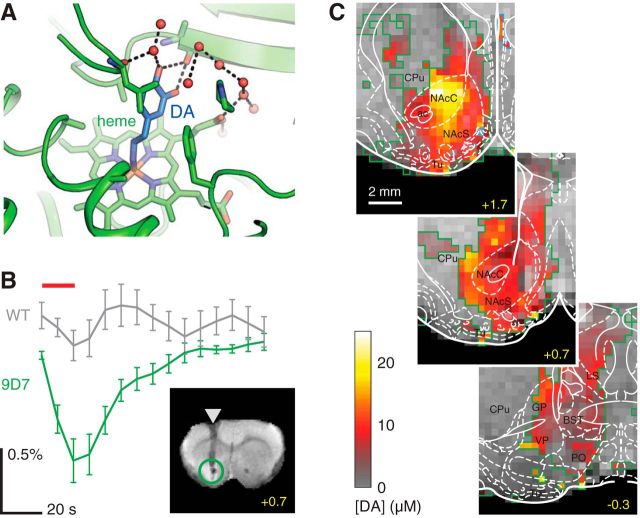
Molecular fMRI with a probe sensitive to dopamine. A, Structure of the dopamine-sensitive contrast agent BM3h-9D7 (Brustad et al., 2012), showing the paramagnetic heme group that creates MRI contrast effects. Binding of dopamine (blue) to the heme blocks interactions with water molecules (red), turning off the contrast agent by decreasing its r1 value. B, Average time course of molecular fMRI signal changes (green) observed in rat ventral striatum during brain stimulation known to evoke dopamine release (red line), in the presence of BM3h-9D7 (Lee et al., 2014). A control time course (gray) was obtained using the same experimental procedure in conjunction with a probe variant insensitive to dopamine, BM3h-WT. Error bars indicate SEM across 7 animals each. Inset, Coronal slice through a rat brain (bregma +0.7 mm), indicating injection cannula placement (arrowhead) and the area of injection (green circle). C, Map of peak dopamine concentrations (red-yellow) evoked by reward-related stimulation in three slices through ventral striatum. Yellow represents rostrocaudal coordinates. White represents brain atlas. Green outline indicates area of contrast agent coverage. Gray underlay is an anatomical image. A, Adapted from Brustad et al. (2012). B, C, Adapted from Lee et al. (2014).
Figure 2.
Figure 2.
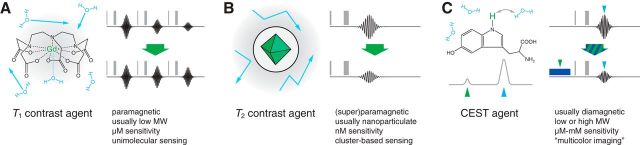
Mechanisms of contrast agents for molecular fMRI. Each panel represents a different type of contrast agent, including a typical example of each (left) and its mechanism of influencing MRI signal (right). The MRI signals (right) are produced by sequences of pulses (vertical gray bars), followed by measurement of a signal (black lines); each schematic represents how the MRI signal changes between the absence of the agent (top right) and its presence (bottom right). Text indicates key characteristics of each type of agent. A, T1 agents such as Gd-DTPA (left) usually incorporate a paramagnetic ion (Gd3+, green) and exert effects arising from magnetic dipolar coupling to directly coordinated water molecules (blue). This results in an increase of mean MRI signal observed after during repetition of the MRI pulse sequence (bottom right vs top right). B, T2 agents (left) usually consist of a superparamagnetic mineral core (green) surrounded by a hydrophilic coating (gray). Contrast arises from long-range magnetic interactions with nearby diffusing water molecules (blue). This leads to decreased MRI signal following each individual repetition of the MRI pulse sequence (right). C, CEST agents such as tryptophan (left) incorporate exchangeable protons (green) that absorb radio waves at well-defined, addressable frequencies. A schematic spectrum (left bottom) represents how the frequency associated with the CEST agent (green arrowhead) might differ from that associated with bulk water (blue arrowhead). Application of the MRI pulse sequence in conjunction with radio irradiation of the CEST protons (dark blue box) results in selective reduction of the MRI signal from bulk water protons (right). Adapted from Jasanoff (2007).

References

    1. Ahrens MB, Orger MB, Robson DN, Li JM, Keller PJ. Whole-brain functional imaging at cellular resolution using light-sheet microscopy. Nat Methods. 2013;10:413–420. doi: 10.1038/nmeth.2434. - DOI - PubMed
    1. Angelovski G, Fouskova P, Mamedov I, Canals S, Toth E, Logothetis NK. Smart magnetic resonance imaging agents that sense extracellular calcium fluctuations. Chembiochem. 2008;9:1729–1734. doi: 10.1002/cbic.200800165. - DOI - PubMed
    1. Angelovski G, Chauvin T, Pohmann R, Logothetis NK, Tóth E. Calcium-responsive paramagnetic CEST agents. Bioorg Med Chem. 2011;19:1097–1105. doi: 10.1016/j.bmc.2010.07.023. - DOI - PubMed
    1. Atanasijevic T, Shusteff M, Fam P, Jasanoff A. Calcium-sensitive MRI contrast agents based on superparamagnetic iron oxide nanoparticles and calmodulin. Proc Natl Acad Sci U S A. 2006;103:14707–14712. doi: 10.1073/pnas.0606749103. - DOI - PMC - PubMed
    1. Attwell D, Buchan AM, Charpak S, Lauritzen M, Macvicar BA, Newman EA. Glial and neuronal control of brain blood flow. Nature. 2010;468:232–243. doi: 10.1038/nature09613. - DOI - PMC - PubMed

Publication types