. 2016 Mar;8(3):632-9.
doi: 10.21037/jtd.2016.02.60.

Dysphagia, dystussia, and aspiration pneumonia in elderly people

Affiliations

Dysphagia, dystussia, and aspiration pneumonia in elderly people

Satoru Ebihara et al. J Thorac Dis. 2016 Mar.

Abstract

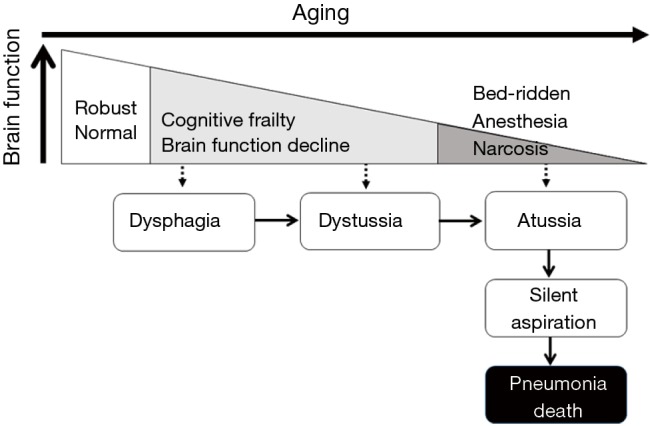
Despite the development and wide distribution of guidelines for pneumonia, death from pneumonia is increasing due to population aging. Conventionally, aspiration pneumonia was mainly thought to be one of the infectious diseases. However, we have proven that chronic repeated aspiration of a small amount of sterile material can cause the usual type of aspiration pneumonia in mouse lung. Moreover, chronic repeated aspiration of small amounts induced chronic inflammation in both frail elderly people and mouse lung. These observations suggest the need for a paradigm shift of the treatment for pneumonia in the elderly. Since aspiration pneumonia is fundamentally based on dysphagia, we should shift the therapy for aspiration pneumonia from pathogen-oriented therapy to function-oriented therapy. Function-oriented therapy in aspiration pneumonia means therapy focusing on slowing or reversing the functional decline that occurs as part of the aging process, such as "dementia → dysphagia → dystussia → atussia → silent aspiration". Atussia is ultimate dysfunction of cough physiology, and aspiration with atussia is called silent aspiration, which leads to the development of life-threatening aspiration pneumonia. Research pursuing effective strategies to restore function in the elderly is warranted in order to decrease pneumonia deaths in elderly people.

Keywords: Dysphagia; aspiration pneumonia; dystussia.


Conflict of interest statement

Conflicts of Interest: The authors have no conflicts of interest to declare.

Figures

Figure 1
Figure 1
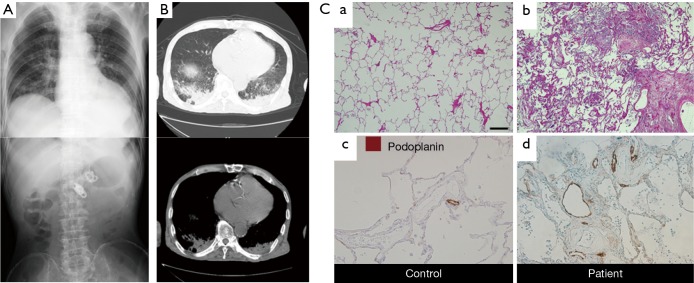
A case of chronic micro-aspiration pneumonia. (A) Chest (upper panel) and abdominal (lower panel) X-rays of a typical case of chronic aspiration pneumonia due to repeated small amounts of aspiration. The patient was a 78-year-old male nursing home resident. He underwent percutaneous endoscopic gastrostomy (PEG) one year earlier and had sporadic fever one day per week for several months. At the time of admission to our geriatric unit, he had continuous low-grade fever for 5 days with coarse crackles; (B) chest CT of the same patient as in A, showing very solid consolidation in bilateral back areas; (C) chronic inflammation and exaggerated lymphangiogenesis in the lung of aspiration pneumonia patients. H&E staining of the lung from controls (a) and patients (b). Staining for lymphatics (podoplanin, brown) in controls (c) and patients (d). Control lungs have podoplanin-immunoreactive tube-like structures at low density, whereas patients’ lungs have no greater density. Scale bar: 400 µm in (a) and (b); 100 µm in (c) and (d). The data are from the same experiment as (20) but are not shown in (20).
Figure 2
Figure 2
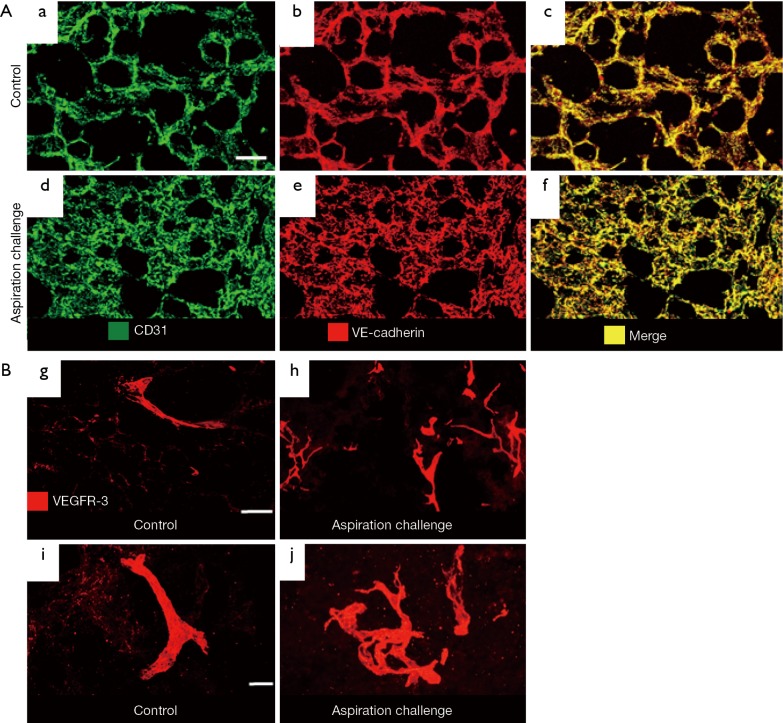
A mouse model of chronic micro-aspiration. (A) Greater blood vessel area density in the lung of the aspiration-challenged mice for 28 days. Staining for blood vessels (CD31 in green and VE-cadherin in red) in the control (a-c) and 28-day aspiration-challenged mice (d-f). Scale bar: 50 µm. (B) Exaggerated lymphangiogenesis in the lung of the aspiration-challenged mice for 28 days. Staining for lymphatics (VEGFR-3, red) in the control (g and i) and 28-day aspiration-challenged mice (h and j). Lymphatics in the control group (g and i) are distributed sparsely, whereas those in the aspiration group (h and j) are distributed densely. High-magnification images show a simple structure of lymphatics in the controls and a complex structure of lymphatics in the aspiration group. Scale bar: 100 µm in (g) and (h); 20 µm in (i) and (j). The data are from the same experiments (20) but not shown in (20).
Figure 3
Figure 3
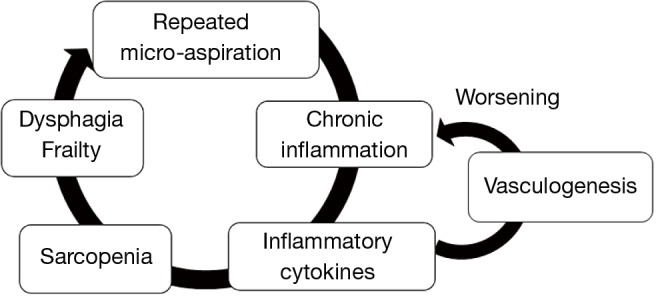
Vicious cycle of chronic aspiration pneumonia due to repeated small amounts of aspiration.
Figure 4
Figure 4
The natural course of functional decline in most elderly people. With aging, brain function declines. With declining brain function, dysphagia starts, followed by dystussia, and then finally atussia and silent aspiration, which is closely related to death from pneumonia.

References

    1. Niederman MS, Bass JB, Jr, Campbell GD, et al. Guidelines for the initial management of adults with community-acquired pneumonia: diagnosis, assessment of severity, and initial antimicrobial therapy. American Thoracic Society. Medical Section of the American Lung Association. Am Rev Respir Dis 1993;148:1418-26. 10.1164/ajrccm/148.5.1418 - DOI - PubMed
    1. Hospital-acquired pneumonia in adults: diagnosis, assessment of severity, initial antimicrobial therapy, and preventive strategies. A consensus statement, American Thoracic Society, November 1995. Am J Respir Crit Care Med 1996;153:1711-25. 10.1164/ajrccm.153.5.8630626 - DOI - PubMed
    1. American Thoracic Society. Infectious Diseases Society of America . Guidelines for the management of adults with hospital-acquired, ventilator-associated, and healthcare-associated pneumonia. Am J Respir Crit Care Med 2005;171:388-416. 10.1164/rccm.200405-644ST - DOI - PubMed
    1. The committee for the Japanese Respiratory Society guidelines in management of respiratory infections (2006). The Japanese Respiratory Society guideline for the management of community-acquired pneumonia in adults. Respirology 2006;11:S1-S77.
    1. The committee for the Japanese Respiratory Society guidelines in management of respiratory infections (2009). The Japanese Respiratory Society guideline for the management of hospital-acquired pneumonia in adults. Respirology 2008;14:S1-S71.

LinkOut - more resources