Estimating Potential Reductions in Premature Mortality in New York City From Raising the Minimum Wage to $15
- PMID: 27077350
- PMCID: PMC4880275
- DOI: 10.2105/AJPH.2016.303188
Estimating Potential Reductions in Premature Mortality in New York City From Raising the Minimum Wage to $15
Abstract
Objectives: To assess potential reductions in premature mortality that could have been achieved in 2008 to 2012 if the minimum wage had been $15 per hour in New York City.
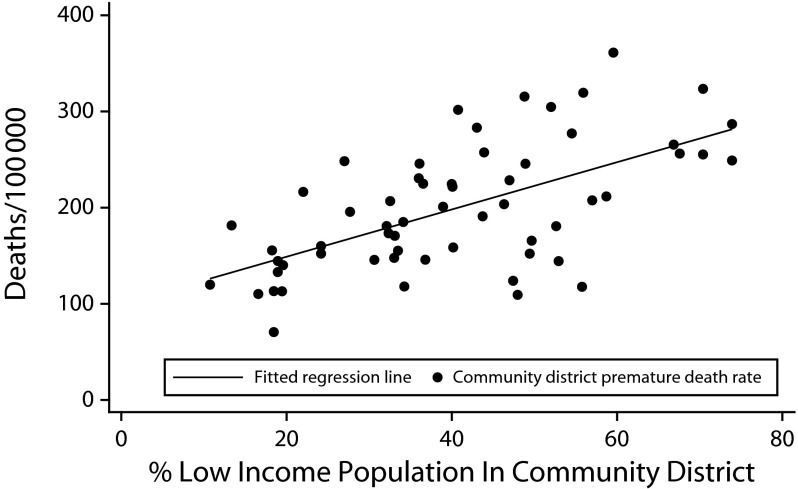
Methods: Using the 2008 to 2012 American Community Survey, we performed simulations to assess how the proportion of low-income residents in each neighborhood might change with a hypothetical $15 minimum wage under alternative assumptions of labor market dynamics. We developed an ecological model of premature death to determine the differences between the levels of premature mortality as predicted by the actual proportions of low-income residents in 2008 to 2012 and the levels predicted by the proportions of low-income residents under a hypothetical $15 minimum wage.
Results: A $15 minimum wage could have averted 2800 to 5500 premature deaths between 2008 and 2012 in New York City, representing 4% to 8% of total premature deaths in that period. Most of these avertable deaths would be realized in lower-income communities, in which residents are predominantly people of color.
Conclusions: A higher minimum wage may have substantial positive effects on health and should be considered as an instrument to address health disparities.
Figures
Comment in
-
The Decline of American Unions Is a Threat to Public Health.Am J Public Health. 2016 Jun;106(6):968-9. doi: 10.2105/AJPH.2016.303217. Am J Public Health. 2016. PMID: 27153008 Free PMC article. No abstract available.
-
Could Raising the Minimum Wage Improve the Public's Health?Am J Public Health. 2016 Aug;106(8):1355-6. doi: 10.2105/AJPH.2016.303288. Am J Public Health. 2016. PMID: 27400346 Free PMC article. No abstract available.
References
-
- Backlund E, Sorlie PD, Johnson NJ. The shape of the relationship between income and mortality in the United States. Evidence from the National Longitudinal Mortality Study. Ann Epidemiol. 1996;6(1):12–20. discussion 21–22. - PubMed
-
- Marmot M. The influence of income on health: views of an epidemiologist. Health Aff (Milwood) 2002;21(2):31–46. - PubMed
-
- Muennig P, Franks P, Jia H, Lubetkind E, Gold MR. The income-associated burden of disease in the United States. Soc Sci Med. 2005;61(9):2018–2026. - PubMed
-
- Woolf SH, Braveman P. Where health disparities begin: the role of social and economic determinants—and why current policies may make matters worse. Health Aff (Milwood) 2011;30(10):1852–1859. - PubMed
MeSH terms
LinkOut - more resources
Full Text Sources
Other Literature Sources