


Trends Over 4 Decades in Disability-Free Life Expectancy in the United States
- PMID: 27077352
- PMCID: PMC4984740
- DOI: 10.2105/AJPH.2016.303120
Trends Over 4 Decades in Disability-Free Life Expectancy in the United States
Abstract
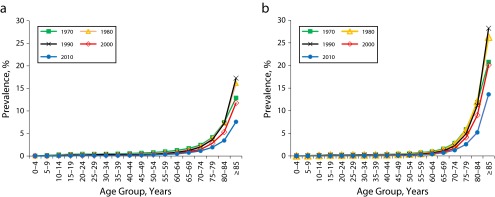
Objectives: To examine changes over 40 years (1970-2010) in life expectancy, life expectancy with disability, and disability-free life expectancy for American men and women of all ages.
Methods: We used mortality rates from US Vital Statistics and data on disability prevalence in the community-dwelling population from the National Health Interview Survey; for the institutional population, we computed disability prevalence from the US Census. We used the Sullivan method to estimate disabled and disability-free life expectancy for 1970, 1980, 1990, 2000, and 2010.
Results: Over the 40 years, there was a steady increase in both disability-free life expectancy and disabled life expectancy. At birth, increases in disabled life and nondisabled life were equal for men (4.5 years); for women, at birth the increase in life with disability (3.6 years) exceeded the increase in life free of disability (2.7 years). At age 65 years, the increase in disability-free life was greater than the increase in disabled life.
Conclusions: Across the life cycle, there was no compression of morbidity, but at age 65 years some compression occurred.
Figures
References
-
- Cai L, Lubitz J. Was there compression of disability for older Americans from 1992 to 2003? Demography. 2007;44(3):479–495. - PubMed
-
- Crimmins E, Saito Y, Ingegneri D. Trends in disability-free life expectancy in the United States, 1970–90. Popul Dev Rev. 1997;23(3):555–572.
-
- Manton K. Changing concepts of morbidity and mortality in the elderly population. Milbank Mem Fund Q Health Soc. 1982;60(2):183–244. - PubMed
Publication types
MeSH terms
Grants and funding
LinkOut - more resources
Full Text Sources
Other Literature Sources
Medical
