


Effect of Recombinant Human Growth Hormone and Rosiglitazone for HIV-Associated Abdominal Fat Accumulation on Adiponectin and other Markers of Inflammation
- PMID: 27077672
- PMCID: PMC4941209
- DOI: 10.1080/15284336.2015.1126424
Effect of Recombinant Human Growth Hormone and Rosiglitazone for HIV-Associated Abdominal Fat Accumulation on Adiponectin and other Markers of Inflammation
Abstract
Background/objective: In a previous report of HIV-infected patients with fat redistribution, we found that recombinant human growth hormone (rhGH) therapy reduced visceral adipose tissue (VAT) but increased insulin resistance, and that the addition of rosiglitazone reversed the negative effects of rhGH on insulin sensitivity. In this study, we sought to determine the effects of rhGH and rosiglitazone therapy on an array of inflammatory and fibrinolytic markers.
Methods: 72 patients with HIV-associated abdominal obesity and insulin resistance were randomized to treatment with rhGH, rosiglitazone, the combination of rhGH and rosiglitazone, or placebo for 12 weeks. Subjects with plasma and serum samples available at weeks 0 (n=63) and 12 (n=46-48) were assessed for adiponectin, C-reactive protein, homocysteine, interleukin-1, interleukin-6, tumor necrosis factor alpha, interferon gamma, fibrinogen, plasminogen activator inhibitor-1 antigen, and tissue plasminogen activator antigen.
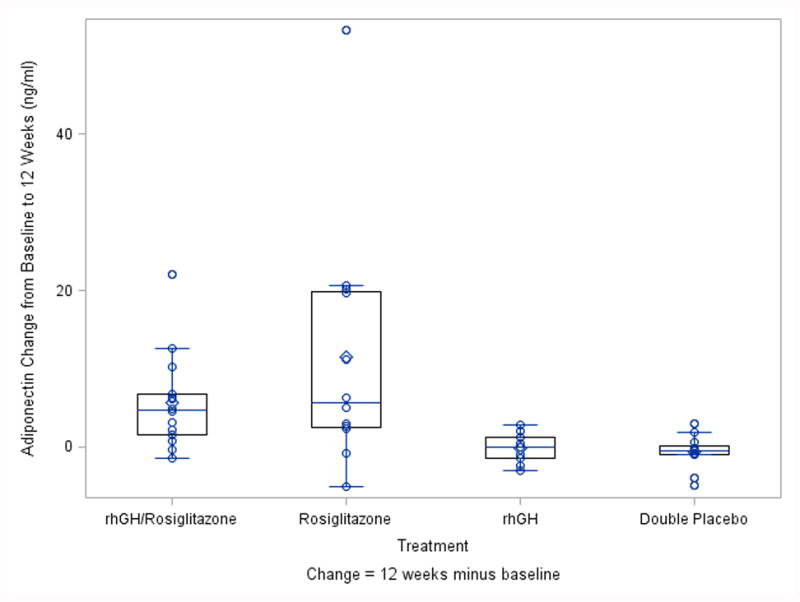
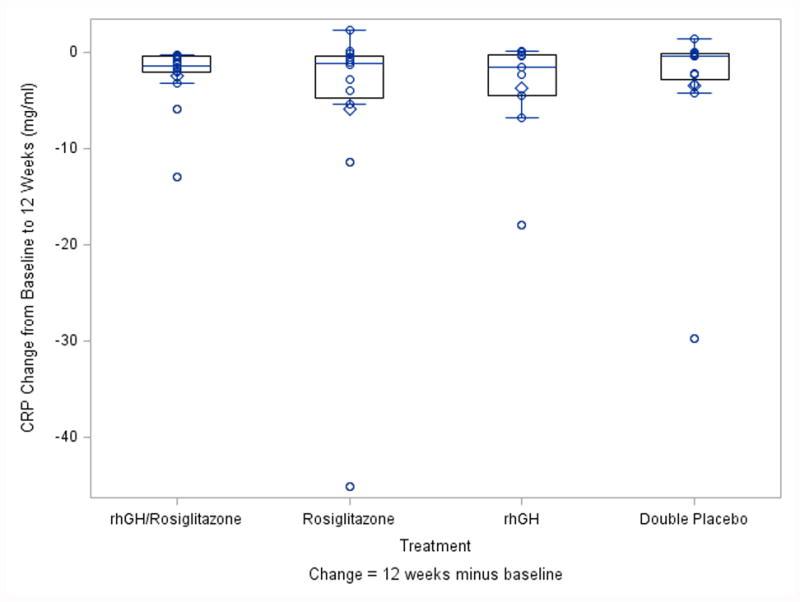
Results: Treatment with both rosiglitazone alone and the combination of rosiglitazone and rhGH for 12 weeks resulted in significant increases in adiponectin levels from baseline. Adiponectin levels did not change significantly in the rhGH arm alone . There were no significant changes in the other biomarkers among the different treatment groups.
Discussion: In this study of HIV-infected patients with altered fat distribution, treatment with rosiglitazone had beneficial effects on adiponectin concentrations, an effect that was also seen with a combination of rosiglitazone and rhGH. RhGH administration alone, however, did not demonstrate any significant impact on adiponectin levels despite reductions in VAT.
Keywords: Adiponectin; HIV-1; Human growth hormone; Lipodystrophy; Rosiglitazone.
Figures
References
-
- Grinspoon S, Carr A. Cardiovascular risk and body-fat abnormalities in HIV-infected adults. N Engl J Med. 2005;352:48–62. - PubMed
-
- Frystyk J, Berne C, Berglund L, Jensevik K, Flyvbjerg A, Zethelius B. Serum adiponectin is a predictor of coronary heart disease: a population-based 10-year follow-up study in elderly men. J Clin Endocrinol Metab. 2007;92:571–76. - PubMed
-
- Pischon T, Girman CJ, Hotamisligil GS, Rifai N, Hu FB, Rimm EB. Plasma adiponectin levels and risk of myocardial infarction in men. JAMA. 2004;291:1730–1737. - PubMed
-
- Danesh J, Lewington S, Thompson SG, Lowe GD, Collins R, Kostis JB, et al. Plasma fibrinogen level and the risk of major cardiovascular diseases and nonvascular mortality: an individual participant meta-analysis. JAMA. 2005;294:1799–809. - PubMed
-
- Bostom AG, Silbershatz H, Rosenberg IH, Selhub J, D'Agostino RB, Wolf PA, et al. Nonfasting plasma total homocysteine levels and all-cause and cardiovascular disease mortality in elderly Framingham men and women. Arch Intern Med. 1999;159:1077–80. - PubMed
Publication types
MeSH terms
Substances
Grants and funding
- M01 RR000645/RR/NCRR NIH HHS/United States
- UL1 RR024996/RR/NCRR NIH HHS/United States
- M01 RR000047/RR/NCRR NIH HHS/United States
- K24 AI078884/AI/NIAID NIH HHS/United States
- UL1 TR000040-07/TR/NCATS NIH HHS/United States
- M01 RR 00645-27/RR/NCRR NIH HHS/United States
- P30 DK020541/DK/NIDDK NIH HHS/United States
- R01 DK065515/DK/NIDDK NIH HHS/United States
- M01 RR 00047/RR/NCRR NIH HHS/United States
- P30 DK026687/DK/NIDDK NIH HHS/United States
- UL1 TR000040/TR/NCATS NIH HHS/United States
- UL1 TR000457/TR/NCATS NIH HHS/United States
LinkOut - more resources
Full Text Sources
Other Literature Sources
Medical
Research Materials
