


Frequency, Antimicrobial Resistance and Genetic Diversity of Klebsiella pneumoniae in Food Samples
- PMID: 27078494
- PMCID: PMC4831839
- DOI: 10.1371/journal.pone.0153561
Frequency, Antimicrobial Resistance and Genetic Diversity of Klebsiella pneumoniae in Food Samples
Abstract
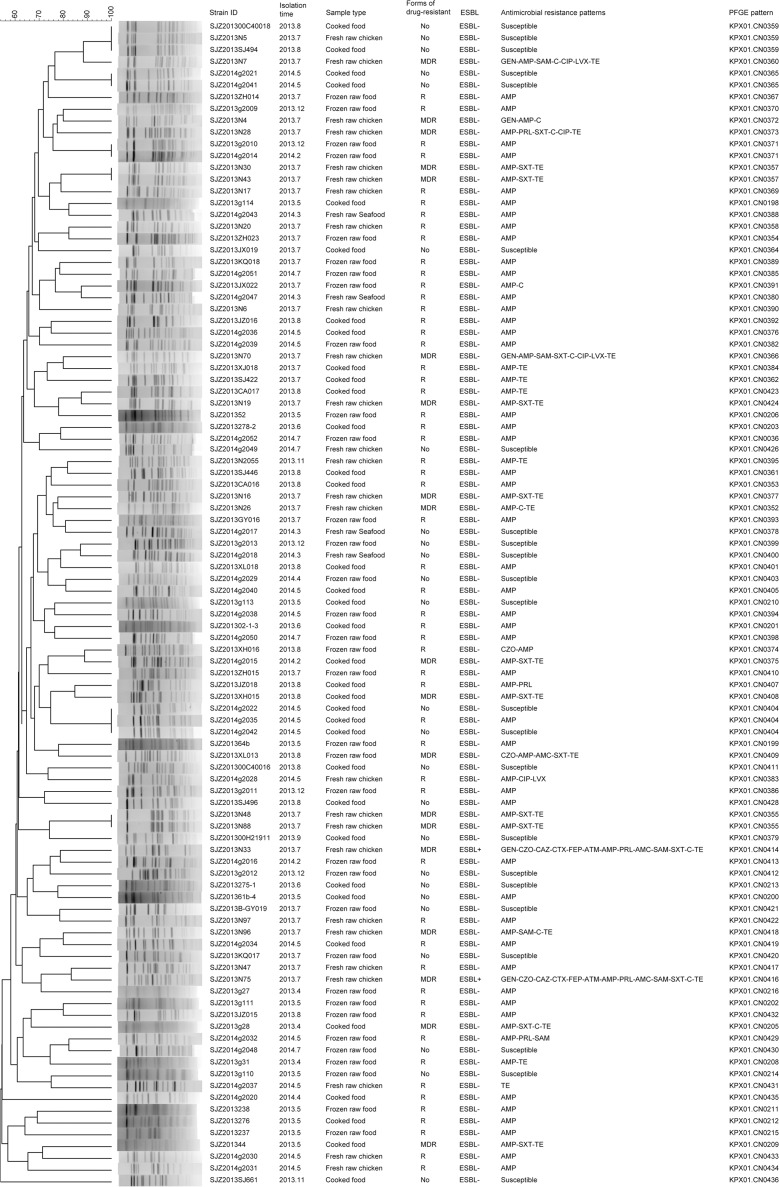
This study aimed to assess the frequency of Klebsiella pneumoniae in food samples and to detect antibiotic resistance phenotypes, antimicrobial resistance genes and the molecular subtypes of the recovered isolates. A total of 998 food samples were collected, and 99 (9.9%) K. pneumoniae strains were isolated; the frequencies were 8.2% (4/49) in fresh raw seafood, 13.8% (26/188) in fresh raw chicken, 11.4% (34/297) in frozen raw food and 7.5% (35/464) in cooked food samples. Antimicrobial resistance was observed against 16 antimicrobials. The highest resistance rate was observed for ampicillin (92.3%), followed by tetracycline (31.3%), trimethoprim-sulfamethoxazole (18.2%), and chloramphenicol (10.1%). Two K. pneumoniae strains were identified as extended-spectrum β-lactamase (ESBL)-one strain had three beta-lactamases genes (blaSHV, blaCTX-M-1, and blaCTX-M-10) and one had only the blaSHV gene. Nineteen multidrug-resistant (MDR) strains were detected; the percentage of MDR strains in fresh raw chicken samples was significantly higher than in other sample types (P<0.05). Six of the 18 trimethoprim-sulfamethoxazole-resistant strains carried the folate pathway inhibitor gene (dhfr). Four isolates were screened by PCR for quinolone resistance genes; aac(6')-Ib-cr, qnrB, qnrA and qnrS were detected. In addition, gyrA gene mutations such as T247A (Ser83Ile), C248T (Ser83Phe), and A260C (Asp87Ala) and a parC C240T (Ser80Ile) mutation were identified. Five isolates were screened for aminoglycosides resistance genes; aacA4, aacC2, and aadA1 were detected. Pulsed-field gel electrophoresis-based subtyping identified 91 different patterns. Our results indicate that food, especially fresh raw chicken, is a reservoir of antimicrobial-resistant K. pneumoniae, and the potential health risks posed by such strains should not be underestimated. Our results demonstrated high prevalence, antibiotic resistance rate and genetic diversity of K. pneumoniae in food in China. Improved control and prevention strategies are urgently needed.
Conflict of interest statement
Figures
References
Publication types
MeSH terms
Substances
LinkOut - more resources
Full Text Sources
Other Literature Sources
Medical
