


Persistent HIV-1 replication during antiretroviral therapy
- PMID: 27078619
- PMCID: PMC4900428
- DOI: 10.1097/COH.0000000000000287
Persistent HIV-1 replication during antiretroviral therapy
Abstract
Purpose of review: The present review will highlight some of the recent findings regarding the capacity of HIV-1 to replicate during antiretroviral therapy (ART).
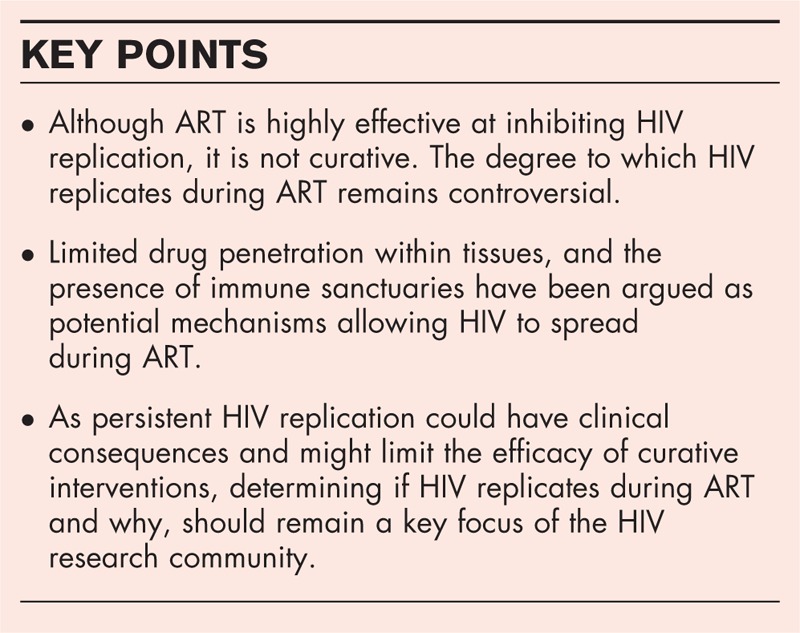
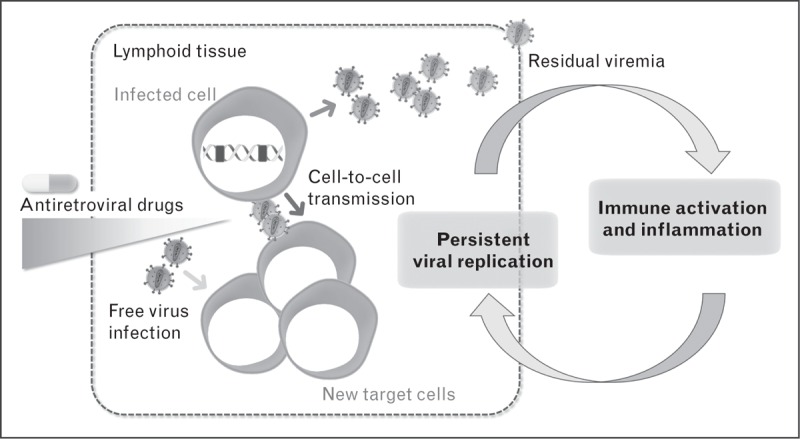
Recent findings: Although ART is highly effective at inhibiting HIV replication, it is not curative. Several mechanisms contribute to HIV persistence during ART, including HIV latency, immune dysfunction, and perhaps persistent low-level spread of the virus to uninfected cells (replication). The success in curing HIV will depend on efficiently targeting these three aspects. The degree to which HIV replicates during ART remains controversial. Most studies have failed to find any evidence of HIV evolution in blood, even with samples collected over many years, although a recent very intensive study of three individuals suggested that the virus population does shift, at least during the first few months of therapy. Stronger but still not definitive evidence for replication comes from a series of studies in which standard regimens were intensified with an integration inhibitor, resulting in changes in episomal DNA (blood) and cell-associated RNA (tissue). Limited drug penetration within tissues and the presence of immune sanctuaries have been argued as potential mechanisms allowing HIV to spread during ART. Mathematical models suggest that HIV replication and evolution is possible even without the selection of fully drug-resistant variants. As persistent HIV replication could have clinical consequences and might limit the efficacy of curative interventions, determining if HIV replicates during ART and why, should remain a key focus of the HIV research community.
Summary: Residual viral replication likely persists in lymphoid tissues, at least in a subset of individuals. Abnormal levels of immune activation might contribute to sustain virus replication.
Figures
References
Publication types
MeSH terms
Substances
LinkOut - more resources
Full Text Sources
Other Literature Sources
Medical
Research Materials
