


Facial Width-To-Height Ratio (fWHR) Is Not Associated with Adolescent Testosterone Levels
- PMID: 27078636
- PMCID: PMC4831733
- DOI: 10.1371/journal.pone.0153083
Facial Width-To-Height Ratio (fWHR) Is Not Associated with Adolescent Testosterone Levels
Abstract
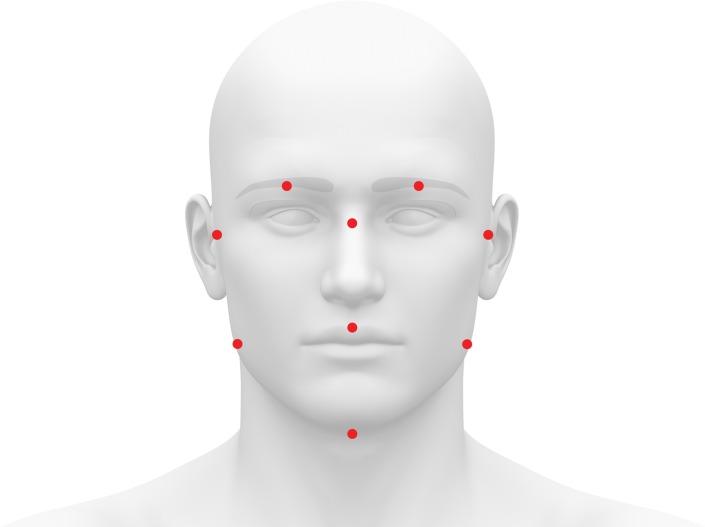
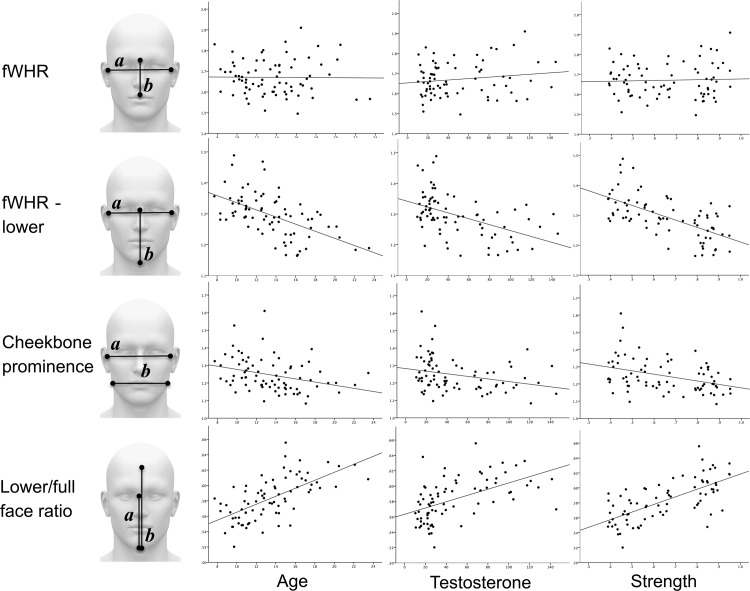
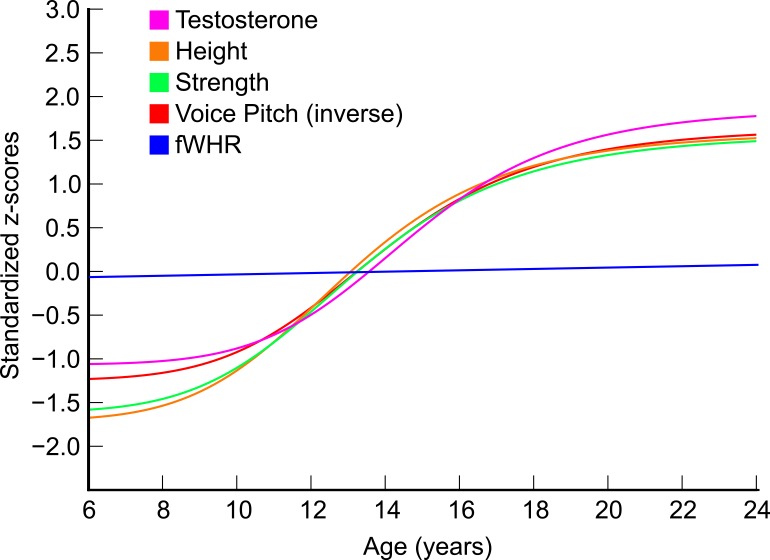
Facial width-to-height ratio (fWHR) has been proposed as a sexually dimorphic signal in humans that develops under the influence of pubertal testosterone (T); however, no studies have examined the association between fWHR and T during the phase in which facial growth is canalized--adolescence. In a sample of adolescent Tsimane males, we evaluate the relationship between T, known T-derived traits (i.e. strength and voice pitch), and craniofacial measurements. If fWHR variation derives from T's effect on craniofacial growth during adolescence, several predictions should be supported: 1) fWHR should increase with age as T increases, 2) fWHR should reflect adolescent T (rather than adult T per se), 3) fWHR should exhibit velocity changes during adolescence in parallel with the pubertal spurt in T, 4) fWHR should correlate with T after controlling for age and other potential confounds, and 5) fWHR should show strong associations with other T-derived traits. Only prediction 4 was observed. Additionally, we examined three alternative facial masculinity ratios: facial width/lower face height, cheekbone prominence, and facial width/full face height. In contrast to fWHR, all three alternative measures show a strong age-related trend and are associated with both T and T-dependent traits. Overall, our results question the status of fWHR as a sexually-selected signal of pubertal T and T-linked traits.
Conflict of interest statement
Figures
Comment in
-
Commentary: Facial Width-to-Height Ratio (fWHR) Is Not Associated with Adolescent Testosterone Levels.Front Psychol. 2016 Nov 18;7:1745. doi: 10.3389/fpsyg.2016.01745. eCollection 2016. Front Psychol. 2016. PMID: 27917130 Free PMC article. No abstract available.
References
-
- Searcy WA, Nowicki S. The evolution of animal communication: reliability and deception in signaling systems Princeton, NJ: Princeton University Press; 2005.
-
- Grafen A. Biological systems as handicaps. J Theor Biol. 1990; 144: 517–546. - PubMed
-
- Zahavi A. The handicap principle New York: Oxford University Press; 1997.
-
- Fink B, Penton-Voak I. Evolutionary psychology of facial attractiveness. Curr Dir Psychol Sci. 2002; 11: 154–158. 10.1111/1467-8721.00190 - DOI
Publication types
MeSH terms
Substances
Grants and funding
LinkOut - more resources
Full Text Sources
Other Literature Sources
Medical
