Type II transmembrane serine proteases as potential targets for cancer therapy
- PMID: 27078673
- PMCID: PMC4981541
- DOI: 10.1515/hsz-2016-0131
Type II transmembrane serine proteases as potential targets for cancer therapy
Abstract
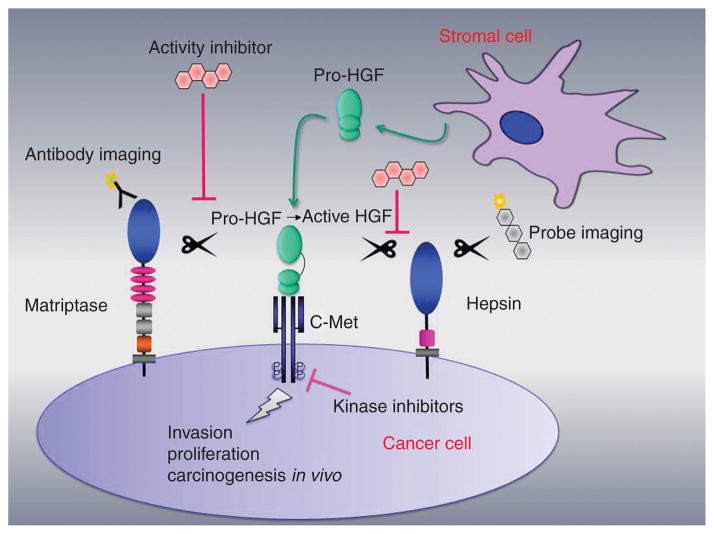
Carcinogenesis is accompanied by increased protein and activity levels of extracellular cell-surface proteases that are capable of modifying the tumor microenvironment by directly cleaving the extracellular matrix, as well as activating growth factors and proinflammatory mediators involved in proliferation and invasion of cancer cells, and recruitment of inflammatory cells. These complex processes ultimately potentiate neoplastic progression leading to local tumor cell invasion, entry into the vasculature, and metastasis to distal sites. Several members of the type II transmembrane serine protease (TTSP) family have been shown to play critical roles in cancer progression. In this review the knowledge collected over the past two decades about the molecular mechanisms underlying the pro-cancerous properties of selected TTSPs will be summarized. Furthermore, we will discuss how these insights may facilitate the translation into clinical settings in the future by specifically targeting TTSPs as part of novel cancer treatment regimens.
Figures
References
-
- Alef T, Torres S, Hausser I, Metze D, Türsen U, Lestringant GG, Hennies HC. Ichthyosis, follicular atrophoderma, and hypotrichosis caused by mutations in ST14 is associated with impaired profilaggrin processing. J Invest Dermatol. 2008;129:862–869. - PubMed
-
- Avrahami L, Maas S, Pasmanik-Chor M, Rainshtein L, Magal N, Smitt J, van Marle J, Shohat M, Basel-Vanagaite L. Autosomal recessive ichthyosis with hypotrichosis syndrome: further delineation of the phenotype. Clin Genet. 2008;74:47–53. - PubMed
-
- Baba T, Kawaguchi M, Fukushima T, Sato Y, Orikawa H, Yorita K, Tanaka H, Lin CY, Sakoda S, Kataoka H. Loss of membrane-bound serine protease inhibitor HAI-1 induces oral squamous cell carcinoma cells’ invasiveness. J Pathol. 2012;228:181–192. - PubMed
-
- Basel-Vanagaite L, Attia R, Ishida-Yamamoto A, Rainshtein L, Ben Amitai D, Lurie R, Pasmanik-Chor M, Indelman M, Zvulunov A, Saban S, et al. Autosomal recessive ichthyosis with hypotrichosis caused by a mutation in ST14, encoding type II transmembrane serine protease matriptase. Am J Hum Genet. 2007;80:467–477. - PMC - PubMed
Publication types
MeSH terms
Substances
Grants and funding
LinkOut - more resources
Full Text Sources
Other Literature Sources
Miscellaneous