


The sensory side of post-stroke motor rehabilitation
- PMID: 27080070
- PMCID: PMC5605470
- DOI: 10.3233/RNN-150606
The sensory side of post-stroke motor rehabilitation
Abstract
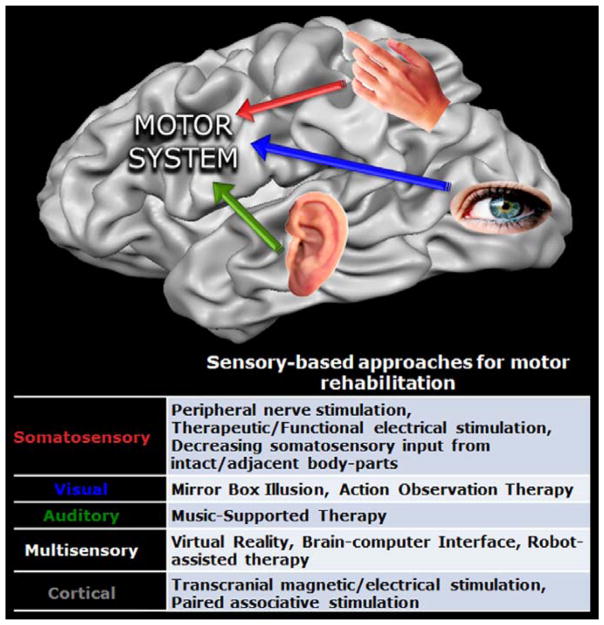
Contemporary strategies to promote motor recovery following stroke focus on repetitive voluntary movements. Although successful movement relies on efficient sensorimotor integration, functional outcomes often bias motor therapy toward motor-related impairments such as weakness, spasticity and synergies; sensory therapy and reintegration is implied, but seldom targeted. However, the planning and execution of voluntary movement requires that the brain extracts sensory information regarding body position and predicts future positions, by integrating a variety of sensory inputs with ongoing and planned motor activity. Neurological patients who have lost one or more of their senses may show profoundly affected motor functions, even if muscle strength remains unaffected. Following stroke, motor recovery can be dictated by the degree of sensory disruption. Consequently, a thorough account of sensory function might be both prognostic and prescriptive in neurorehabilitation. This review outlines the key sensory components of human voluntary movement, describes how sensory disruption can influence prognosis and expected outcomes in stroke patients, reports on current sensory-based approaches in post-stroke motor rehabilitation, and makes recommendations for optimizing rehabilitation programs based on sensory stimulation.
Keywords: Stroke; motor recovery; motor rehabilitation; non-invasive brain stimulation; sensorimotor integration; sensory stimulation.
Figures
References
-
- Altenmüller E, Marco-Pallares J, Münte TF, Schneider S. Neural reorganization underlies improvement in stroke-induced motor dysfunction by music-supported therapy. Annals of the New York Academy of Sciences. 2009;1169(1):395–405. - PubMed
-
- Altschuler EL, Wisdom SB, Stone L, Foster C, Galasko D, Llewellyn DM, Ramachandran VS. Rehabilitation of hemiparesis after stroke with a mirror. The Lancet. 1999;353(9169):2035–2036. - PubMed
-
- Amengual JL, Rojo N, Veciana de Las Heras M, Marco-Pallarés J, Grau-Sánchez J, Schneider S, Vaquero L, Juncadella M, Montero J, Mohammadi B, Rubio F, Rueda N, Duarte E, Grau C, Altenmüller E, Münte TF, Rodríguez-Fornells A. Sensorimotor plasticity after music-supported therapy in chronic stroke patients revealed by transcranial magnetic stimulation. PLoS One. 2013;8(4):e61883. - PMC - PubMed
-
- Andersen RA, Buneo CA. Intentional maps in posterior parietal cortex. Annual Review of Neuroscience. 2002;25(1):189–220. - PubMed
-
- Andersen RA, Cui H. Intention, action planning, and decision making in parietal-frontal circuits. Neuron. 2009;63(5):568–583. - PubMed
Publication types
MeSH terms
Grants and funding
LinkOut - more resources
Full Text Sources
Other Literature Sources
Medical
