


Early treatment of acute submacular haemorrhage secondary to wet AMD using intravitreal tissue plasminogen activator, C3F8, and an anti-VEGF agent
- PMID: 27080482
- PMCID: PMC4941069
- DOI: 10.1038/eye.2016.67
Early treatment of acute submacular haemorrhage secondary to wet AMD using intravitreal tissue plasminogen activator, C3F8, and an anti-VEGF agent
Abstract
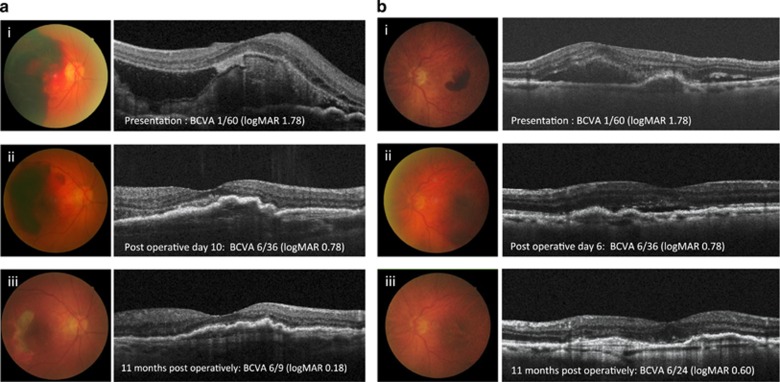
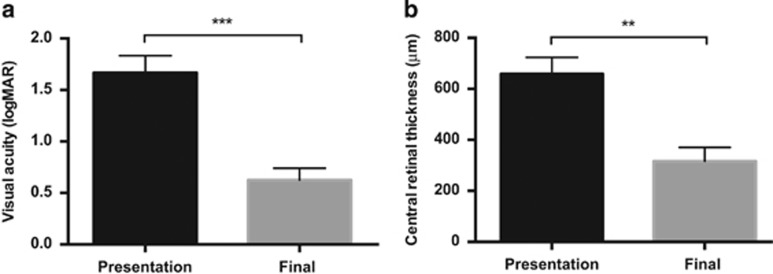
PurposeAcute submacular haemorrhage secondary to wet age-related macular degeneration (AMD) has a poor prognosis for which there is currently no 'gold standard' treatment. We evaluated the efficacy of early treatment using intravitreal triple therapy of tissue plasminogen activator (tPA), expansile gas, and an anti-VEGF agent.MethodsThis retrospective case series included eight patients presenting with acute submacular haemorrhage involving the fovea. All patients received treatment with 50 μg (0.05 ml) tPA, 0.3 ml 100% perfluoropropane (C3F8), and an anti-VEGF agent (0.05 mg Ranibizumab or 1.25 mg Bevacizumab in 0.05 ml) administered via intravitreal injection. An anterior chamber paracentesis post injection or vitreous tap was performed before injection to prevent retinal vascular occlusion secondary to raised intra-ocular pressure. Outcomes assessed were visual acuity, change in macular morphology, and complications.ResultsPatients presented promptly with delay between symptom onset and clinic review being 1.9±0.6 days (mean±SD). Treatment was delivered quickly with interval from presentation to treatment being 1.1±1.2 days. Symptom onset to treatment was 3.0±1.0 days. Subfoveal haemorrhage was effectively displaced in all patients. LogMAR visual acuity improved from 1.67±0.47 at presentation to 0.63±0.33 at final follow-up (P<0.0001), a mean of 7.9±4.8 months after treatment. Central retinal thickness improved from 658.1±174.2 μm at presentation to 316.6±142.4 μm at final follow-up (P=0.0028).ConclusionsEarly treatment of submacular haemorrhage using intravitreal tPA, C3F8, and anti-VEGF was effective in significantly improving visual acuity in this series of patients who presented soon after symptom onset. Treatment was well tolerated in this group of elderly and potentially frail patients.
Figures
References
-
- Bennett SR, Folk JC, Blodi CF, Klugman M. Factors prognostic of visual outcome in patients with subretinal hemorrhage. Am J Ophthalmol 1990; 109(1): 33–37. - PubMed
-
- Scupola A, Coscas G, Soubrane G, Balestrazzi E. Natural history of macular subretinal hemorrhage in age-related macular degeneration. Ophthalmologica 1999; 213(2): 97–102. - PubMed
-
- Glatt H, Machemer R. Experimental subretinal hemorrhage in rabbits. Am J Ophthalmol 1982; 94(6): 762–773. - PubMed
-
- Avery RL, Fekrat S, Hawkins BS, Bressler NM. Natural history of subfoveal subretinal hemorrhage in age-related macular degeneration. Retina 1996; 16(3): 183–189. - PubMed
-
- Kim JH, Chang YS, Kim JW, Kim CG, Yoo SJ, Cho HJ. Intravitreal anti-vascular endothelial growth factor for submacular hemorrhage from choroidal neovascularization. Ophthalmology 2014; 121(4): 926–935. - PubMed
MeSH terms
Substances
LinkOut - more resources
Full Text Sources
Other Literature Sources
Miscellaneous
