


Long-term Cost-Effectiveness of Diagnostic Tests for Assessing Stable Chest Pain: Modeled Analysis of Anatomical and Functional Strategies
- PMID: 27080921
- PMCID: PMC6490729
- DOI: 10.1002/clc.22532
Long-term Cost-Effectiveness of Diagnostic Tests for Assessing Stable Chest Pain: Modeled Analysis of Anatomical and Functional Strategies
Abstract
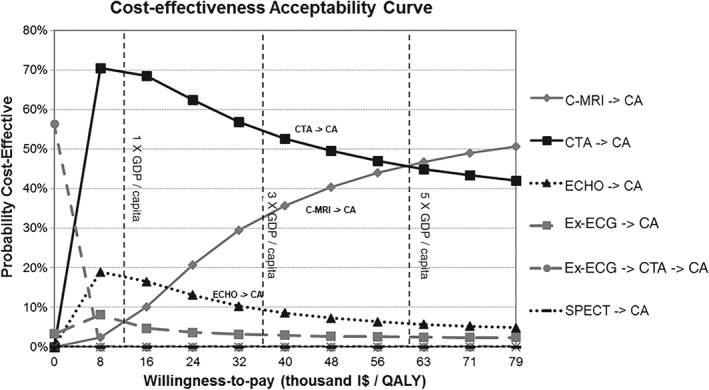
Several tests exist for diagnosing coronary artery disease, with varying accuracy and cost. We sought to provide cost-effectiveness information to aid physicians and decision-makers in selecting the most appropriate testing strategy. We used the state-transitions (Markov) model from the Brazilian public health system perspective with a lifetime horizon. Diagnostic strategies were based on exercise electrocardiography (Ex-ECG), stress echocardiography (ECHO), single-photon emission computed tomography (SPECT), computed tomography coronary angiography (CTA), or stress cardiac magnetic resonance imaging (C-MRI) as the initial test. Systematic review provided input data for test accuracy and long-term prognosis. Cost data were derived from the Brazilian public health system. Diagnostic test strategy had a small but measurable impact in quality-adjusted life-years gained. Switching from Ex-ECG to CTA-based strategies improved outcomes at an incremental cost-effectiveness ratio of 3100 international dollars per quality-adjusted life-year. ECHO-based strategies resulted in cost and effectiveness almost identical to CTA, and SPECT-based strategies were dominated because of their much higher cost. Strategies based on stress C-MRI were most effective, but the incremental cost-effectiveness ratio vs CTA was higher than the proposed willingness-to-pay threshold. Invasive strategies were dominant in the high pretest probability setting. Sensitivity analysis showed that results were sensitive to costs of CTA, ECHO, and C-MRI. Coronary CT is cost-effective for the diagnosis of coronary artery disease and should be included in the Brazilian public health system. Stress ECHO has a similar performance and is an acceptable alternative for most patients, but invasive strategies should be reserved for patients at high risk.
© 2016 Wiley Periodicals, Inc.
Figures
References
-
- Fihn SD, Gardin JM, Abrams J, et al. 2012 ACCF/AHA/ACP/AATS/PCNA/SCAI/STS guideline for the diagnosis and management of patients with stable ischemic heart disease: a report of the American College of Cardiology Foundation/American Heart Association Task Force on Practice Guidelines, and the American College of Physicians, American Association for Thoracic Surgery, Preventive Cardiovascular Nurses Association, Society for Cardiovascular Angiography and Interventions, and Society of Thoracic Surgeons [published correction appears in Circulation. 2014;129:e463]. Circulation. 2012;126:e354–e471. - PubMed
-
- Toronto Health Economics and Technology Assessment (THETA) . Relative Cost‐Effectiveness of Five Non‐invasive Cardiac Imaging Technologies for Diagnosing Coronary Artery Disease in Ontario. http://lgdata.s3‐website‐us‐east‐1.amazonaws.com/docs/3744/928383/TR_201.... Accessed June, 2014.
-
- Cooper A, Calvert N, Skinner J, et al. Chest Pain of Recent Onset: Assessment and Diagnosis of Recent Onset Chest Pain or Discomfort of Suspected Cardiac Origin. London, UK: National Institute for Health and Clinical Excellence (NICE); 2010.
-
- Ministério da Saúde do Brasil. DATASUS. 2014. http://www.datasus.gov.br [website in Portuguese].
-
- Kind P, Lafata JE, Matuszewski K, et al. The use of QALYs in clinical and patient decision‐making: issues and prospects. Value Health. 2009;(12 suppl 1):S27–S30. - PubMed
Publication types
MeSH terms
LinkOut - more resources
Full Text Sources
Other Literature Sources
Medical
