


Rationale and study design for a phase I/IIa trial of anakinra in children with Kawasaki disease and early coronary artery abnormalities (the ANAKID trial)
- PMID: 27080929
- PMCID: PMC5221485
- DOI: 10.1016/j.cct.2016.04.002
Rationale and study design for a phase I/IIa trial of anakinra in children with Kawasaki disease and early coronary artery abnormalities (the ANAKID trial)
Abstract
Background: Although Kawasaki disease (KD) is the most common cause of acquired heart disease in children and may result in coronary artery aneurysms (CAA) with an attendant risk of myocardial infarction, there is no recommended therapy to halt progression of arterial wall damage and prevent aneurysm formation in the acute phase of the vasculitis. While intravenous immunoglobulin (IVIG) reduces the risk of CAA, up to 20% of KD patients are IVIG resistant and have a higher risk for developing CAA. The IL-1 pro-inflammatory pathway is upregulated in children with acute KD and plays a critical role in the experimental animal model of KD. Thus, IL-1 is a logical therapeutic target.
Objectives: The goal of this study is to determine the safety, tolerability, pharmacokinetics, and immunomodulatory effects of anakinra, a recombinant human IL-1 receptor antagonist, in acute KD patients with coronary artery abnormalities on the baseline echocardiogram.
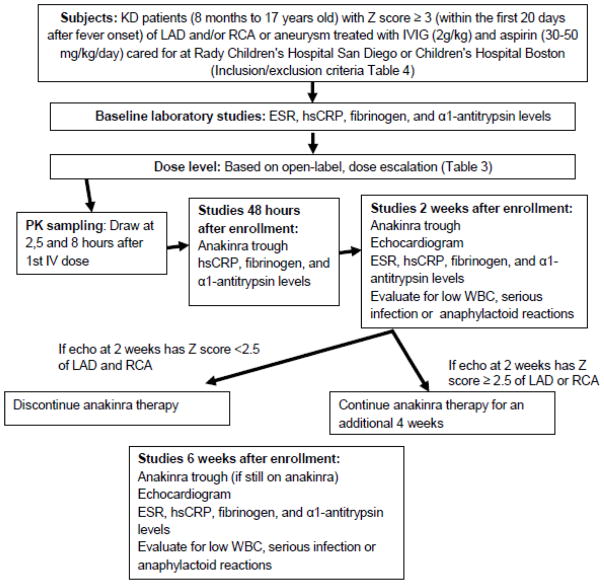
Design: This is a two-center dose-escalation Phase I/IIa trial in 30 acute KD patients ≥8months old with a coronary artery Z score≥3.0 in the right coronary artery and/or left anterior descending artery or an aneurysm. Subjects will receive a 2- to 6-week course of anakinra by daily subcutaneous injection and will be assessed for resolution of inflammation and dose limiting toxicities (leukopenia, anaphylactoid reaction, or severe infection).
Conclusion: The safety and tolerability of blocking both IL-1α and Il-1β by anakinra will be evaluated as a strategy to prevent or attenuate coronary artery damage in infants and children with acute KD.
Trial registration: Clinical Trials.gov # NCT02179853, registered June 28, 2014.
Keywords: Anakinra; Coronary artery aneurysm; Interleukin 1; Kawasaki disease.
Copyright © 2016 Elsevier Inc. All rights reserved.
Figures
References
-
- Aksentijevich I, Masters SL, Ferguson PJ, Dancey P, Frenkel J, van Royen-Kerkhoff A, Laxer R, Tedgard U, Cowen EW, Pham TH, Booty M, Estes JD, Sandler NG, Plass N, Stone DL, Turner ML, Hill S, Butman JA, Schneider R, Babyn P, El-Shanti HI, Pope E, Barron K, Bing X, Laurence A, Lee CC, Chapelle D, Clarke GI, Ohson K, Nicholson M, Gadina M, Yang B, Korman BD, Gregersen PK, van Hagen PM, Hak AE, Huizing M, Rahman P, Douek DC, Remmers EF, Kastner DL, Goldbach-Mansky R. An autoinflammatory disease with deficiency of the interleukin-1-receptor antagonist. N Engl J Med. 2009;360(23):2426–2437. - PMC - PubMed
-
- Alexander MR, Moehle CW, Johnson JL, Yang Z, Lee JK, Jackson CL, Owens GK. Genetic inactivation of IL-1 signaling enhances atherosclerotic plaque instability and reduces outward vessel remodeling in advanced atherosclerosis in mice. The Journal of Clinical Investigation. 2012;122(1):70–79. - PMC - PubMed
-
- Bonin PD, Fici GJ, Singh JP. Interleukin-1 promotes proliferation of vascular smooth muscle cells in coordination with PDGF or a monocyte derived growth factor. Experimental cell research. 1989;181(2):475–482. - PubMed
-
- Cohen S, Tacke CE, Straver B, Meijer N, Kuipers IM, Kuijpers TW. A child with severe relapsing Kawasaki disease rescued by IL-1 receptor blockade and extracorporeal membrane oxygenation. Ann Rheum Dis. 2012;71(12):2059–2061. - PubMed
Publication types
MeSH terms
Substances
Associated data
Grants and funding
LinkOut - more resources
Full Text Sources
Other Literature Sources
Medical
