. 2016 Apr 15;352(6283):349-53.
doi: 10.1126/science.aad9279.

Parasites resistant to the antimalarial atovaquone fail to transmit by mosquitoes

Affiliations

Parasites resistant to the antimalarial atovaquone fail to transmit by mosquitoes

Christopher D Goodman et al. Science. .

Abstract

Drug resistance compromises control of malaria. Here, we show that resistance to a commonly used antimalarial medication, atovaquone, is apparently unable to spread. Atovaquone pressure selects parasites with mutations in cytochrome b, a respiratory protein with low but essential activity in the mammalian blood phase of the parasite life cycle. Resistance mutations rescue parasites from the drug but later prove lethal in the mosquito phase, where parasites require full respiration. Unable to respire efficiently, resistant parasites fail to complete mosquito development, arresting their life cycle. Because cytochrome b is encoded by the maternally inherited parasite mitochondrion, even outcrossing with wild-type strains cannot facilitate spread of resistance. Lack of transmission suggests that resistance will be unable to spread in the field, greatly enhancing the utility of atovaquone in malaria control.


Figures

Fig. 1
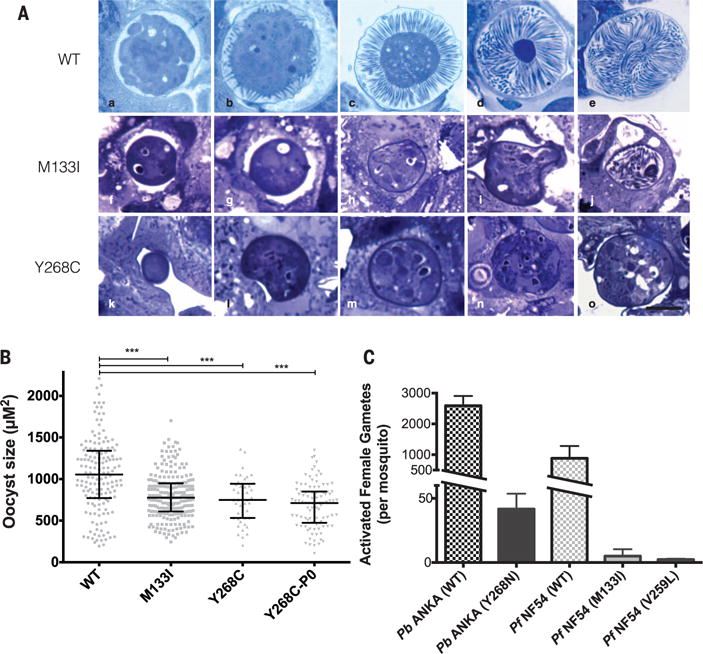
Fig. 1. Atovaquone-resistant parasites generate small, malformed oocysts in the mosquito that fail to form infectious sporozoites
(A) (a to e) Developmental series of oocyst sporogony in PbANKA (atovaquone sensitive and wild type) over ~18 days. The sporoblast buds off hundreds of long, thin sporozoites within the cyst wall. (f to j) Atovaquone-resistant mutant (PbM133I) has smaller oocysts with dense cytoplasm, and sporozoite budding is minimal. Rare oocysts (j) form short, thick sporozoites that do not emerge. (k to o) Atovaquone-resistant mutant (PbY268C) also has small, dense, misshapen oocysts that fail to bud off any sporozoites. Scale bar, 25 μm. (B) Quantification of oocyst area at 12 days after feeding, showing reduced size of atovaquone-resistant parasites. Bars represent median with interquartile range. ***P < 0.001); difference between three atovaquone-resistant lines is not significant (P > 0.05); Dunn’s multiple comparison test. (C) Number of activated females in P. berghei (all activated forms 24 hours after feeding) and P. falciparum (females and zygotes present 20 hours after feeding).
Fig. 2
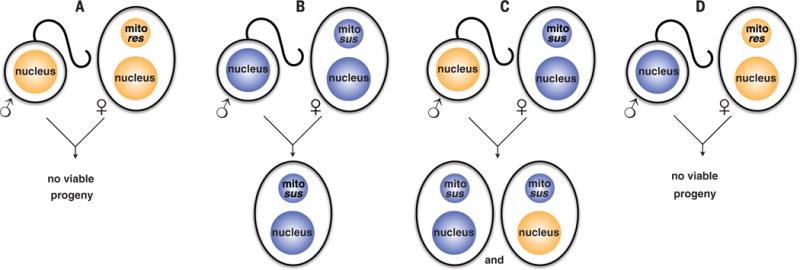
Fig. 2. The genetics of inheritance of mitochondrial DNA–encoded atovaquone resistance mutations in cytB prevent transmission
(A) Parasites with atovaquone-resistant cytB genes in their mitochondrion (mito res) cannot generate viable progeny by self-fertilization and cannot transmit. (B) Susceptible (mito sus) parasites produce susceptible progeny when self-fertilizing. (C) Sperm from resistant lines are able to fertilize eggs from susceptible lines and recombinant progeny ensue, but all inherit a susceptible mitochondrion from the female parent. (D) Sperm from susceptible lines fertilizing eggs carrying a mitochondrion-encoded resistance allele. The progeny develop poorly in mosquitoes, are not viable, and cannot transmit.

References

    1. Nixon GL, et al. J Antimicrob Chemother. 2013;68:977–985. - PMC - PubMed
    1. Maude RJ, Nguon C, Dondorp AM, White LJ, White NJ. Malar J. 2014;13:380. - PMC - PubMed
    1. Cottrell G, Musset L, Hubert V, Le Bras J, Clain J. Antimicrob Agents Chemother. 2014;58:4504–4514. - PMC - PubMed
    1. Klein EY. Int J Antimicrob Agents. 2013;41:311–317. - PMC - PubMed
    1. Ashley EA, et al. N Engl J Med. 2014;371:411–423. - PMC - PubMed

Publication types

MeSH terms