Heart within a Heart
- PMID: 27081446
- PMCID: PMC4828416
- DOI: 10.4250/jcu.2016.24.1.60
Heart within a Heart
Abstract
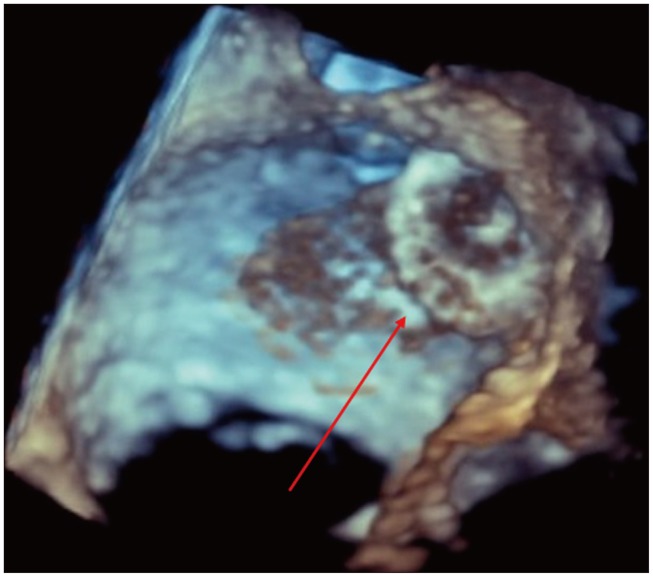
Device based closure of the left atrial appendage (LAA) has emerged as a viable approach for stroke prevention in atrial fibrillation (AF) patients with contraindications to chronic oral anticoagulation. One of the most feared complications is device related thrombus formation. We present a 66-year-old male with chronic AF who developed a life-threatening intracranial bleed on oral anti-coagulation. He subsequently underwent LAA closure using an Amplatzer muscular ventricular septal defect closure device for stroke prevention. However, he was found to have a large thrombus attached to the device a year later. We present a review of the various LAA closure devices, importance of periodic surveillance via echocardiography and management options to prevent this complication. Also, the case highlights the importance of contrast-enhance echocardiography in diagnosis of LAA closure device thrombus.
Keywords: Atrial fibrillation; Left atrial appendage; Transcatheter occlusion device.
Figures


References
-
- Roger VL, Go AS, Lloyd-Jones DM, Adams RJ, Berry JD, Brown TM, Carnethon MR, Dai S, de Simone G, Ford ES, Fox CS, Fullerton HJ, Gillespie C, Greenlund KJ, Hailpern SM, Heit JA, Ho PM, Howard VJ, Kissela BM, Kittner SJ, Lackland DT, Lichtman JH, Lisabeth LD, Makuc DM, Marcus GM, Marelli A, Matchar DB, McDermott MM, Meigs JB, Moy CS, Mozaffarian D, Mussolino ME, Nichol G, Paynter NP, Rosamond WD, Sorlie PD, Stafford RS, Turan TN, Turner MB, Wong ND, Wylie-Rosett J American Heart Association Statistics Committee and Stroke Statistics Subcommittee. Heart disease and stroke statistics--2011 update: a report from the American Heart Association. Circulation. 2011;123:e18–e209. - PMC - PubMed
-
- Blackshear JL, Odell JA. Appendage obliteration to reduce stroke in cardiac surgical patients with atrial fibrillation. Ann Thorac Surg. 1996;61:755–759. - PubMed
-
- Lardizabal JA, Sharma S. Mechanical approaches to stroke prevention in atrial arrhythmias. J Innov Cardiac Rhythm Manage. 2012;3:809–813.
-
- Holmes DR, Reddy VY, Turi ZG, Doshi SK, Sievert H, Buchbinder M, Mullin CM, Sick P PROTECT AF Investigators. Percutaneous closure of the left atrial appendage versus warfarin therapy for prevention of stroke in patients with atrial fibrillation: a randomised non-inferiority trial. Lancet. 2009;374:534–542. - PubMed
-
- Reddy VY, Möbius-Winkler S, Miller MA, Neuzil P, Schuler G, Wiebe J, Sick P, Sievert H. Left atrial appendage closure with the Watchman device in patients with a contraindication for oral anticoagulation: the ASAP study (ASA Plavix Feasibility Study With Watchman Left Atrial Appendage Closure Technology) J Am Coll Cardiol. 2013;61:2551–2556. - PubMed
Publication types
LinkOut - more resources
Full Text Sources
Other Literature Sources