Review
. 2015 Dec 18:4:F1000 Faculty Rev-1472.
doi: 10.12688/f1000research.7189.1. eCollection 2015.

FGF23 as a calciotropic hormone

Affiliations
Review

FGF23 as a calciotropic hormone

María E Rodríguez-Ortiz et al. F1000Res. .

Abstract

Maintaining mineral metabolism requires several organs and hormones. Fibroblast growth factor 23 (FGF23) is a phosphatonin produced by bone cells that reduces renal production of calcitriol - 1,25(OH) 2D 3 - and induces phosphaturia. The consequences of a reduction in 1,25(OH) 2D 3 involve changes in calcium homeostasis. There are several factors that regulate FGF23: phosphorus, vitamin D, and parathyroid hormone (PTH). More recently, several studies have demonstrated that calcium also modulates FGF23 production. In a situation of calcium deficiency, the presence of 1,25(OH) 2D 3 is necessary to optimize intestinal absorption of calcium, and FGF23 is decreased to avoid a reduction in 1,25(OH) 2D 3 levels.

Keywords: FGF receptor; FGF23; calcium.


Conflict of interest statement

Competing interests: M.E. Rodríguez has nothing to declare.

Figures

Figure 1.
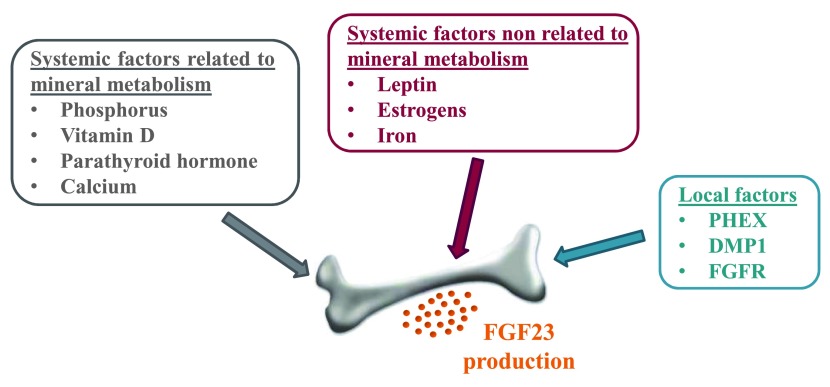
Figure 1.. Overview of the main regulators of fibroblast growth factor 23 (FGF23) production.
Figure 2.
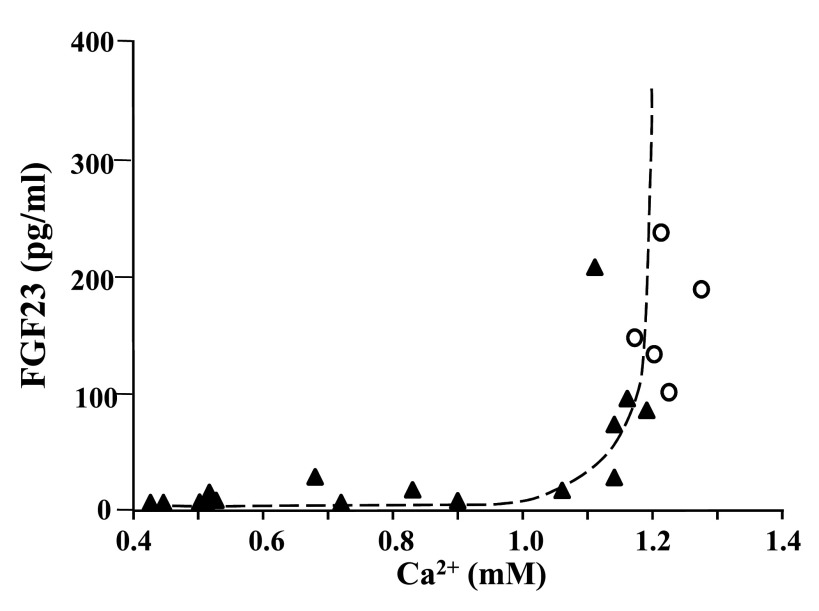
Figure 2.. Relationship between serum fibroblast growth factor 23 (FGF23) and ionic calcium in rats fed with a normal diet (r 2=0.07; P=0.66) or a calcium and vitamin D-deficient diet (r 2=0.73; P<0.001) (dotted line).
Adapted from reference (Rodríguez-Ortiz et al., 2012).

References

    1. ADHR Consortium: Autosomal dominant hypophosphataemic rickets is associated with mutations in FGF23. Nat Genet. 2000;26(3):345–8. 10.1038/81664 - DOI - PubMed
    1. Shimada T, Mizutani S, Muto T, et al. : Cloning and characterization of FGF23 as a causative factor of tumor-induced osteomalacia. Proc Natl Acad Sci U S A. 2001;98(11):6500–5. 10.1073/pnas.101545198 - DOI - PMC - PubMed
    2. F1000 Recommendation

    1. Jonsson KB, Zahradnik R, Larsson T, et al. : Fibroblast growth factor 23 in oncogenic osteomalacia and X-linked hypophosphatemia. N Engl J Med. 2003;348(17):1656–63. 10.1056/NEJMoa020881 - DOI - PubMed
    1. Larsson T, Yu X, Davis SI, et al. : A novel recessive mutation in fibroblast growth factor-23 causes familial tumoral calcinosis. J Clin Endocrinol Metab. 2005;90(4):2424–7. 10.1210/jc.2004-2238 - DOI - PubMed
    1. Shimada T, Hasegawa H, Yamazaki Y, et al. : FGF-23 is a potent regulator of vitamin D metabolism and phosphate homeostasis. J Bone Miner Res. 2004;19(3):429–35. 10.1359/JBMR.0301264 - DOI - PubMed
    2. F1000 Recommendation

LinkOut - more resources