


Comment
doi: 10.1038/mt.2016.49.
AAVR: A Multi-Serotype Receptor for AAV
Affiliations
- PMID: 27081719
- PMCID: PMC4886949
- DOI: 10.1038/mt.2016.49
Item in Clipboard
Comment
AAVR: A Multi-Serotype Receptor for AAV
Mol Ther.
2016 Apr.
Erratum in
-
Corrigendum to "AAVR: A Multi-Serotype Receptor for AAV".Mol Ther. 2016 Aug;24(8):1502. doi: 10.1038/mt.2016.113. Mol Ther. 2016. PMID: 27578285 Free PMC article. No abstract available.
No abstract available
Figures
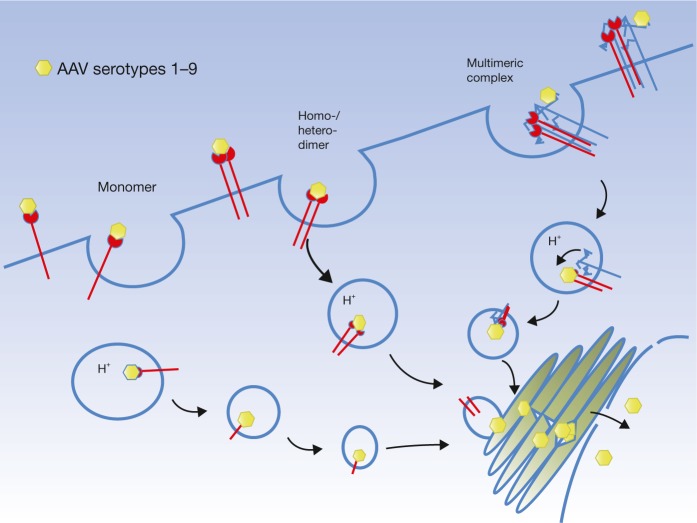
Potential scenarios for AAV cellular uptake mediated by AAVR. AAV serotypes 1–9 may exhibit a direct interaction with AAVR by binding to a monomer, a dimer, or even a heterodimer of AAVR, followed by subsequent endocytosis. Alternatively, AAVR may form a multimeric complex with other AAV receptors (e.g., glycans or other receptors) necessary for endocytosis, and a direct interaction with AAVR at the cell surface is not required.
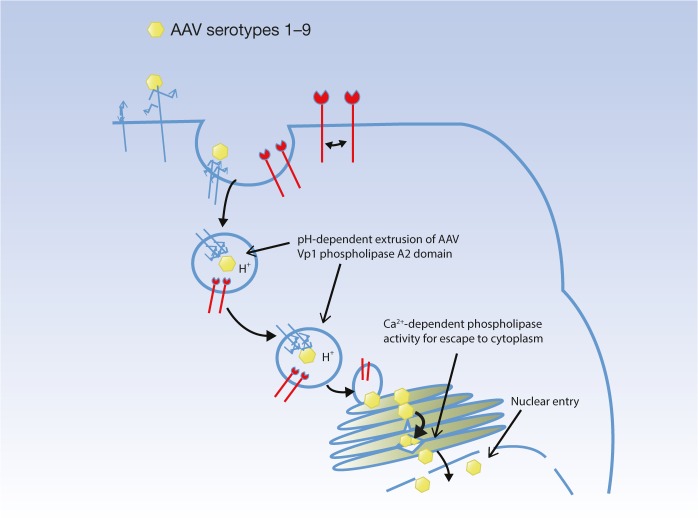
The role of AAVR may not be virus uptake. The AAV serotypes 1–9 may internalize into the cell using distinct surface receptors, and the function of AAVR may lie within the endosome, e.g., aiding in a conformational change for VP1 extrusion, or trafficking the different serotypes to the trans-Golgi network, where Ca2+ levels may be optimal for VP1 PLA2 activity leading to efficient escape to the cytoplasm and subsequent nuclear transport. This is not inconsistent with the data of Pillay et al. The soluble AAVR and polyclonal antibody used by Pillay et al. may disrupt an interaction of AAVR with another plasma or endosomal membrane protein (e.g., disrupt a homo- or hetero- interaction) that is necessary for function of AAVR. The function of AAVR may be aiding in the conformational change of AAV necessary for infection, or the function may be for trafficking of AAVR to the TGN. It will be important to look at the effect of soluble receptor and antibody on the steps of binding, internalization, and trafficking of AAV to gain a better understanding of the stage at which AAVR is actually functioning.
Comment on
-
An essential receptor for adeno-associated virus infection.Nature. 2016 Feb 4;530(7588):108-12. doi: 10.1038/nature16465. Epub 2016 Jan 27. Nature. 2016. PMID: 26814968 Free PMC article.
References
Publication types
MeSH terms
LinkOut - more resources
Full Text Sources
Other Literature Sources
Miscellaneous
