


Irregular menses predicts ovarian cancer: Prospective evidence from the Child Health and Development Studies
- PMID: 27082375
- PMCID: PMC6917033
- DOI: 10.1002/ijc.30144
Irregular menses predicts ovarian cancer: Prospective evidence from the Child Health and Development Studies
Abstract
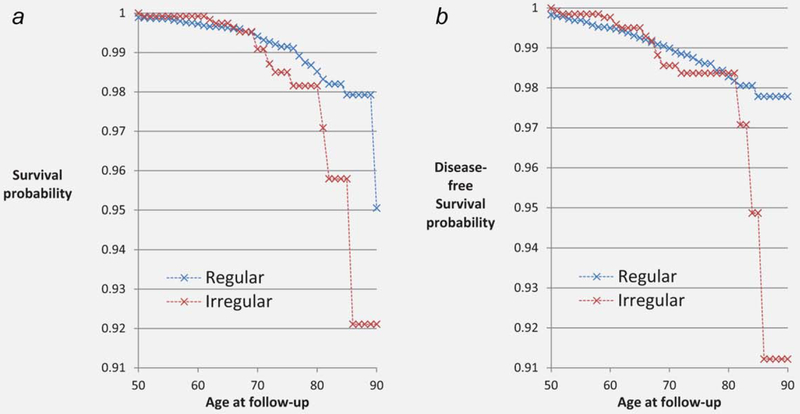
We tested the hypothesis that irregular menstruation predicts lower risk for ovarian cancer, possibly due to less frequent ovulation. We conducted a 50-year prospective study of 15,528 mothers in the Child Health and Development Studies cohort recruited from the Kaiser Foundation Health Plan from 1959 to 1966. Irregular menstruation was classified via medical record and self-report at age 26. We identified 116 cases and 84 deaths due to ovarian cancer through 2011 via linkage to the California Cancer Registry and Vital Statistics. Contrary to expectation, women with irregular menstrual cycles had a higher risk of ovarian cancer incidence and mortality over the 50-year follow-up. Associations increased with age (p <0.05). We observed a 2-fold increased incidence and mortality by age 70 (95% confidence interval [CI] = 1.1, 3.4) rising to a 3-fold increase by age 77 (95% CI = 1.5, 6.7 for incidence; 95% CI = 1.4, 5.9 for mortality). We also found a 3-fold higher risk of mortality for high-grade serous tumors (95% CI = 1.3, 7.6) that did not vary by age. This is the first prospective study to show an association between irregular menstruation and ovarian cancer-we unexpectedly found higher risk for women with irregular cycles. These women are easy to identify and many may have polycystic ovarian syndrome. Classifying high-risk phenotypes such as irregular menstruation creates opportunities to find novel early biomarkers, refine clinical screening protocols and potentially develop new risk reduction strategies. These efforts can lead to earlier detection and better survival for ovarian cancer.
Keywords: cohort study; irregular menstrual cycles; ovarian cancer; polycycstic ovarian syndrome; prospective.
© 2016 UICC.
Conflict of interest statement
The authors report no conflict of interest.
Figures
References
-
- American Cancer Society. Cancer Facts & Figures 2015. Atlanta: American Cancer Society, 2015.
-
- National Cancer Institute. Bethesda M, http://seer.cancer.gov/statfacts/html/ovary.html. Seer cancer statistics factsheets: ovary cancer. 1975–2012.
-
- Stewart SL. Ovarian cancer incidence: current and comprehensive statistics. Atlanta, Georgia: INTECH Open Access Publisher, 2012.
Publication types
MeSH terms
Grants and funding
LinkOut - more resources
Full Text Sources
Other Literature Sources
Medical
