Review
. 2016 Jul 19;7(29):46692-46706.
doi: 10.18632/oncotarget.8727.

Changing perspective on oncometabolites: from metabolic signature of cancer to tumorigenic and immunosuppressive agents

Affiliations
Review

Changing perspective on oncometabolites: from metabolic signature of cancer to tumorigenic and immunosuppressive agents

Mauro Corrado et al. Oncotarget. .

Abstract

During tumorigenesis, the shift from oxidative phosphorylation to glycolysis in ATP production accounts for the dramatic change in the cellular metabolism and represents one of the major steps leading to tumour formation. The so-called Warburg effect is currently considered something more than a mere modification in the cellular metabolism. The paradox that during cancer cell proliferation the increase in energy need is supplied by glycolysis can be only explained by taking into account the many roles that intermediates of glycolysis or TCA cycle play in cellular physiology, besides energy production. Recent studies have shown that metabolic intermediates induce changes in chromatin structure or drive neo-angiogenesis. In this review, we present some of the latest findings in the study of cancer metabolism with particular attention to how tumour metabolism and its microenvironment can favour tumour growth and aggressiveness, by hijacking and dampening the anti-tumoral immune response.

Keywords: cancer; immune response; lymphocytes; metabolism.


Conflict of interest statement

The Authors have no conflicting interests to declare.

Figures
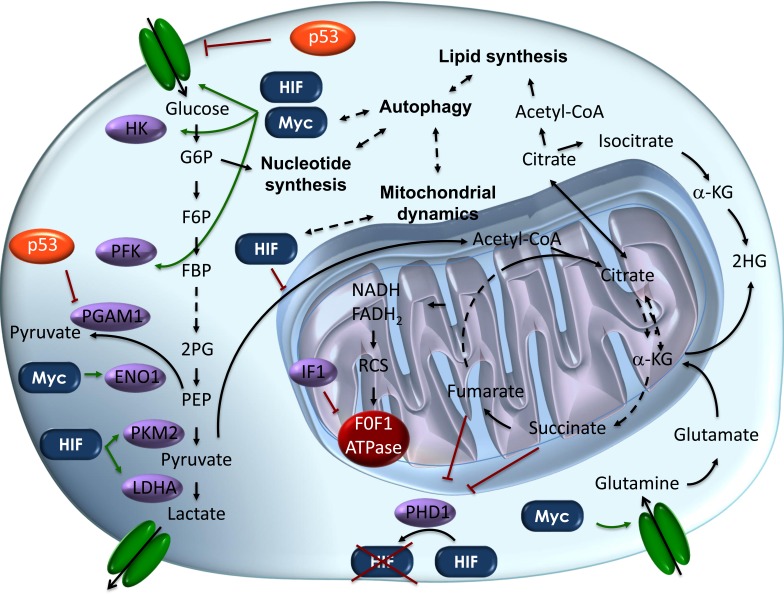
Figure 1
Figure 1. Schematic representation of the metabolic pathways altered in cancer cells
Metabolic pathways in cancer cells are directly controlled by the main oncogenes and oncosuppressors. This schematic picture depicts our current knowledge about how glycolysis and oxidative phosphorylation are inter-regulated through the synthesis of nucleotides and lipids. Key steps promoting the “Warburg effect” in cancer cells are shown. In orange onco-suppressor proteins, while in blue onco-proteins are shown. In violet, onco-proteins' direct targets in the metabolic cascade are depicted. Dashed lines represent biunique interactions. Abbreviations: α-KG, α-Ketoglutarate; ENO1, Enolase1; FBP, Fructose-1,6-biphosphate; F6P, Fructose-6-phosphate; G6P, Glucose-6-phosphate, HK, hexokinase; HIF, hypoxia inducible factor; IF1, ATPase inhibitory factor 1; LDHA, Lactate dehydrogenase A; PGAM1, phosphoglycerate mutase 1; PFK, phosphofructokinase; PEP, Phosphoenolpyruvate; PHD1, prolyl hydroxylase domain 1; PKM2, pyruvate kinase isoform 2; 2HG, 2-hydroxyglutarate; 2PG, 2-phosphoglycerate; RCS, Respiratory Chain Supercomplexes.
Figure 2
Figure 2. Tumour microenvironment hijacks anti-tumoral immune response
Cancer cells alter the immune response through metabolic competition establishing an inflammatory microenvironment. Increased glycolysis in tumoral cells depletes the tumour microenvironment of glucose and amino acids, so making TEFF cells hyporesponsive to tumour antigens. Moreover, high lactic acid levels generated by tumoral cells engage macrophages in a differentiation pathway towards a pro-inflammatory and tumour-promoting M2 subtype. Chemotherapy induces immunogenic cancer cell death, which through increased extracellular ATP (eATP) is able to partially re-activate TEFF cells.
Figure 3
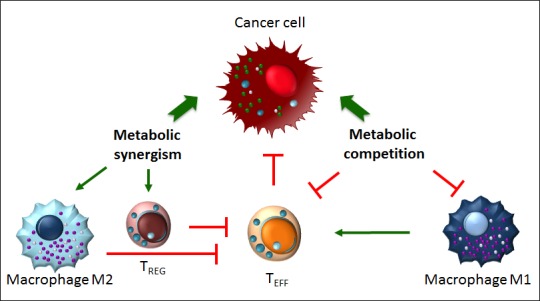
Figure 3. Metabolic competition and metabolic synergism in the tumour microenvironment
Metabolism influences the function of tumour-invading immune cells. Metabolic competition dampens the anti tumoral properties of M1 macrophages and TEFF cells. Metabolic synergism, instead, favors the development of pro-tumoral immune TREG cells and M2 macrophages.

References

    1. Hanahan D, Weinberg R A. The hallmarks of cancer. Cell. 2000;100:57–70. - PubMed
    1. Hanahan D, Weinberg R A. Hallmarks of cancer: the next generation. Cell. 2011;144:646–674. - PubMed
    1. Evan G I, Vousden K H. Proliferation, cell cycle and apoptosis in cancer. Nature. 2001;411:342–348. - PubMed
    1. Vander Heiden M G, Cantley L C, Thompson C B. Understanding the Warburg effect: the metabolic requirements of cell proliferation. Science. 2009;324:1029–1033. - PMC - PubMed
    1. Slater E C. Mechanism of oxidative phosphorylation. Annu Rev Biochem. 1977;46:1015–1026. - PMC - PubMed

Substances

LinkOut - more resources